
The Incident Room
Splash of Cold Fear
The Incident Room
by Olivia Hirst and David Byrne
BCP and Wild Duck Theatre, at Kitson Hall, Barnes until 3rd June
Review by Harry Zimmerman
“I’m Jack. I see you are still having no luck catching me. I have the greatest respect for you, George, but Lord, you are no nearer to catching me now than four years ago when I started.”
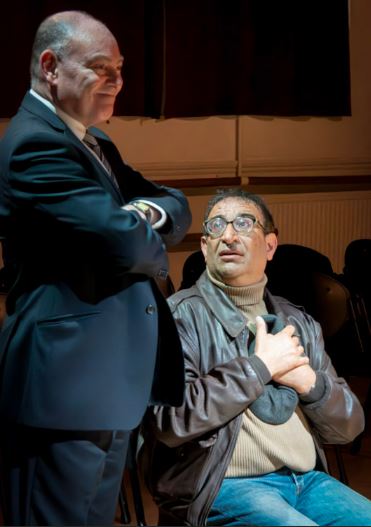
West Yorkshire. 1977. A sixteen year old schoolgirl is brutally murdered. Her death is linked with five similar fatal attacks. The chilling description of “The Yorkshire Ripper” is coined by the press, and will dominate the headlines for the rest of the decade. The murders perpetrated by Peter Sutcliffe left an indelible mark on the national psyche and the perennial coverage by the media at the time compounded the pressure on the police, who, operating out of the cramped Millgarth Incident Room in Leeds, became the central focus of the biggest manhunt in Britain.
Barnes Community Players, in association with Wild Duck Theatre, effortlessly take us back to the 1970s, a world bedevilled by institutionalised misogyny and ingrained sexism, and characterised by a claustrophobic office with its index cards, lever-arch files and heavy table-based telephone sets. No computers, no laptops, no iPhones. Just paper, lots and lots of paper.
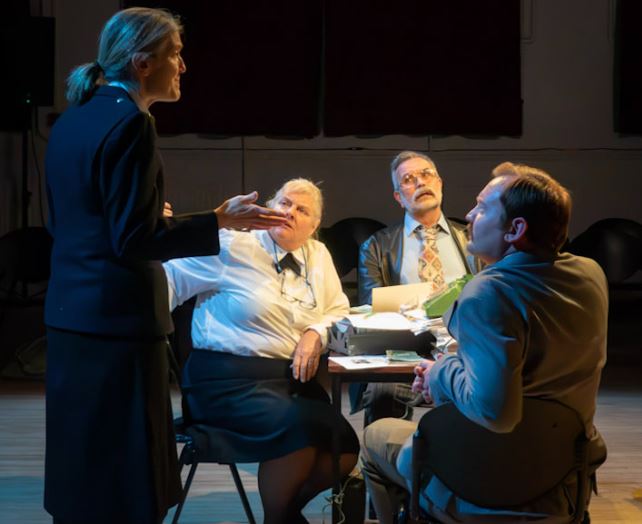
The simple set evokes the cramped, uncomfortable working environment that the police officers working on the case had to operate within. As the audience took their seats, the hits from the era wove their own magic. It was a powerful touch to begin the soundtrack with Don’t Stand So Close to Me by, who else, The Police.
This production is set in the round, which accentuates the intimacy and suffocating nature of the environment in which the investigation team had to operate and catapults the audience into the heart of the action.
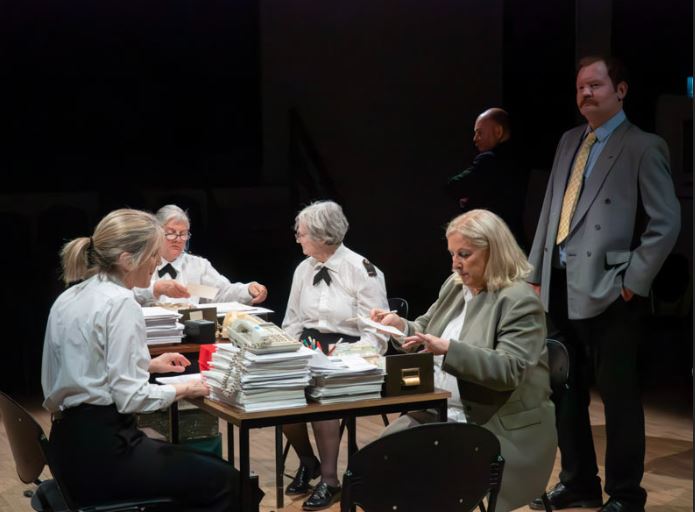
As the appalling ‘incidents’ are spread out across the north of England, jurisdictional red tape is removed by concentrating all resources upon the eponymous ‘incident room’ – the repository for the findings from the investigation across the North, from Leeds and Bradford to Manchester. Led by Assistant Chief Constable George Oldfield, the heart and soul of the taskforce is Sergeant Megan Winterburn. She coordinates everything and does most of the legwork. However, this being the 1970s, she doesn’t always get the recognition she should receive from Oldfield or her peers. Junior police officer Andy Laptew, for example, is promoted to detective ahead of her, the justification being Winterburn is too good at her job to be replaced after promotion. There is one person, however, who is ‘in her corner’ – Detective Superintendent Dick Holland.
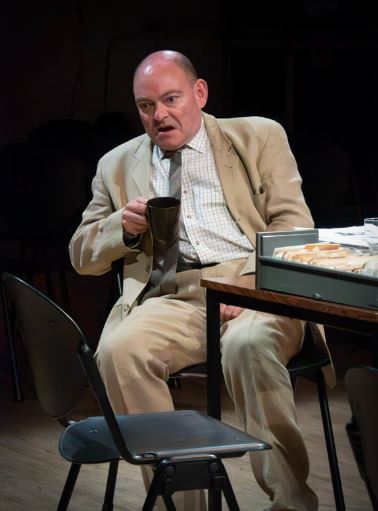
Danny Wain gives us a George Oldfield whose journey from a confident, dominating figure to someone broken by his failure to get his man is a compelling one. His slow descent into an exhausting paranoia, punctuated by fits of impotent fury will remain long in the memory.
In contrast, Fiona Lawrie’s Megan Winterburn gives a thoughtful, almost gentle portrayal of a woman fighting against the sexist preconceptions of her time, and the growing realisation of the magnitude of the horrors that are mounting up as she seeks to maintain a degree of order amidst administrative chaos.
A play such as this stands or falls by the strength of the ensemble playing. The audience needs to see and feel the development of the relationships and clashes between the members of the team.
In this respect, we are well served, with excellent playing from a cast who underpin and drive forward the strong progression of the narrative. Whether we are enjoying Chris Mounsey’s ebullient and cocksure Jack Ridgway, empathising with the increasing anxiety and concerns of a loyal Dick Holland (Ashley Brown) about the deteriorating mental state of his boss, or noting the ruthless ambition of journalist Tish Morgan (Marie Bushell), each actor contributes to a compelling series of relationship building which helps progress the action, often leavened with well observed humorous moments.
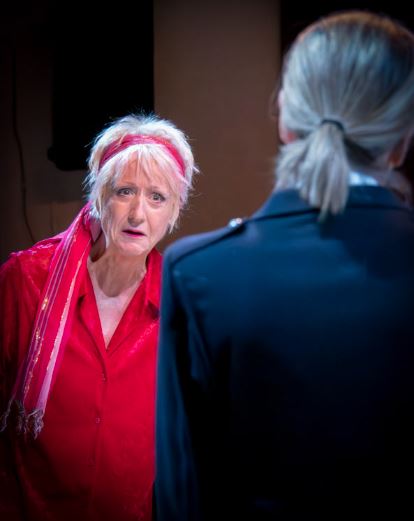
Of particular note in this respect is the relationship between Maureen Long (Clare Catford), a victim of the Ripper who survived the attack, and Megan. Their unlikely friendship, whilst providing an opportunity for moments of levity, also contains the seeds of sadness: Maureen may not have been murdered, but her victimhood will continue for the rest of her life, dominated by her encounter with Sutcliffe.
The final moments of the play have a particular poignancy. Meg and Maureen reconnect after the killer has been found and convicted. Rather than remembering the women whose lives were ended as being defined by their death, they try to imagine them alive, doing the mundane things that we all do every day: waiting for a bus, going clothes shopping with friends, visiting the cinema.

For those old enough to remember these events of over forty years ago, The Incident Room retains the power to chill. The voice of the hoaxer, “Wearside Jack”, for example is still able to deliver a splash of cold fear as it plays out.
Watching the events depicted in The Incident Room from today’s perspective, one realises that the lack of resources, the absence of modern policing procedures and the dominance of preconceived notions in lieu of hard evidence all created a ‘perfect storm’ where ‘progress’ was impossible. The upside of these events is that lessons were learnt that would benefit the approach to dealing with such cases in the future… but at what a cost.
Director Susan Conte has delivered an absorbing and emotive production with real heart, and a hefty emotional punch. It well rewards watching.
Harry Zimmerman, May 2023
Photography by Ian Trowbridge


 Mark Aspen