
Chopped Liver and Unions
Left Far Left Behind?
Chopped Liver and Unions
by J.J. Lepink
Out of the Fire for Blue Fire Theatre Company at the Exchange Theatre, Twickenham then on tour until 26th August
Review by David Stephens
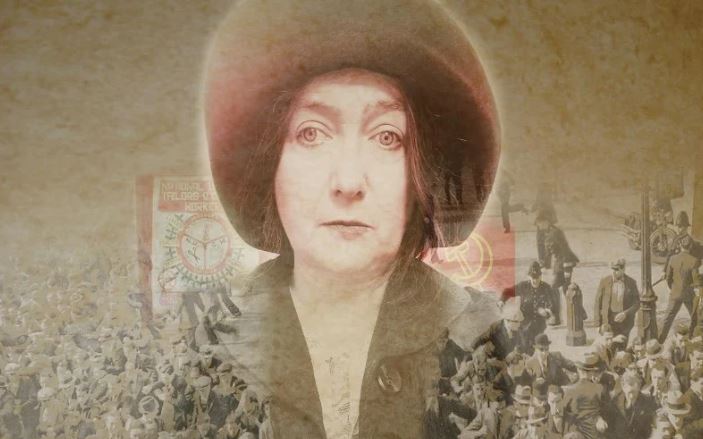
An evening of thought provoking historical story-telling was enjoyed by all at The Exchange Theatre on Thursday evening, as the Blue Fire Theatre Company returned to impress their Twickenham audience with the latest addition to their growing repertoire of historical plays. Blue Fire have found great success in recent years with producing a number of original pieces, penned by the hugely talented J.J. Leppink, which focus on little known historical figures, and whose impact on British society have either been completely forgotten or, in some cases, erased by those who used their success as a springboard for their own and, in doing so, condemned them to history’s shadows.
The latter was certainly the case for Sara Wesker, upon whom this latest piece is based. Born in London’s East End at the turn of the century and spending her formative years living in the Rothschild Buildings in Spitalfields, Wesker was no stranger to either poverty or to the racial hatred of the growing ranks of British fascists, so frighteningly active in the East End during this time. Her humble East End surroundings, however, though certainly poor in a materialistic sense, were found to be hugely rich in a political one. Fuelled by a widening political awakening, the Rothschild Building’s became an early 20th century melting-pot of political ideologies, and, being heavily influenced by these radical thinkers and communist sympathisers, the young Wesker soon came to realise the importance of both community and solidarity and how crucial they would be in any attempt to affect and improve the status quo.
As a young seamstress in the Goodman trouser factory, the now politically aware Wesker soon became a mouthpiece for her fellow female workers, opening both their eyes and minds and organising them into planned demonstrations, demanding fairer pay and conditions for women. Through direct action and organised trade-unionism, she was able to secure one farthing for each pair of trousers made – a large improvement and a significant victory. Buoyed by this and other early successes, Wesker went on to participate in a number of rallies in the East End, and soon became an important figure in organising members to strike under the banner of her newly formed trade union, The United Clothing Workers’ Trade Union. Throughout the 1920’s and 30’s, Wesker went on to organise many more strikes in and around Hackney, helping to lead the Rego and Polikoff strikes of 1929 and the infamous strike at the nationally renowned Simpsons Clothing Factory in Stoke Newington in 1930. She was also a prominent figure in the Battle of Cable Street in 1936, which saw violent clashes between the Jewish Communists and the rapidly growing forces of Oswald Mosley’s British Union of Fascists. This clash resulted in a law being passed banning the wearing of political uniforms for purposes of demonstration…. Without their bravery and resistance at Cable St, similar images to the Nuremberg rallies may well have been common place on the streets of London. Truly terrifying!
One cannot help but wonder, therefore, why the histories of such important political figures as Wesker are not more widely known? Teaching the next generation the history of inspirational, brave historical figures, such as Wesker, flies in the face of Western socio-economic ideologies, and perhaps this is another reason why the history of people like Sara Wesker are confined to a short paragraph on Wikipedia.
This story, and others like it, must be told…. And don’t Blue Fire tell them well!?!
Playing Wesker, Lottie Walker was simply splendid. As with her portrayal of another historical London figure, Nelly Power, in her one-woman show, Marie Lloyd Stole My Life, Walker manages to find just the right tone. Never allowing herself to fall foul of stereotypes, her performance was well measured and offered the perfect blend of comedy and poignancy. With cleverly crafted and well delivered lines such as, “Teach a man to make a net and he’ll have fish for life. Teach a woman to sew and she’ll use it to create civil unrest”, the audience’s immediate reaction is, understandably, to laugh before then being hit with a rather more pensive wave of silence as the importance and significance of that statement truly sinks in. Women weren’t meant to push back. In Wesker’s own words, “They wanted women to be strong enough to put in a full shift but not strong enough to fight back”. The hour long monologue was punctuated with many such lines, all of which were humorous and thought-provoking in equal measure. Huge praise must therefore go to both J.J. Lepink for such thoughtful writing and to Lottie Walker for such effective delivery.
Aiding in the delivery and helping with the many subtle mood-shifts throughout the piece was Blue Fire’s Musical Director, James Hall. Also giving the occasional prompt when needed (the monologue is almost an hour in length and barely a prompt was needed, might I add), Hall’s musical input was hugely effective. Expertly delivering the perfect underscore to the accompanying text, this further helped to take the audience back in time, creating the illusion of the proscenium as a window back in time rather than a staged piece of historical acting… this is the real strength of Blue Fire, which was also prevalent in its delivery of Marie Lloyd Stole My Life.
But the music wasn’t just there for effect. Indeed, music played a vital role in the success of Sara Wesker’s trade union. As they were an all-female body, they were not recognised as a formal Union and, as such, were not eligible for the financial support that their male counterparts enjoyed. Instead, they were forced to write militant songs, put to existing tunes and would tour London singing them for donations in public houses and variety halls. These much needed funds were then used to support the women during their strikes. Walker delights the audience with her delivery of many of these songs, cleverly interspersed within her hour-long monologue. An hour, might one add, which simply flew by.
This show is now being taken to the Edinburgh Fringe Festival before, one hopes, touring the country with the rest of Blue Fire’s repertoire. On the strength of tonight’s performance and the audience’s reaction, it will certainly be one of the must-see shows of the festival and its success will be richly deserved.
Congratulations to Blue Fire on an enthralling piece of historical theatre and thank you to J.J. Lepink for bringing the history of this truly inspirational woman into the limelight.
David Stephens, June 2023
Photography courtesy of Blue Fire

 Mark Aspen
Trackbacks & Pingbacks