
Céphale et Procris
High Quality Ditchwater, But Still Dull
Céphale et Procris
Music by Elizabeth Jacquet de la Guerre, libretto by Joseph-François Duché de Vancy
Ensemble OrQuesta at the Arcola Theatre, part of the Grimeborn Festival, until 2nd September
Review by Patrick Shorrock

Elizabeth Jacquet de la Guerre was the first woman to write a French opera, which makes her a perfect candidate for Grimeborn. Her opera is certainly no worse than those written Rameau – and sometimes better – but there is no getting away from the fact that French opera at that time was pretty stiff and stilted. The libretto is dreadful, starting with an allegorical prologue in praise of Louis XIV and never recovering, as all the characters, whether divine or human, do everything in their power to thwart the love of Céphale and Procris. They eventually succeed by convincing each of the lovers that the other is unfaithful, with the result that he accidentally kills her with an arrow. Othello it ain’t.
The music feels pretty constrained as well, with an awful lot of recitative interspersed with airs that usually fail to blossom into something musically or dramatically coherent. It had me longing for the intensity and focus of Italian opera seria, although I would have been content with something more like Monteverdi or Cavalli. The ensemble writing is often more interesting than the solos, including a ravishing duet for the lovers and a trio of Zephyrs, but unless you are a lover of the French baroque, it is always in danger of becoming dull.
It seems a bit of a waste of some extremely talented performers, although their belief in what they are performing never seems to falter. Ensemble OrQuesta has some fine instrumentalists who were beautifully audible in this intimate auditorium. The singers were impressive too. Kieran White (Céphale) has a beautiful high flexible tenor and did wonders in making this difficult music sound ingratiating. He was well matched by Poppy Shotts as Procris. Helen May as Aurore has a voice with more edge – she is the angry one – but still with beautiful tone, while Tara Venkatesan has a classic early music pure soprano that is perfect for this music.
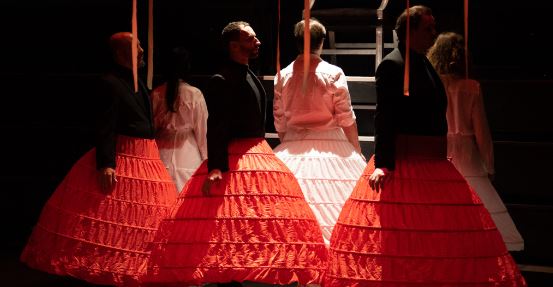
Jack Lawrence-Jones and Flavio Lauria provide solid support in the other male roles, as does Marcio da Silva who sings Arcas, as well as conducting and taking responsibility for the staging, lighting, set, costumes, and choreography. His talents are considerable but he spreads them far too thinly. He has far too many ideas – and not all of them work or are properly developed. Despite the very long programme note, I don’t understand the point of choosing to ‘represent Céphale with female characteristics’ when he still has a beard and occasionally loses his skirt for no good reason. But the lighting is varied and the costumes and choreography are simple but stylish. He just needs to be a bit more careful in his choice of repertoire. Hasse next year perhaps?
Patrick Shorrock, August 2023
Photography courtesy of Ensemble OrQuesta, image by François de Troy

 Mark Aspen
Trackbacks & Pingbacks