
Hamnet
Still-Life with Apples, an Elegy to Loss
Hamnet
by Maggie O’Farrell, adapted by Lolita Chakrabarti
The Royal Shakespeare Company and Neal Street Productions at the Garrick Theatre, West End until 17th February 2024
Review by Mark Aspen

Nearly four and a half centuries separate today and the domestic events of depicted in Hamnet, yet it seems just as much real and alive as it seems alien. Ulster writer, Maggie O’Farrell’s multi award-winning historical novel of the same name was published in March 2020, one week after the first Covid lockdown. Suddenly, in the 21st Century, we all experienced the reality and fear of plague, all too familiar experiences in Tudor England … and we have one of the raw live links with Hamnet, novel and play.
The RSC’s gripping and moving stage version, Hamnet covers episodes in the life of William Shakespeare, referred to as Will or as Agnes’ husband, and Anne Hathaway, here called Agnes (with some historical justification). The “g” in Agnes is silent … “but she is not” quips Will. The timeframe is from early 1582, when Agnes and Will first meet, to about 1600, when Will’s play, Hamlet is first performed.
Anne (Agnes) gave birth to twins Hamnet (named after his godfather) and Judith in February 1585. In the stage adaptation by Lolita Chakrabarti (whose adaptation of Life of Pi won her an Olivier Award), the non-linear narrative of O’Farrell’s novel has been unravelled, so that the action progresses chronologically. However, consequently, the title character does not appear until half-way through the play.
This is significant though, as Hamnet is really a play about Agnes, while her eponymous son becomes the catalyst to intense emotional upheavals. The plot, such as it is, is simple: a new family comes into being, then a beloved member of it tragically dies young. The play is a mood piece on grief, an elegy to loss. Within the play’s simplicity, however, is rolled up some complex concepts.
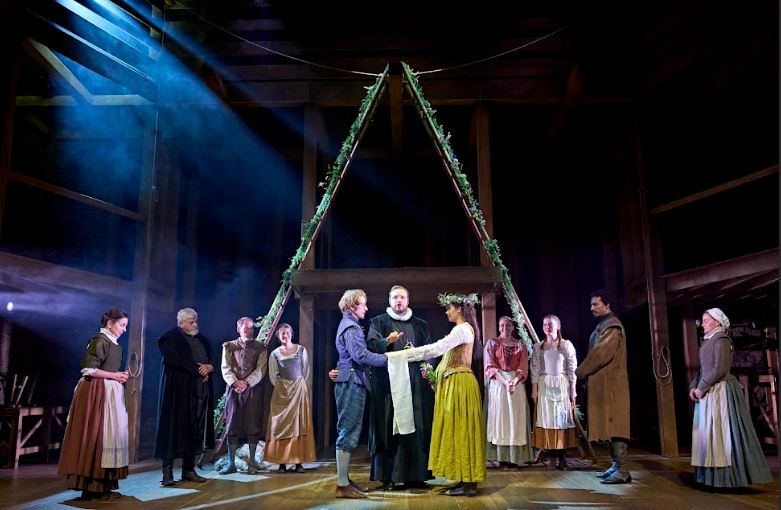
Their eldest child, Susanna, was born in the spring of 1583, six months after Will and Agnes’ hasty marriage. However, after the birth of Hamnet and Judith two years later, Shakespeare’s plays frequently featured twins, predominantly in The Comedy of Errors (1594) and Twelfth Night (1601). The difference in treatment of the subject in the two works is notable, for Hamnet, just eleven years old, tragically died in August 1596. It could be said that Hamnet is reborn in Shakespeare’s Hamlet, written in 1599, as its premise is a premature death separating father and son. The concept of biographical allusions seeping into Shakespeare’s plays is one of the theses of Hamnet, and it is an idea strongly and convincingly developed.
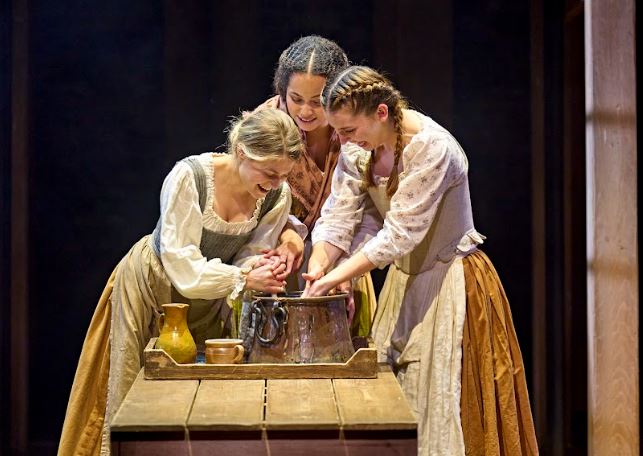
Another concept convincingly developed, and which is the subject of programme notes, is the crucial role of women in maintenance and management of the household, the purlieus of which in Tudor times often included kitchen gardens, orchards, and smallholdings. In Agnes’ household this is accentuated by the frequent long absences of Will, who has decamped to London to follow his career. The women’s role extended beyond the quotidian into significant life events, including childbirth and laying-out the dead. We see the women as a group, mothers, sisters, older children, maids, family friends; all involved. The birth scenes of Susanna and of the twins are depicted with the women winding sheets around an increasingly pregnant Agnes. Her gravid outline is formed by bundles of the sheets, which become the new-born babies, delivered by the same women, as midwives to the crouching Agnes. It is the same women who prepare the dead body of Hamnet, in the same winding-sheets. Importantly, though, it is the women who keep the household together emotionally.
Agnes is shown as an esoteric character, skilled as a falconer, a herbalist and an apothecary. She is regarded as somewhat of an outsider by the wary townsfolk of Stratford, who do not understand her love of the woods (where she prefers to be during her labour) or her rapport with nature. Another programme note extends this concept into the thesis that early modern England was more multicultural than we are led to believe. Hence, the decision to cast Agnes and her offspring with actors with some African heritage. This concept is less convincing, as it does not feature in the text of Hamnet. In some respects, it does a disservice to these actors, who, notwithstanding the extensive experience of the venerable actors playing the older roles, are almost the most skilled in their roles of all the cast. In particular, Madeleine Mantock is outstanding in the enigmatic role of Agnes.
The illiterate Agnes’ talents are very different from the academic skills of young Latin tutor Will, although she is savvy enough to point out that the roof area under the attic is hers, as it forms the letter A. And this is the preeminent feature of Tom Piper’s ingenuously simple robust set, which appears to be made of massive oak beams. (Hamnet’s London run has already been extended and it could be around for some while.) It provides the loft that is the bedroom for the youngsters of the house. Fly height ladders can be adjusted by pulleys and trucked platforms convert it to various rooms and even to the stage of the Wooden O at the Globe. At the pre-set, a fruit storage rack presents still-life with apples, but this is where Will woos Agnes and where they first make love. And when the mood is different, a fireplace appears on the stage, the practical fire-pit that is a feature of RSC’s Stratford home. All is richly lit by Prema Mehta.

The design aims at authenticity and the costumes are rural of the period, with Will’s wardrobe going upmarket with his increasing wealth. Period-enhancing music by Oğuz Kaplangi complements Simon Baker’s soundtrack, whose bucolic background evokes the smell of honey from those bees.
Both Tom Varey, as Will, and Madeleine Mantock are making their RSC debuts and are largely television actors, but make lithe and vivacious stage actors, depicting the tenderness of early love. From their youthful gambols around the stage to the crestfallen pathos as they finally realise their lives have drifted apart and only united in grief, they are utterly believable in their journey to maturity. Mantock’s picture of Agnes’ shattering anguish at the death of her only son, is heartrending. It comes after we have seen the palpably expressed love for her children grow as she works to bring up Susanna and the twins alone.
Susanna, the eldest, beautifully played by relative newcomer Phoebe Campbell, has burgeoning apothecary skills learnt from her mother. (Susanna went on to marry physician Dr John Hall, and troublesome events in her own live are dramatised in Peter Whelan’s The Herbal Bed.)

The childish playfulness of Hamnet and Judith is accurately captured by Ajani Cabey and Alex Jarrett, as is their close-knit relationship as twins growing up together. That closeness proves to be their downfall, for when Judith catches bubonic plague, it is Hamnet who tries to comfort her. It has he who succumbs, painfully, to the disease. Cabey, in the title role, gives a suitably controlled death scene and has a renaissance as the Prince of Denmark, masterly delivering, “What a piece of work is a man …”, touchingly only seen through Agnes’ eyes.
The various women of the household work much as an ensemble, although each with significant roles. Liza Sadovy, as Mary, Will’s mother portrays her as a woman of principle who has to embrace the pragmatism demanded of the circumstances. Mary Arden was heiress to her late father’s extensive farmland, and no doubt guarded her status. Joan, the stepmother to Agnes, is played with some edge by experienced performer Sarah Belcher. Agnes resents her stepmother, whom she believes has taken her father’s inheritance, and Joan resents Agnes’ resentment. Agnes also feels let down by her brother Bartholomew, tautly played by Gabriel Akuwudike, whom she believes may be complicit, in spite of his protective stance. Joan comes across as unhappy and truculent. The script gives little occasion to be otherwise, and Belcher unfortunately seems trapped into delivering much of her lines as a screechy harridan. It is a pity that she is deprived of an opportunity to develop a more three dimensional persona.
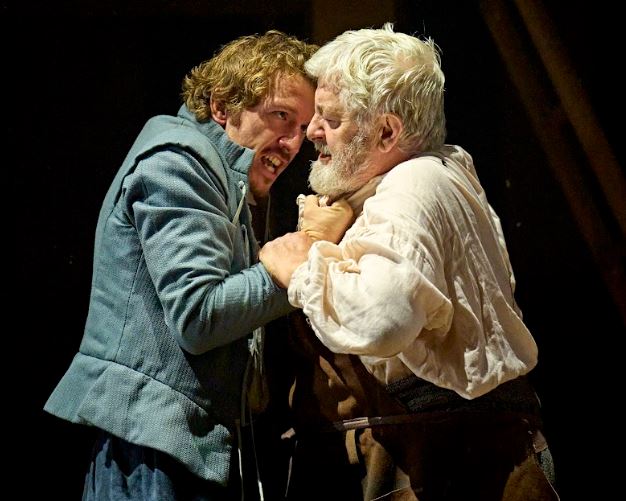
Of the lives all the people in the real-life Shakespeare household, the best documented is John Shakespeare, William’s father (closely followed by Susanna), largely because of court cases he was involved in. He was an alderman and guildsman in Stratford, but his fortunes seemed to have seesawed. He was a glover and white-tanner with wealth and social standing, but fell foul of the authorities due to some wheeler-dealering during the mid-part of his career. He does seem to have got into some scraps and was probably quite augmentative.
In Hamnet, however, John is presented as a drunkard, verbally abusive to all, and physically aggrieve to his son, Will. He is however, a complex character. His emotions are as much internalised as Agnes’ are externalised. It is a great role for a great actor and Peter Wight gives a powerful performance of John’s own seeming inadequacies, as it seems to him, against the successes of his own family, and especially against the intellectual talents of Will. Wight balances the pitiful and the brutish with consummate skill, as John meets his own shortcoming in gratuitous violence against his apprentice Ned (the versatile Karl Haynes, who also plays the actor Condell and a plaque doctor) and especially against Will. It must be said that the, literally to the throat, attacks on Will look particularly vicious (much to the credit of fight director Kate Waters).
Will’s only response is to retreat to the loft, where he writes “what I cannot say”, so perhaps it is not surprising that he absents himself down to London. In contrast to factious Stratford household, London and especially its theatres offer expansive opportunities for Will’s talents.
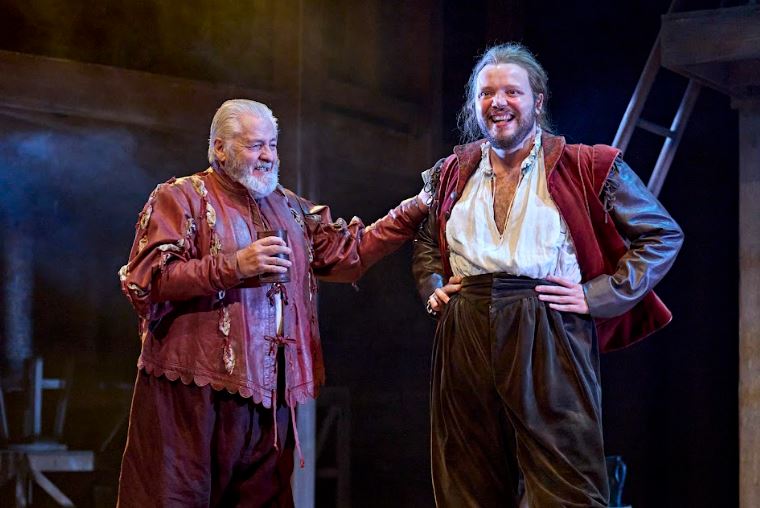
William Shakespeare was on a roll in the years just before Hamnet’s death with the licensing of the Chamberlain’s Men. The scenes in rehearsal are seen as more cooperative than we normally imagine. We see the well-known Elizabethan actors who formed Shakespeare’s company working together, planning together and making merry together. Kempe is there, another strong performance by Peter Wight, with reference to his famous dance from London to Norwich, and Burbage, in a sturdy on-the-nail performance by Will Brown. Perhaps we see and maybe understand the enticing diversion of London from his distant responsibilities.
In Hamnet, we see Will as an ordinary man doing extraordinary things, things he could not do without the support of a family, who are, at root, a loving family.
The remarkable achievement of director Erica Whyman is to create an empathy with the characters of Hamnet, and bring them to life as real people, people with weaknesses as well as strengths. They strive, they suffer and we feel for them. It is a study of the effects of grief and of the various coping mechanisms, beautifully and movingly exposed on the stage.
Hamnet takes a re-imaged look at William Shakespeare and Anne Hathaway and explores the human effort and emotional expenditure in creating greatness. “Behind every great man is a great woman”, goes the well-worn adage, but this play examines the role that a great woman fulfils. The composite of sparse historic fact and prolific imagination that is Agnes, brilliantly serves to fill the “wife-shaped void”, as Germaine Greer put it, that history has left for Shakespeare’s wife.
Mark Aspen, October 2023
Photography by Manuel Harlan


 Mark Aspen
Trackbacks & Pingbacks