
King Lear
Branagh Lithic
King Lear
by William Shakespeare
Fiery Angel and Kenneth Branagh Theatre Company, at Wyndham’s Theatre, West End until 9th December
Review by Mark Aspen
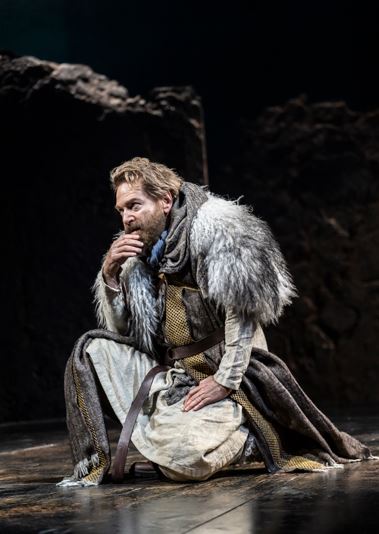
Welcome to the Stone Age. A circle of standing stones rings Wyndham’s stage, like a semi-dilapidated Stonehenge; and a fluid one, for we do not always see the same henge. Above hangs a massive glossy toroidal installation, its curved surfaces receiving the changing pictures of the projection and lighting designs of Ninna Dunn and Paul Keogan. It would not be out of place gracing the ceiling of a grand five-star hotel or an ocean liner. Designer Jon Bausor’s impressive setting is quite a spectacle.
The giant torus, though, often resembles the iris of a titanic eyeball, the pitch-black pupil in its central void an all-seeing organ of a Neolithic god, an atavistic deity. Such fatalistic influences impel the plot of King Lear, although Shakespeare does not place it in a clearly defined era. One can therefore forgive Shakespeare his anachronisms. The concept of political and military rivalries between England and France is clearly a preoccupation of the late medieval mind. And there are the repeated references to swords: the swordsmith first put in an appearance in the Bronze Age. This production sidesteps this by having almost everyone armed with a willow stave. A lot of time is spent by everyone thwacking everyone else with sticks.
Stave fighting then is another spectacular visual element. Fight director Bret Yount has obviously had a great time creating scarily vicious bouts. Another, as one might say… striking, feature is the use of the staves in chain dances, energetically performed by large numbers of the cast under the choreography of Aletta Collins. The circles are like ferocious hakas, in which the stage floor also gets a sound thwacking.
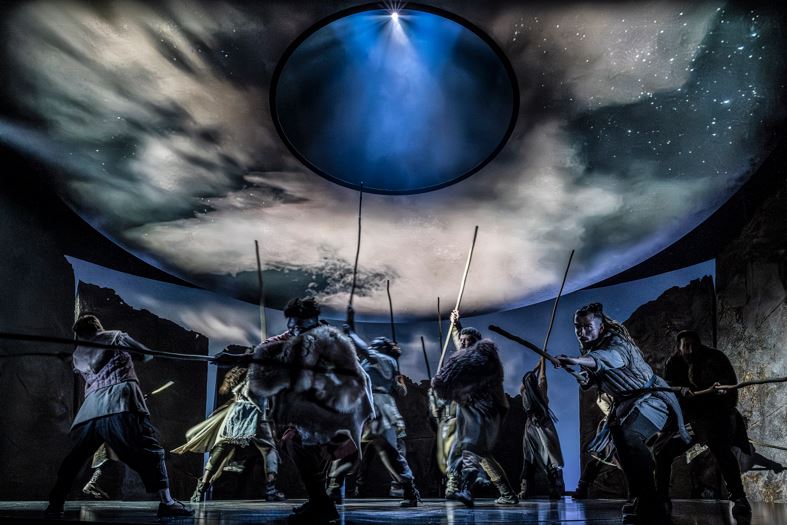
The staves, sticks, stomping and smacking, together with a sometimes overbearing soundscape, do make a lot of noise: so much so that it is difficult to hear actors’ opening words over the ringing in the ears.
The Neolithic costumes seem to be from the rag bag, although Lear’s fur stole is rather fetching. But the princesses’ Doc Martins? Add in steel buckles and paper letters … in the Stone Age. Perhaps we need to forgive the Kenneth Branagh Company its anachronisms too.
With its eclectic cast, it feels part African, part Celtic, part ancient Gallic. Generally it is confusing as to knowing both where and when we are. Perhaps this is how Lear himself feels during his decline from majesty to misery, from sanity to idiocy
The eponymous role of Lear is, undoubtedly, amongst the greatest in Shakespeare’s genius canon of plays. It has been tackled throughout the centuries by the greatest of Shakespearean actors, Burbage, Garrick, Keen, Irving, Wolfit, Olivier. Now it is Sir Kenneth Branagh’s turn, and indeed there was a palpable buzz of expectation in the bar before the Press Night performance. But, what’s this? Branagh seems to be trying out all of his predecessors’ styles, ranging from declamatory, through realistic, to intense. Branagh is without doubt a superb actor, and various speeches are text-book exemplars of various styles, but how does it all hang together? He does have fun with certain lines, the little relief points of comedy that Shakespeare injects (“wren goes to’t … let copulation thrive”) into the otherwise overwhelming tragedy of the play. Somehow, though, the tragedy itself seems a little clinical, and Lear’s descent into madness too episodically abrupt.
Lear is in his dotage; he describes himself, “I am a very foolish fond old man, fourscore and upward … I fear I am not in my perfect mind”. Branagh doesn’t look 81+ years old (he is 62), striding around, banishing his stave, pectorals rippling; with a lush hair-do, a Michael Heseltine mane. Why does such an apparently fortyish-something robust king want to abdicate?
The point, however, with this production is that it is experimental. And the biggest, boldest experiment is the casting. Branagh, lauded, awarded and knighted, is a preeminent actor at the top of the tree, but, with a few exceptions of actors with some experience, the rest of the cast are all recent graduates of RADA, some straight from acting school. The experiment is genuinely generous, not just a foil to make the top man shine, more of a contrast of freshness against experience. It works and works well, showcasing much talent to watch.
Jessica Revell plays Lear’s only faithful daughter Cordelia pitch perfect, confused in her rejection by Lear for telling the truth (still a hazard today) yet steadfastly loving and loyal. She also successfully takes on the part of Lear’s Fool, with a fleetness of foot and words, for here is someone dangerously pushing the boundaries.

Corey Mylchreest’s Edmund, the Duke of Gloucester’s resentful illegitimate son is suitably dastardly, although Mychreest tends to overplay it towards melodrama: let’s boo the villain! In contrast Doug Colling slightly underplays the part of Edgar, the loyal son, who is forced to go into hiding as Mad Tom, although making a very lithe version of a penurious naked beggar.
The more experienced Joseph Klouska, playing a rather too young Gloucester, needs a little more space to full develop the character, although his rendering of the role induces the most sympathy. Hugie O’Donnell goes full blast on nastiness as the Duke of Cornwall, a powerfully vicious portrait of the treacherous courtier.
Eleanor de Rohan bravely takes on the cross-cast role of the Duke of Kent, a noble nobleman, and one of the few with moral certainty. Kent should be a retired warrior, who is in a favoured position to speak truth the authority, so the part requires some heft. But de Rohan imbues the part with a more subtle diplomatic approach, which sort-of works.
This production of King Lear has been severely cut to two-thirds of its usual running time, but still the bladder-bursting interval-less two hours does seem too long. This is in spite of the breakneck pace the Branagh pushes the action, which alas does not allow the plot to breathe and develop credibly.
Oh, yes, Branagh himself also directs, which leads to the schizoid position of trying to look into the picture and out of it at the same time; witness some rather strange visual compositions.
One must bear in mind the experimental nature of Branagh’s King Lear, but it lacks a coherence. It is a jigsaw with many gorgeous pieces, but they don’t fit together as a whole. The effect is awkward.
Shakespeare’s King Lear is a work like opera without music, in that all emotions are intensified, but in this production it is hard to experience. One doesn’t like to admit that the heart-wrenching moments at the end of the play when Lear and Cordelia, only for her to meet a violent death at Edmund’s hands, and Lear’s subsequent senile grief, do not cause a welling of tears. Equally, the sheer horror of Cornwall’s gouging out of Gloucester’s eyes, does not turn the stomach. (The plop of the Kensington Gore soaked lychee, or whatever formed the prop eyeball, in fact caused some audience giggles!) In its headlong rush, there is no time for meditative moments for the emotions to be absorbed, which it a pity.
Nevertheless, go if you can get tickets: matinées, day-tickets or a ballot may be what is left, such is the pull of a big Name). So why go? Go for see Kenneth Branagh’s intriguing masterclass of stylistic acting; go to see a wide showcase of emerging acting and creative talent; and go for a the visual art setting, and its sculptural spectacle.
Mark Aspen, October 2023
Photography by Johan Persson

 Mark Aspen