
The White Carnation
A Sad Tale’s Best For Winter
The White Carnation
by Robert Cedric Sherriff
The Questors at the Questors Studio, Ealing until 31st December
Review by Andrew Lawston
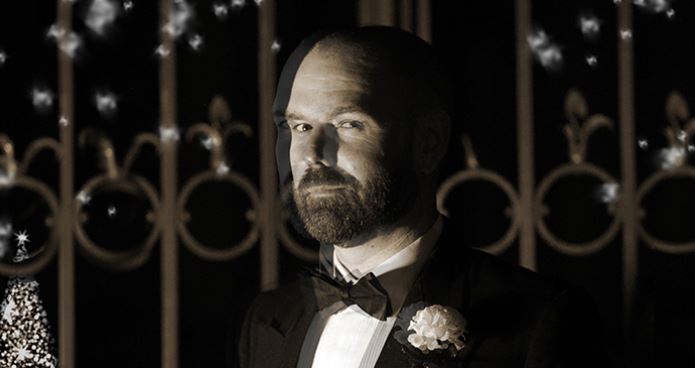
We are now firmly in the grip of the wintry dark days of December, and the British have long agreed that there’s nothing like a good ghost story to while away the longest nights of the year. These stories have taken many forms over the years, from the morality tale of A Christmas Carol to the chilling short stories of M.R. James, but perhaps none of them are quite so urbane as The White Carnation, R.C. Sherriff’s 1953 play, now revived by Questors Theatre for this festive season, and running in their studio alongside the pantomime fun of Treasure Island.
Following a Christmas Eve party, the faintly obnoxious stockbroker John Greenwood waves off his guests before his front door slams shut, locking him outside, and his house is plunged into darkness.
Breaking into his own house by smashing a window, Greenwood is spotted by a police constable who confronts the man with the awkward revelation that the house in which he claims to live was destroyed by a V-1, or flying bomb, five years earlier. As Sergeant Philips (Mark Hill) appears, followed by local official Mr Gurney (Tony Diggle) and Dr McGregor (Martin Halvey), it quickly becomes clear that John Greenwood is an unusually solid, talkative, and recalcitrant ghost, determined to live on in his old house as though nothing much has changed.
Over the subsequent two hours against a deceptively simple set designed by Alex Marker, The White Carnation presents a gentle comedy that is as much a satire of the British establishment as it is an exploration of the philosophical questions raised by Greenwood’s apparently limitless afterlife. These parallel themes are encapsulated by Richard Graylin’s commanding central performance as John Greenwood. A man who always got his own way in life, he doesn’t see why he shouldn’t have his own way in death too, he obstinately insists on recreating his old home in the bombed-out ruins of the original building. At the same time, he comes to believe that he may be able to haunt his house indefinitely, vowing to read his shelves of classic books and become the world’s most educated man. The character is on stage throughout the play, and Graylin gives a very human portrayal of an arrogant, career-driven, but fundamentally likeable man, prone to intense irritation at bureaucracy and officialdom of all kinds.
PC Thompson, the policeman who first discovers Greenwood breaking into his own house, is assigned to guard the property, and eventually becomes a kind of valet to the ghost. Greenwood eventually bonds with Daniel Thompson’s energetic constable, and while he irritably waves off suggestions that they turn the haunted house into some sort of exhibit, the deceased stockbroker seems to respond to the younger man’s entrepreneurial spirit, eventually giving him stock market tips.
Similarly, Greenwood forms an unlikely friendship with the aspiring spiritualist, and niece of the Town Hall’s clerk, Lydia Truscott. Sally Parker’s vivacious Lydia presents John with some hard facts; according to her research, John’s immortal afterlife is highly conditional. He is tied to the house in which he died. He can’t change his clothes, condemned to spend eternity in his dinner jacket and unable to remove even his eponymous white carnation buttonhole.
The idea that John is essentially fixed in position raises the question of whether he can change anything about himself at all. He announces that he will become an educated man and finally read his shelves of books, but later scenes show him deriding the books as “tripe” and instead poring excitedly over the Financial Times. This key question is mostly relegated to the play’s subtext, but Francis Lloyd’s direction brings it out well in the characters’ reactions to Greenwood’s antics.
The second act sees the stakes raised as the establishment becomes increasingly determined to be rid of John Greenwood. The ghost worries that an impending visit from the local vicar will be an attempt to exorcise him, but John Dobson’s avuncular Reverend Pendlebury instead provides some of the play’s best jokes, and a charming conversation about the nature of the afterlife and the non-linearity of time.
Instead it is the man from the Home Office who proves to be Greenwood’s greatest foe, as Sir Horace Duncan confronts the ghost with the findings of several committees, who we learn have been investigating the haunting off-stage throughout the play’s events. Craig Nightingale only gets one scene as the smooth and apparently unflappable civil servant, but he makes the most of it. From his nervous entrance, Sir Horace increases in confidence as he explains the bureaucratic, political, and legal shenanigans that will force John Greenwood to vacate his home. The civil servant raises a few questions that remain topical to this day, particularly regarding immigration.
Greenwood eventually becomes furious with Sir Horace, strengthening the government’s resolve, and the local council’s determination to demolish his house in order to build new flats. But the ghost’s earlier, far calmer, conversation with his neighbour Mrs Carter, played by Lynn Scrivener in an understated performance, is perhaps more significant. As John humours his neighbour by feigning an interest in her family photos, he is forced to confront his past reputation as a career-driven boorish man.
As Christmas Eve rolls around again, marking the first anniversary of John Greenwood’s afterlife, matters come to a head. As we again see the Christmas Eve party, including Daniel Thompson and Sally Parker doubling up as party guests Tony Dale and Cynthia Gray, the play appears to come full circle. Alan Waldock and Dorothy Lawson’s Sir George and Lady Wallace only get a brief moment to shine in these party scenes but seem like great fun, and it’s similarly a shame that Caroline Ash’s quietly stoic Lady Mary doesn’t get more to do. But if the audience has spent much of The White Carnation wondering precisely what sort of ghost story the play will turn out to be, it’s gratifying that it turns out to be rather more in the vein of A Christmas Carol rather than M.R. James, as Francis Lloyd’s pacy direction keeps the sentimentality under control while John Greenwood finally performs his much-heralded card trick.
Andrew Lawston, December 2023
Photography by Evelina Plonyte

 Mark Aspen
Trackbacks & Pingbacks