
The Kite Runner
Uplifting Storytelling
The Kite Runner
by Khaled Hosseini, adapted by Matthew Spangler
Nottingham Playhouse, and Liverpool Everyman and Playhouse, at Richmond Theatre until 27th March, then on tour until 6th July
Review by Viola Selby

Khaled Husseini’s bestselling debut The Kite Runner is a book filled with guilt, remorse, unspeakable cruelty, friendship and loyalty all interwoven in the history of the upheavals Afghanistan has gone through for over half a century. It is poignant and personable in so many ways and Matthew Spangler’s thorough adaptation masterfully manages to truly encompass this, staying as true to the novel as a theatre drama possibly can.
The story is told through the narration of the main character himself, Amir (Stuart Vincent), now an adult living in America who unveils the cowardice and guilt from the terrible events of his childhood in an autobiographical nature, never once leaving the stage. For many a production this would lead to a clunky recital feeling performance, but not this one. Just like the kites that are elegantly flown through the air at various points of the performance, Vincent effortlessly flows between playing the adult and the twelve-year-old version of himself in such a realistic and remarkable way that shows he has truly taken the time and care for his character. Such a character seems to be unworthy of this time and effort, due to his absolute cowardice and selfishness shown in the first act. From not saving his friend from unspeakable abuse, to then, through his own guilt and shame of his inaction, not only encouraging him to frame his friend for a crime he did not commit but to beat and abandon him as well. This character would be extremely hard to like or even sympathise with, if it was not for the emotive and humanising portrayal Vincent gives, and through the thought-provoking and riveting renditions of the other twelve cast members.

In particular, Amir’s staunch and seemingly insensitive father BaBa (Dean Rehman) and the sociopathic bully Assef (Bhavin Bhatt) both of whose clear chemistry with the other actors, particularly Vincent, highlights how this is not a 2D fairy-tale where good is always good and bad is evil, but a deep insight into the complexities of being human. Both of these characters would be easily acted as comedic baddies, but through Rehman and Bhatt’s careful depiction, they are given a depth and made real to the audience, with their impact on Amir’s actions and character arc providing the reason why one can feel for the protagonist and ache for his redemption just as much as him.

Such heart strings are also pulled on by the sweetest and bravest character, Amir’s servant and friend Hassan (Yazdan Qafouri), whose unquestioning loyalty and joyful innocence moves everyone. Qafouri is the very depiction of this, as he perfectly portrays the childish innocence of Hassan and later Hassan’s son Sohrab, making you believe you are watching a child and not a grownup. However Qafouri also manages the emotional weight and effect of the terrors both his characters go through and, particularly for Hassan, the background impact of being a Hazara and a Shi’a Muslim in a heavily Pashtun and Sunni-Muslim dominated place in that time period. An increased liking for Amir’s character is also gained through his electrifying chemistry with Daphne Kouma as Soraya, from when they have that awkward first introduction at the market and Amir even more awkwardly trying to start a conversation with Soraya under the very watchful and conservative eye of her father General Taheri (Ian Abeysekera), through to the difficulties they face as a married couple. Abeysekera and Kouma are particularly good at providing comic relief through their realistic portrayal of a relatable father and daughter relationship who do not see eye to eye, putting Amir in tricky situations as a husband and son-in-law.

Further and much needed laughs are also provided by Tiran Aakel as Farid – the sarcastic and hardened taxi driver who takes Amir to the Taliban to help save Hassan’s son. Aakel’s comedic capabilities are only matched by his astonishing ability to depict two completely differing characters, for he also plays Hassan’s father Ali, a kind and tolerant man with a limp who, like Hassan, is unquestionably loyal to his master and friend Baba. In fact such rare adaptability is found in most of the cast, including Christopher Glover who not only plays Rahim Khan – the story’s moral centre – but also Dr Schneider, the pulmonologist who Baba refuses to see when he finds out the doctor’s family is Russian; and Omar Faisal, a rather disorganised glass-half-full immigration lawyer, each of whom Glover plays with such intricate differences that the cast seems a lot bigger than the thirteen members it actually is.
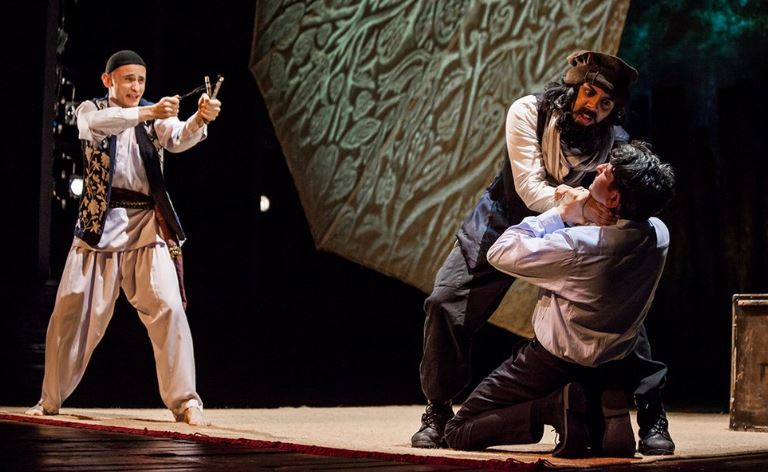
Three scenes particularly stand out due to their beautiful and effortless-seeming choreography, thanks to the detailed direction of movement director Kitty Winter, fight director Philip D’Orleans and fight and dance captain Bhavin Bhatt. These were the kite competition which saw the level of detail in creating realistic kite fights, that kept every audience member on the edge of their seat, but without using a single kite, the terrifying fight between Hassan and the local gang, including Assef, and the final scene -one of the most emotional parts – again involving kites in a beautiful and poignant moment. Each of these scenes although seeming simple, were stunning in their imagination and overall visual movement.
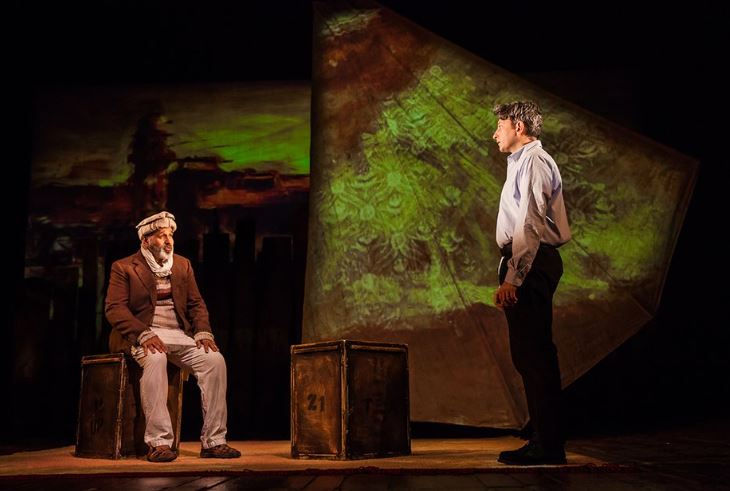
For such a tragedy filled story, through Giles Croft’s dynamic direction, events glide into one another at a particularly palatable rate with a level of superlative simplicity rather like the stage design, lighting and projections. The creative collaboration of Barney George’s minimalist stage design of a cityscape with a jaggedy fence across it, some stunning kites used by the cast, and the effective use of two large kite-like sails, alongside William Simpson’s beautiful wallpaper and backdrop projections and Charles Balfour’s atmospheric lighting, the audience are not only transported across the world to Afghanistan and then the US but also across time.

This is especially helped by the evocative musical direction of Jonathan Girling whose use of live percussion and song brings the audience into the heart of Afghanistan, with the use of singing bowls and schwirrbogen to enrich each scene. Girling also used translated Dari and Afghan songs, and, as mentioned in the programme, ‘experimented with a number of ragas – Indian classical scales’ which encapsulates the depth and cultural appreciation every cast and crew member has given to this production. Special mention must also be made to Hanif Khan whose tremendous talent as a tabla player adds greatly to the overall atmosphere and emotion of each event. Such cultural intricacies as these, as well as the use of Farsi dialect, could not have been included so well without the cultural advice and guidance of Humaira Ghilzai, the accurate accents the actors perfected with the coaching of Sally Hague and the stunning and both culturally and period perfect costumes designed by Elizabeth Dennis. All of which combined to create a mesmerising and most compelling must-watch performance of this much loved novel.
Just remember to bring your tissues!
Viola Selby, March 2024
Photography by Barry Rivett

 Mark Aspen