
Semele
Bye Jove!
Semele
by George Frideric Handel, libretto by William Congreve
Richmond Opera at Normansfield Theatre, Teddington until 21st April
Review by Susan Furnell
Nestled away on an unlikely campus in Teddington, lies one of London’s best kept secrets – an absolute treasure of a Victorian theatre. The Normansfield Theatre was completed in 1879 and has been recently restored to its full glory and grandeur and is the venue for Richmond Opera’s 2024 offering, the musical drama, Semele, by Handel.
Above the elevated stage hangs a curtain from a proscenium arch, flanked by resplendent gilded paintings. With dimensions more akin to a church than a theatre, our eyes are taken first upwards to the lofty beamed wooden ceilings and then back along the vast walls resplendent in red and pale brick patterns and panel portraits who try to make eye contact with us to tell us secrets of a bygone era, and to hint at the magic that will unfold when the curtain rises and the patiently sitting twenty-strong musicians in the Baroque orchestra lift their gaze attentively to the conductor awaiting the first beat.
Semele is a mid-period Handel work, written in English during the time the composer was living in London. It is musically rich and defies categorisation as it is full of beautiful operatic arias, contains lots of ornamentation, is written for continuo accompaniment, and has musically interesting polyphonic choruses. It is also (which will please some people), more economical than some other Handel operas in its use of long recitatives and when they do occur, more often than not they have the lugubrious accompaniment of the cello.
The story of Semele, which originates indirectly from Ovid’s Metamorphoses, is timeless with its themes of desire, ambition, challenge of the status quo in pursuit of personal fulfilment and with the consequential rise and fall of public figures. However its liberal attitudes towards adultery and vengeance (Semele’s spiral into death is triggered by hubris rather than immorality) seem at odds with the puritanical values of the Victorian period the theatre was built in, and this only serves to remind us that societal values are relative and change over time, something of which we are increasingly being made aware today.
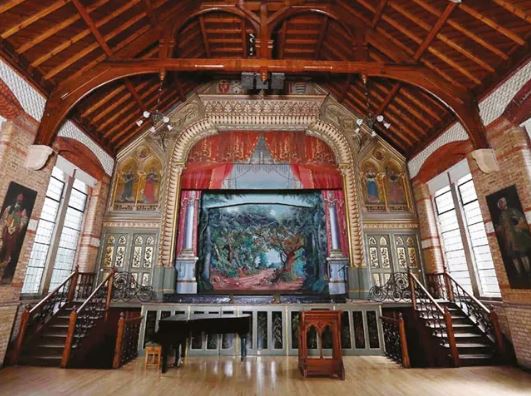
As the curtain lifts, a crowd of people in the court of King Cadmus, Semele’s father, glisten in their costumes while the beautifully painted backdrop (the first of several painted scene backdrops, as this was one of the few Victorian theatres to have a scene changing system) and props transport us to the feast in the Court at which everyone is preparing to celebrate the marriage of Semele to Athamas (acted convincingly by Amélie Saintonge, although she struggles slightly with breath control on the most challenging of Handel’s very long lines). The stage, enveloped by Simon Pike in masterfully designed lighting, conveys a sense of joy while simultaneously injecting a sense of anticipation through gentle shadows.

Many of the later scenes revolve around the bedroom. In one enchanting scene, a fabulous and cheeky pixy-like Cupid in pyjamas (Claire Doran) unleashes her dreamy voice to work her magic on Semele. In another Somnus (sung by Richard Perry) refuses to wake from his favourite thing in life (sleep) while jealous Juno is trying to engage him in a conspiracy to bring about Semele’s destruction.
In yet another scene of light relief, Semele and her sister Princess Ino (Erin Holmes) bounce up and down on Semele’s bed. Fortunately neither fall off, but the thought was a minor distraction for a moment! Erin Holmes sings exquisitely and her strong vibrato worked for her portrayal of the sensible sister but might not have worked so well for the more emotionally free Semele, suggesting both roles were well cast.
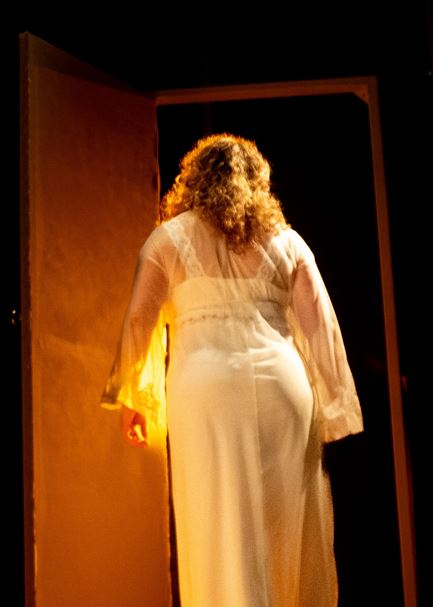
The most creative visual device is the use, in the middle of the stage, of a door, not attached to any walls, that only Semele walks through. She does so just once as she is about to die and to be forgotten by Jupiter. The ethereal portal echoes the rise and fall of influencers on the internet and the ability to swipe someone out of your life on Tinder.
Under Lindsay Bramley’s baton, the small Baroque orchestra, which is an ambitious mix of professional and amateur musicians (ambitious not least because of the technical challenges of keeping Baroque wind instruments in tune) play with gusto. Lindsay maintains a drive and energy at a tempo that isn’t too fast and allows us to wallow in the enveloping music. Although there are occasions the music sections could play off each other more, the orchestra as a whole consistently respond to the singers’ phrasing and timing and emotions making this a truly integrated musical experience as the composer would have intended. My guest enjoyed the opera but commented on the occasional monotony of too many repetitive passages. A potential solution could have been to imbue the repetitions with subtle changes in dynamic range or tempo or timbre.
Although two of the professionals, leader Rebecca Collen and continuo harpsichordist Michael Keen, play well and hold the orchestra together (indeed Michael provided virtuosic flourishes at times) the star of the orchestra was undoubtedly the cellist (basso), Giles Kennedy. Handel skilfully wrote the cello part to reflect the internal states of the characters. The poetic tone and shape of every note are hypnotic but what was mesmerizing was to hear, and above all feel, the cello behave as a chameleon, altering its timbre and emotional range so one minute we feel the roller coaster flirtations and palpitations of Semele’s desire and then the next, the menacing, brooding jealousy of Juno, and then again it changes so that the deep resonant tones give inner voice to Jupiter’s intense love for Semele. Some of these emotional depths are actually rather mundane in the original libretto, so it is a revelation when the cello adds its insight communicating with our hearts not our minds.
The singers are relaxed and act consistently well with numerous small gestures and facial expressions exchanged effortlessly and consistently as the story progresses. Naomi Kilby’s Semele exudes a charm that endears her to the audience so that we care about the terrible fate she brought upon herself. Her voice filled the intimate theatre and her vocal control including use of stepped dynamics and head voice drew us in and provided strong dramatic shifts between flirtatiousness and desires on the one hand and her concerns and fears on the other hand. Handel sometimes writes some very, very long lines and Naomi was one of the few singers with the breath control to sustain the beauty of the music in the longest of these lines.
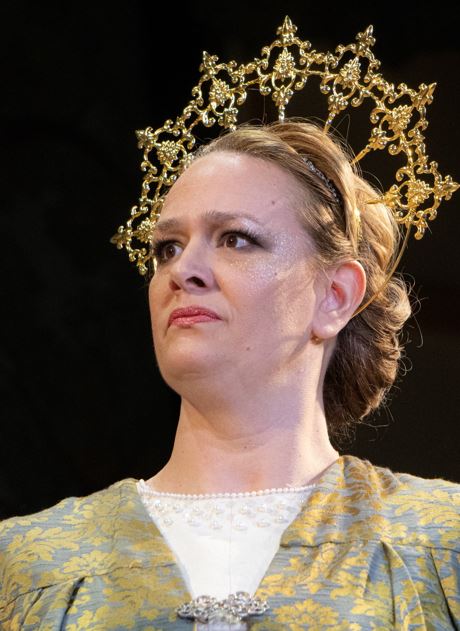
Hugh Benson (Jupiter) delivered some lovely passages musically but his stage presence never quite convinces that he was the all-powerful god Jupiter rather than a contemporary millennial husband straying slightly. Similarly, Juno (Ruth Vanni) who has a wonderful rich mezzo tone which in its middle range is gorgeous) never quite elevates her stage presence from spurned vengeful wife to Goddess, let alone to her ironic title goddess of marriage. For all this, they both sing the parts well and through the combination of good singers, a genius composer and super sensitive cellist, the whole is bigger than the sum of the parts and one feels the emotions and drama that Handel wanted us to feel.

Other mentions must go to soprano Dawn Rolt for her role of Iris (to which she brings a gorgeous voice, and very free ornamentation that feels very consistent with reading that she performs jazz as well as opera) and also to the wonderful rich velvet baritone voice of King Camdus (Will Kwiatkowski), whom I felt relieved to hear early on in the opera as a good omen for what was to come after a slightly jarring small earlier entry by another male singer.
All in all this is a lovely production, performed with musical sensitivity and convincing acting (many fully professional opera companies could learn a thing or two from the naturalness of the ensemble towards each). It is a story that resonates with 21st Century issues and is being performed in a beautiful Victorian theatre that every arts-loving Londoner should visit at least once. Do make sure to get onto the email list so you can book your ticket to whatever Richmond Opera performs this time next year!
Susan Furnell, April 2024
Photography by Leepyphoto ©

 Mark Aspen
Trackbacks & Pingbacks