
The Importance of Being Oscar
Sprung From Gaol
The Importance of Being Oscar
by Micheál Mac Liammóir
Reading Rep Company and Original Theatre at the Reading Rep Theatre until 8th June
Review by Sam Martin

This oral biography of the prolific Oscar Wilde is truly special being performed at Reading Rep, just a stone’s throw from Wilde’s place of incarceration, Reading Goal. Alastair Whatley, the only actor in this solo performance, makes explicit reference to our location at the beginning of the play, drawing the audience’s attention to the significance of the space we are occupying together, and therefore making the moments where the jail is mentioned even more vivid.
The Importance of Being Oscar is a touching tribute to Wilde, interweaving the writer’s life and works seamlessly, simultaneously entertaining and informing. Under Michael Fentiman’s able direction, Whatley’s performance is well balanced, with great timing and is, at times, heartbreaking. He deftly moves between characters in the Wilde’s life, as well as characters in Wilde’s plays, and blurs the transitions so smoothly that the piece gives a suggestion that his works are really just an extension of Wilde himself. This subtle characterisation (rather than a marked divide and clarity that one might associate with multi-roleing) emphasises the mirrored worlds of Wilde and his fictions, and provides a small shift between actor, narrator and character voice which serves to sooth and lull the audience. This is a challenge to tune into at the start, especially the change between narrator and the voice of Oscar himself, but once immersed creates a comforting rhythm for the audience that highlights the words of the biography and the power of his letters, dialogue, and poems.

The character that does seem to stand out a little further is that of Lady Bracknell, which is played with a little more gusto as Whatley skilfully switches between Bracknell and Worthing. This gentle exaggeration pushes and plays on the comedy of the scene, with Whatley’s timing perfect to remind the audience of the wit and humour in Wilde’s work. This is a moment that gets the most laughs from the audience, unsurprisingly as a scene recreated from arguably Wilde’s most famous play.
However, the strength of this performance isn’t simply in the elements of comedy, entertaining as they are, but in the poems and letters of Wilde’s pain and heartbreak. Whatley’s honest, stripped-back performance of Wilde’s letter to Bosley from his cell is undeniably moving. The focus remains on the language, yet Whatley’s precision in tone, pace, and the alterations in his facial expression to highlight the anguish, but also the love in the letter, creates a touching tribute to this phase in Wilde’s life, emphasising the unjust nature of his incarceration. Here, the lighting is lowered and appears to cast the actor into shades of grey, beautifully capturing his loss of joy and perhaps loss of hope that he would be able to return to his once lover.
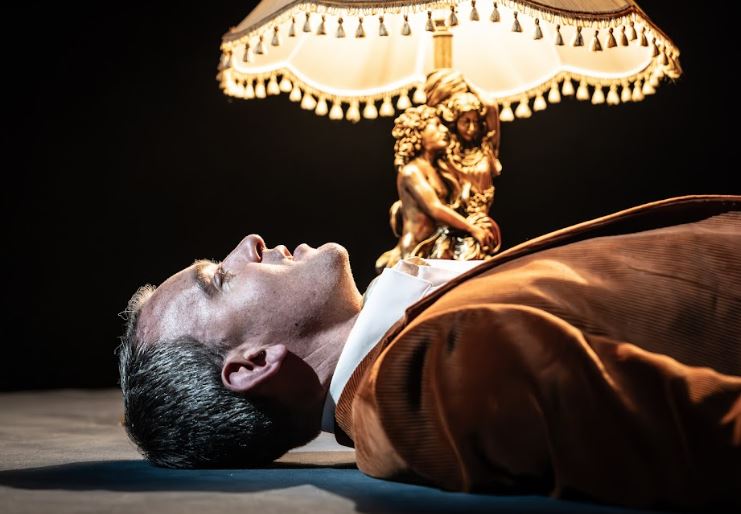
In fact, the stripped-back nature of the design, with exposed stage lighting and scaffolding, as well as exposed wings, helps to draw focus to Whatley throughout. With the lighting concentrated on a smaller, circular stage leaves the surrounding space in darkness creating a sense of uncertainty outside of Wilde’s ‘bubble’. The lighting further emphasises the focus of society on him as his notoriety grew, with a series of states that serve as spotlights from different angles on stage, a take on the multiple perspectives and opinions of Wilde’s life. This clever, yet effective staging achieved by Madeleine Girling and Chris Davey’s collaboration supports the shifts in time and place purposefully and avoids undue breaks in attention from the central performance. The subtle use of colour changes on the circular stage and mirrored circular lighting ring hung directly above the stage, creates pitch-perfect shifts in mood and helps to delineate the changes in the narrative. The only time this appears to jar is when Whatley recreates Wilde in his cell at Reading Goal, reciting one of his later and more unadorned poems. As Whatley moves to the back of the stage area, the lights snap invasively onto the audience, intense and accusing. This state marks the start and end of the jail scene, perhaps logistically to cover the actor’s movements from and back to the circular, elevated stage area or maybe to revive the audience’s attention of our environment. Either way, this unfortunately is so blinding and separate from the previous lighting states, that it startles the audience in a manner that distances rather than providing an increased alert state.
Despite this moment, the performance is moving and clever. The audience audibly gasps, laughs and sighs along with the tumultuously life story as it unfolds. Whatley captures us completely and does not fail to deliver the interplay between the comedy of Wilde’s work and the tragedies of his life. A thoroughly enjoyable night, masterfully created in the shadows of such an important piece of the Oscar Wilde puzzle.
Sam Martin, May 2024
Photography by Marc Brenner


 Mark Aspen