
Platée
Swamped with Love
Platée
by Jean-Philippe Rameau, libretto by Adrien-Joseph Le Valois d’Orville, after Jacques Autreau
Garsington Opera, at Wormsley, Stokenchurch until 30th June
Review by Mark Aspen

Bizarre, bold and brilliant; Garsington’s Platée is packed with wild grotesquerie, vivid fluorescence, and exuberant energy.
In a municipal garden near my home in Twickenham, there is a very imposing statuary group of Naïades, or possibly Oceanides, always known locally as the Naked Ladies. They had found their way there early in the nineteenth century, when classical subjects provided thinly veiled eroticism. Anyway they are water nymphs. The Ladies are beautiful and full of joy.
Not so the water nymph in Rameau’s Platée, who is aesthetically challenged and hapless. She is one of the Limnades, the nymphs of swamps and marshes, not the most hospitable of habitats. The eponymous Platée has puffed herself up with unrealistic vanity and obsessional delusions, weaknesses which lead her to become the butt of a cruel practical joke.
Platée was first performed during the wedding celebrations in the spring of 1745 for the marriage of the Dauphin Louis, son of King Louis XV of France, to the Spanish Infanta, María Teresa Rafaela. The Infanta was described by a contemporary as “physically ill-served by Nature”, so one might have thought it rather tactless and also dangerously undiplomatic to present the opera at such a significant wedding. However, Rameau seems to have got away with it, partly by the sheer novelty of the work.
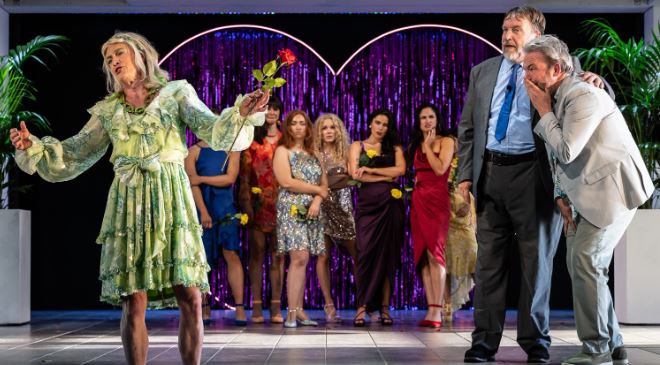
The plot of Platée revolves around a ruse by Jupiter, king of the gods, to cure his wife, Juno of what he sees as her tiresome jealousy, her idea that he would chase after any passing nymph … as if! The set-up is to make it appear that Jupiter has fallen in love with a nymph, pushing it as far as a wedding ceremony, but with such an ugly repulsive creature that Juno will be gulled into seeing how preposterous the whole idea is, and how ill-founded is her jealous. Poor Platée is chosen as the target for this heartless trick.

Counterintuitively, director Louisa Muller has relocated her production of Platée into a twenty-first century reality television show: think Love Island rather than Mount Olympus. Remarkably, this work brilliantly; and uncomfortably, as it draws out startlingly similarities with the vindictive steaks that so disfigure modern life.
The seat of the gods becomes the studios of Olympus TV, where the executives are revisiting their business, because their top rating, The Jupiter and Juno Show has had to go off-air. Juno has left him, jealous of his (perceived or actual?) philandering. A revival is planned by Momus, the personification of satire, and Thalie, the muse of comedy, The Jupiter and Platée Show. But the studio offices are in mess after an all-night party with all the staff, and they need to wake Thespis, the inventor of comedy.
This mis-en-scène is appropriate, for, once Thespis is up (and singing the praises of Bacchus), the office and studio become a hyper-busy beehive of action. The stage soon swarms with the octet of dancers and the twenty-two strong Garsington Opera chorus. These performers are indefatigable throughout the opera with their insistent energy. In fact, the opera is very much an ensemble piece, involving all the named parts too. Movement Director, Rebecca Howell keeps wonderful dynamic patterns on the stage the whole time. Moreover, all of this latches well to the lively patterns of the bright bubbly Baroque music, a music that never stands still.

Designer, Christopher Oram’s garish set of chrome and glass, and fluorescent plastics in pink or lime green, is extended by the glass side walls of the theatre itself. Its foci are a heart-shaped pink lighting tube heart with purple lamé slit-drape as the upstage centre entrance and a giant TV screen on the upper level behind an elevator gantry. Both allow for surprise appearances. There is no excuse for Lighting Designer, Malcolm Rippeth not to let rip; and so he does. Matt and Rob Vale’s video design by Illuminos animates the TV screen.
With Thespis awake, the plotting can start. Established tenor Robert Murray, whom we last saw at Garsington as Mithrades, is on cracking form as Thespis and doubles as the messenger god Mercury. Baritone Jonathan McGovern as Momus, and soprano Holly Brown’s Thalie, complete the strong band of TV executives, who soon recruit the king of the mountains, Chitheron, as their front man, a role to which the rich bass-baritone of Henry Waddington brings suitable gravitas and bonhomie, in spite of the task that befalls him.
The task is one that tests both gravitas and bonhomie, as it is he who executes the plan and gulls Platée into taking part in a rigged competition as part of the reality show. Platée is full of self-belief and empty of self-awareness, and is convinced that every man is in love with her, especially Chitheron, who rapidly extracts himself by revealing that she has caught the eye of Jupiter. From king to god is quite notch up the social standing, and serves to further boost Platée’s bloated self-esteem.

To further heighten the outlandishness of the character, Rameau scored the role for an haute-contre, the highest of the tenor voices. Breeches roles for sopranos are common in Baroque opera, but this was Rameau innovatively extending the concept. Samuel Boden is Platée to perfection, sharply portraying her solipsistic nature. The role is demanding in its vocal contortions, but he sings with assurance and agility. In spite of the masculine angularity of his figure, Boden can act with a softness that induces empathy with this put-upon character. And he has a muscular athleticism: how many top-notch tenors can walk across a stage on their hands, as part of the dancers’ set piece?
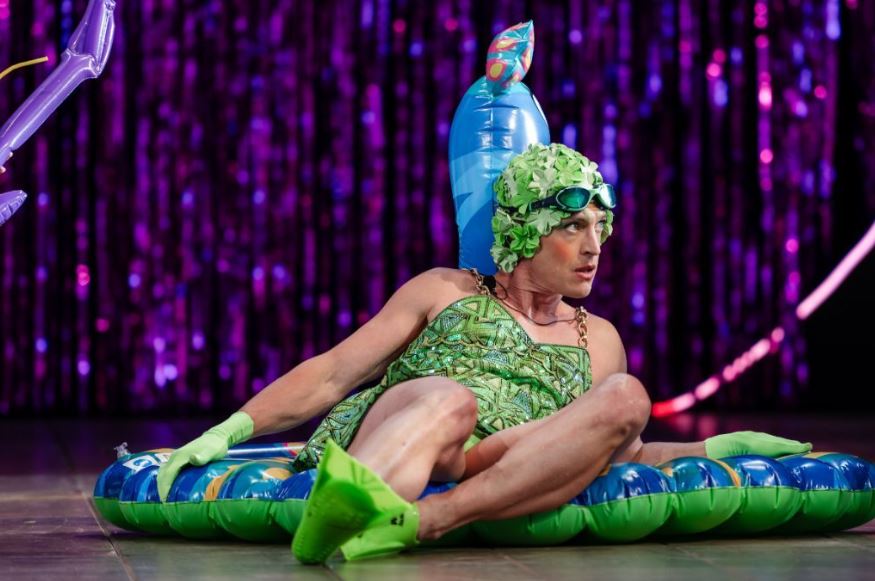
Muller has given Platée some wonderful absurdly exotic costumes. We see her in green bathing cap and flippers, amongst blow-up flamingos in the jacuzzi; then in her Sunday-best purple tutu, tiered tiara, and peacock tail. (Much fun was had with the latter.)

But when it comes to big-moment entrances, it has to be Jupiter’s. He arrives in a gold golf-buggy, borne on golden wings, the vehicle that is, not the god, who sits jauntily in a silver lamé jacket and cool shades, like an archetypical Las Vegas narcissist. Award-winning bass-baritone Ossian Huskinson, now well-established at Garsington, eats this role with relish, bringing out a cocky swagger for this interpretation, but my what a rich voice he has.
Everyone has a chance, though, to steal the show, Rameau gives them all a slot to “do a turn”. But a sure highlight is offered to La Folie, the personification of human foolishness so evidently exposed in Platée. La Folie emcees the celebrations at the reality show when Platée “wins” the completion against the, by then disgruntled, bevy of beauties whose plastic pulchritude is apparently surpassed by a swamp-nymph. Mireille Asselin’s La Folie is a self-assured popstar and she really puts plenty of oomph behind a versatile soprano voice. Backed up by a DJ in the gantry and glo-stick banishing chorus, the aria Aux langueurs d’Apollon becomes very 21st Century in style. The dancers wear ash-blond wigs and silver cropped puffa jackets, and little else, and their sensual contemporary dance puts an explicit erotic edge to the wooing of Apollo and Daphne. Who would have thought that Rameau could be so flexible?

The answer is probably Paul Agnew, who conducts The English Concert with vigour and vivacity. Over the past thirty years, he has not only conducted Platée many times, but has played the eponymous role on a number of occasions. He knows better than anyone Rameau’s musical inventiveness that was startlingly innovative in its time. It twists and turns, pulls up and runs away, and the musical comments and gags pop up all over the place, while Agnew drives every note for its full impact. Pizzicato strings are bird calls one moment and heartbeats the next and when Platée is taunted with “qu’elle est belle”, did the bassoon blow a raspberry?
Yet, far from being gimmicky, many music passages are sublime, witness Holly Teague’s superb deliveryof the aria Soleil, fuis de ces lieux, the lament of Clarine, a fountain naïade. Indeed the whole of the opera is a wonderful amalgam of arias, interludes, choruses and dances. Dance is much to the fore; besides, Rameau first called the piece a ballet bouffon, and certainly the dance octet seems omnipresent. They can be studio workers, flocks of birds, the popstar’s backing group or assorted wedding guests. Although no choreographer is credited, Howell’s work is evident here.

The birds follow on Jupiter’s teasing of Platée, when he first meets her, appearing as a donkey and then an owl, these transmogrifications taking place behind his minders’ golden parasols (in lieu of clouds). All of this sets Platée up for the mock wedding, which takes up most of the final act.
The “wedding” is chavery at its brashest, geezers and girls, first-bumping blokes, their tottering birds in stilettoes and fascinators. The chorus have much to do here, keeping neatly choreographed ranks and files of chairs on the move. Excuses come thick and fast to delay the ceremony until the arrival of Juno. The chorus, as the guests, nod off then move again, then in slo-mo, all the while singing superbly.
Platée impatiently asks when Cupid and Hymen are coming, only to be told that “the gods of love and marriage are rarely seen together”. (This, for some reason, caused laughter in the audience!). Then, to placate her, Cupid arrives. Not genuine thing, Victoria Songwei Li’s gently tingling soprano, Amor; but Momus, very thinly disguised in gold lamé with a foam-rubber bow, a brave departure for McGovern.
And at the end, when Juno comes crashing in, but her incandesce at the events turns to incredulous laughter, Platée has been totally ridiculed and humiliated. But who are the losers in amongst all this madcap tomfoolery?
Spirited mezzo Annabel Kennedy’s Juno seems quite sanguine and forgiving at the end, but she has lost a lot, mainly trust in Jupiter: but did she ever have it?
Then there’s the crushed and humiliated Platée. Surely she did not deserve such a fate for her overweening egotism. It makes a downbeat and very cruel ending to the opera, Rameau suddenly pouring cold water over all this fun. Sitting on the floor, while everybody turns away to party, her final words dissolve in despair, allons contre eux exhaler mon courroux (let’s run away from those I vent my rage against).
Mark Aspen, May 2024
Photography by Clive Barda, Alistair Muir and Julian Guidera


 Mark Aspen
Trackbacks & Pingbacks