
Cyrano de Bergerac
The Best? Who Nose?
Cyrano de Bergerac
by Edmond Rostand, adapted by Glyn Maxwell
Richmond Shakespeare Society at the Fountain Gardens, York House, Twickenham until 20th July
Review by Salieri
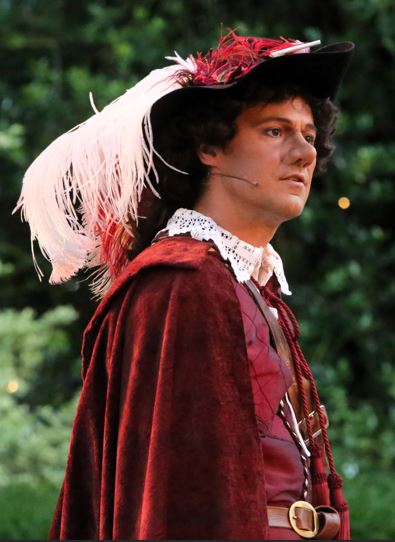
Cyrano de Bergerac, presented by the Richmond Shakespeare Society for its annual Open-Air Production is one of the most fascinating theatrical evenings I have spent. Probably the best of its previous such productions to date, it reduced the large area of the Fountain Gardens to a Theatre in the Round with the audience around its perimeter. This undoubted created an atmosphere of intimacy and led to a brilliant display by the actors, who inexhaustibly portrayed a number of different characters as the First Act proceeded. The pace was excellent and the energy of the cast was well up to the demands made upon them. One carp I had was the use of microphones, which I feel was unnecessary in such a small acting area and was not always kind to some of the female members of the cast.
However, such an explosion of energy tended to have its drawbacks: it was difficult to really know what characters we were seeing, who they were and what their contribution to the play was, particularly as most of the actors doubled, some even having four different roles. The dialogue was sprightly and quick-fire with 17th Century gags combining with 21st Century ones.
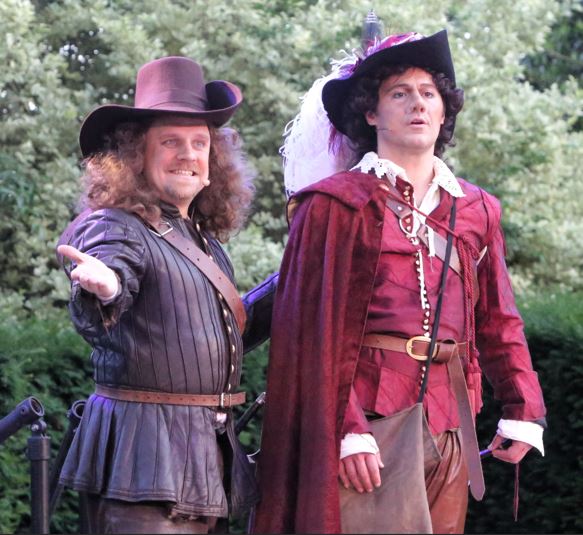
Nevertheless, the leading roles began to crystallise with a sudden strong duologue between Cyrano and Roxane, which foreshadowed their relationship, and Luciano Dodero and Francesca Ellis shone as the main protagonists, both developing as the play continued towards the fun of the First Act to the darkness of the Second, but I’ll come to that in due course.
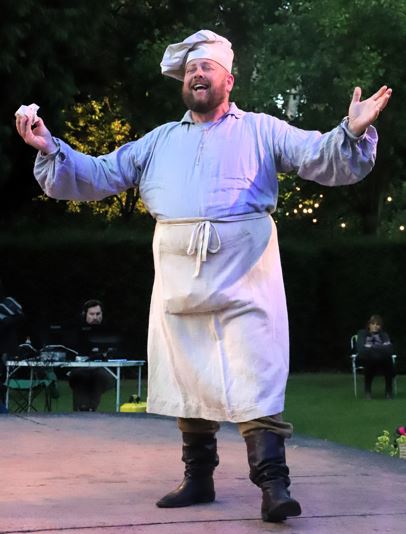
Other main characters also emerged. Terry Bedell’s Ragueaneau had some fine comic moments, Ben Collingwood Best as Le Bret seemed to be the Narrator-Chorus, but it was a confident performance. However, the entry of Scott Tilley as the Count De Guiche about halfway through the Act gave the play a sudden change to what was happening: Scott had a strong authority which we badly needed, since I was still not precisely sure where we were going. He also became a suitor to Roxane.
Her third suitor was Christian, played by Theo Byrne; I was less enthusiastic here, since I found he lacked depth and the passion was somewhat unconvincing: the scene where he is prompted by Cyrano to express his feelings lapsed into something approaching slapstick, which may be a fault of the play, but there was a decided drop in the action.
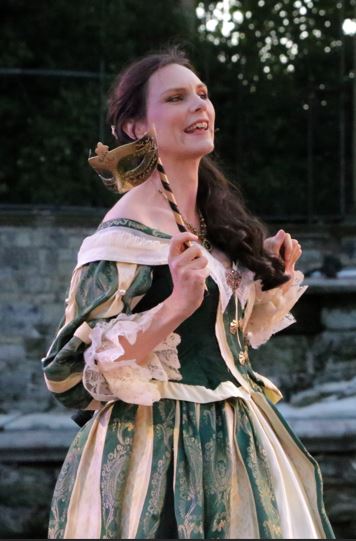
Before I conclude the First Half, I was not entirely happy that the initial opening, described as The Prelude set in a French convent featuring all the Nuns, but it then led straight into the fun and games of the Parisian theatre. I felt that there should have been a definite contrast – perhaps a rendering on the soundtrack of a solemn Kyrie to establish the Nuns’ presence – with subdued lighting which is then swept away into the actual Act One.
After the interval, all the jollity disappears: we are at the Siege of Arras and the battlefield. It is a totally different play to the first half, and a challenge for all the actors, which they certainly lived up to. The lights were dimmed with the approach of actual night in the gardens themselves, which aptly made the flowers disappear, and we had some very moving moments. We see how the presence of war alters everything and everyone. Francesca Ellis, Luciano Dodero and Scott Tilley excelled themselves in their approach to the final tragic denouement, and the rest of the cast had their brief, but telling contributions.
This was a real achievement for the RSS: the costuming was fine and the discipline of the entire company ensured that the play moved at a cracking pace, something which is somewhat rare in other amateur, and occasionally professional, productions. Undoubtedly the much smaller stage area was a bonus, and the presentation in the round was the best way a play of this nature could be successfully achieved.
Salieri, July 2024
Photography by Simone Best


 Mark Aspen