
Red Speedo
In at the Deep End
Red Speedo
by Lucas Hnath
David Adkin and OT Productions, at The Orange Tree Theatre, Richmond until 10th August
Review by Harry Zimmerman

Ray lives to swim. He is within touching distance of Olympic glory and a life-changing sponsorship deal. But everything changes when performance-enhancing drugs are discovered in the club’s refrigerator. As tensions run high, Ray’s brother wants them destroyed, his coach wants to call the authorities, his ex-girlfriend doesn’t want to know, and Ray wants the drugs back.
Written by Lucas Hnath, directed by Matthew Dunster and receiving its’ UK premiere at The Orange Tree Theatre, Red Speedo is a taut construct of power, political manoeuvring and moral ambiguities played at the breakneck pace of an Olympic sprint. At its heart, the play tackles the unforgiving weight of success in a world where the only crime is getting caught.
Red Speedo opens on the eve of the Olympic trials. If Ray makes the U.S swimming team, he will win a deal with the swimwear company, Speedo. And if he secures that deal, he will be wealthy. In fact, he will possess so much money that he will never need a job.
However, there is just one problem. A stash of performance-enhancing drugs has been found in the fridge of his team’s locker room. Whether the drugs were Ray’s or not, the find and the subsequent ramifications and consequences of the discovery threatens his fate, his future and that of his closest companions.
Ray is one of four characters in Red Speedo who face significant dilemmas and radical lifestyle choices. There is also Lydia, Ray’s former girlfriend who, at one point, provided him with performance-enhancing drugs to improve his swimming results. There is also Peter, Ray’s brother and an attorney seeking to transition away from his law career to become Ray’s sports agent. And then there is Ray’s coach, who has invested considerable time and emotional effort to develop Ray’s talent and bring him to the cusp of Olympic immortality.
As the narrative progresses, the relationships between them all become complex, absorbing and, at times visceral. Plots and subplots, threats and bribes, all combine to weave a shifting pattern of relationship twists based on past present and future scenarios delivering a pulsating high-stakes drama.
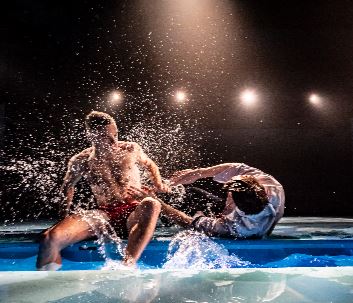
The conflicts and shifting sands of the relationships between the protagonists escalate in intensity as the performance progresses. All four characters handle the rapid-fire dialogue skilfully, while also ensuring that their actions and reactions retain a genuine sense of spontaneity with particularly adroit use of pauses and intense periods of silence.
Finn Cole as Ray gives his character a believable passion and a hint of immaturity and disingenuousness that suggests, at times, an almost Forrest Gump like simplicity. As he carefully opines “We all do things that are sorta good and sorta not so good.”
Proud of his skill as a swimmer, and aware that this offers him the key to a better life, Ray is continually wrestling with how far he should commit to winning.
Ciaran Owens, as Peter, the lawyer aspiring to a new career as an influential sports management executive, is only too well aware of the importance that his brother’s talent will be in realising his own lofty ambitions. Peter’s dilemma is how far is he prepared to go to achieve his goals, and how important his relationship with his brother actually is?
Fraser James as the coach gives us an honest depiction of a solid, dependable supportive professional, dedicated to his sport and his charges … until he gets a hint that all is not what it seems with his protégé. His struggle to reconcile his ingrained belief systems with “real world” practicality is an intriguing sub plot.
In an assured professional stage debut, Parker Lapaine’s Lydia is by turns assertive and determined, sassy and confident, yet exhibits a vulnerability based upon her harsh experience of professional malpractice, and her inability to shake off her true feelings for Ray. She would like to walk away from him, yet cannot quite muster the ruthlessness to do so.
This is ensemble playing of the highest order, with not a line wasted, and all of the cast displaying an admirable facility to exhibit greed, vulnerability, anger, pathos and humour in the course of just a few lines, a glance, a shrug of the shoulders or a touch on the arm.
The set is in keeping with the production’s values; simple, direct, effective. At the beginning of the play, the removal of a red cover reveals a body of water which serves as Ray’s pool, the only place where he feels safe and confident.
“I’m concerned not about what you have done, but whether you will be caught”
The staccato nature of some of the dialogue is underpinned by the completion of each scene delineated by a harsh klaxon horn. This serves to help the play grow in intensity as the clock winds down on an eighty-minute running time that races along, sweeping the audience up in its intensity, and ratcheting up the tension with each intrusive blast.
The adroit use of Roy Orbison’s You Got It to top-and-tail the action is extremely effective, and subtly embellishes the fundamental ambiguity which imbues the ending of the play, after a concluding scene of raw, shocking intensity; red not only in Speedo, but also in tooth and claw.
This is a particularly well-timed production, running as it does in tandem with the Paris Olympics, where we shall marvel at the achievements and dedication of the athletes, the swimmers et al. Red Speedo will also make us question at what cost are these achievements attained.
This is a highly invigorating piece of theatre, which fully deserved the enthusiastic acclaim of a packed audience at its breathless conclusion.
See it if you can.
Harry Zimmerman, July 2024
Photography by Johan Persson

 Mark Aspen