
Suor Angelica
Piercingly Sublime
Suor Angelica
by Giacomo Puccini, libretto by Giovacchino Forzano
West Green House Opera, at the Theatre on the Lawn, Hartley Wintney, 26th July
Review by Mark Aspen

Never was there a composer who could write such tear-jerking melodies as Giacomo Puccini. His tragic sopranos are etched into the opera-goers memory. Somehow, whenever they are spoken of, their names are prefaced with the adjectives “poor little”. Think Cio-Cio San waiting for the faithless Pinkerton in Madama Butterfly, the consumptive Mimi in La Bohème dying in Rodolfo’s garret while their friends wait impotently by, Liu in Turandot taking her own life to protect her aged father and save the Prince whom she loves.
But if you need a tissue for these heroines’ fate, you will need a whole box for Angelica in Suor Angelica. Handkerchiefs? I got through my one-for-blow and my one-for-show. However, this is not shallow sentimentality. It is bare emotion rubbed raw.
West Green House Opera’s one-off performance of Suor Angelica was by far the best and most affecting I have seen. At its conclusion the audience were stunned into silence, before it recovered enough to give a long and loud ovation.
The production is billed as Suor Angelica – In Concert, which, as in last year’s Robinson Crusoé, is not quite accurate. It is in fact part costumed and is semi-staged. Director
John Ramster has made the wise choice to keep the setting very simple, and allow for music and libretto to speak for itself. The set, apart from an entrance that hints at a church door, is a full floorcloth in chequered black and white. The subtle optical illusion this presents cleverly gives a slight feeling of unease.
The fourteen strong cast are, all but one, playing nuns. However, Ramster clearly differentiates them by the subtle device of their positioning in the stage blocking and with a stylised movement pattern. Each has a light chair that is woven into these movement patterns, which delineate the action.

The beautifully lyrical opening would stand alone as sacred music, and starts to set the scene, but then the reality of life in the convent becomes clear as the Sister Monitor sets penances for even the pettiest infringements of the strict discipline of the convent. Here even prayers are used as punishments, rather than an act of communing with God. Sister Osmina has simply hidden a spray of roses in her vestments; soprano Zoë Jackson as a petulant Osmina adds a spark of humour in her futile moment of rebellion. Sister Dolcina merely longs for something nice to eat, a guilty cameo from Portuguese soprano Mariana Fernandes. Adding a note of pathos is Soprano Nazan Fikret’s Sister Genovieffa. Once a shepherdess, she would love to hold a lamb once more. The irony of offering an Agnus Dei in penance is unmissable. Sophie Goldrick, a mezzo with polish and poise, portrays a withering Sister Monitor, who dismisses the nun’s excuses and requests with the mere flick of an eyebrow.
In practice, most of the nuns are effectively incarcerated in the convent, to an extent where it is an anticipated event when the rays of setting sun light up the water in the font, turning its water golden. The Mistress of the Novices, played with gravitas by mezzo Miriam Sharrad, sees this as a mark of God’s grace, but the nuns see it as marking the passing of time, and mourn a recently deceased Sister.
Nevertheless, in this oestrogenic pressure cooker, none of these privations prevent a latent cattiness coming to the surface, and gossip is rife. What is Sister Angelica’s secret, that only the most senior members of the convent are privy to? The goss’ is that Angelica is from an aristocratic family. She is undoubtedly well educated, certainly in terms of late 17th Century Siena, and she is the convent’s herbalist and physician. When Sister Chiara, tending the garden, is stung by a swarm of wasps, the Infirmary Sister (mezzo Eleanor O’Driscoll) goes straight to Sister Angelica for medication, which she immediately prepares from various herbs (though not spurge as in the subtitles, which is toxic, but marigolds). This knowledge becomes significant.
The gossip boils over when an opulent coach arrives at the convent door. Angelica asks if it has damask upholstery in azure embroidered with silver, and bears an ivory coat-of-arms.
This is a visit that Angelica has anticipated for seven years. Her secret is her illegitimate son, who was taken away from her at his birth. Angelica has been doing penance all that time to exculpate what is seen as the besmirching of her family’s name.
The Abbess knows the secret, and now enters, dismissing all the other nuns, and sternly announcing a visit from Angelica’s aunt, the Princess. The nuns sing the funereal prayer, Requiem aeternam.
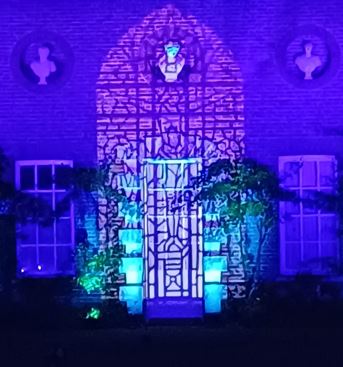
As the nuns file off from the stage into the upstage void, with its vista towards West Green House, the architectural lighting on the house, seen across its stepped lawns, becomes a deep purple, the liturgical colour associated with the end of Lent (the opera is set in May). Lighting designer, Sarah Bath has created a backdrop of great subtlety that intrudes so little on the action, such that one seems to feel it rather than see it.
As the Abbess, Jess Dandy makes an imposing presence. She has great bearing, but her rich contralto is astounding. The abbess is unrelenting, demanding even more penitence. Her aria instructing Angelica how to behave with the Princess, that really hits the word “ubbidienza”, obedience, is full of foreboding.
Then the Princess enters. Acclaimed mezzo-soprano Susan Bickley plays La Zia Principessa with statuesque authority. She wears the heraldic colours of her coach livery, an azure gown and coat trimmed with silver, and carries a silver-topped ebony walking cane. Bickley skilfully lends the part a firm sense of control. She knows how to work the drama of silence, pausing before she makes the Princess’s imperious declaration of the reason for her coming.
She intends to make the whole of the estate of Angelica’s late parents, which she holds in trust, over to Angelica’s younger sister, who is about to be married. She has the deeds, already prepared.
When Angelica asks who the bridegroom is, the Princess replies one who can forgive “la colpa di cui macchiaste il nostro bianco stemma” (the stain with which you have blemished our pure coat-of-arms). This is the point that triggers the full animosity between the two women. What follows could become mawkish, or overblown, but Bickley and Jenny Stafford, who plays Suor Angelica, handle the emotional tornado brilliantly, with balance, insight and reality.
When Angelica protests that her aunt is so “relentless”, the Princess reacts explosively and invokes the spirt of Angelica’s dead mother to make her argument. Bickley dispenses the blistering aria “nel silenzio di quei raccoglimenti”, (in in the stillness of those memories), with measured vehemence, her mezzo resonant with sumptuous maturity. Angelica must pay for her “sin” again and again.
Jenny Stafford, who played Nedda in West Green’s Pagliacci last year with such sumptuous lyricism, and previously a highly expressive Tanya in Eugene Onegin, also roles of a woman trapped and psychologically destroyed, excels in an exceptional performance as Suor Angelica. The emotional trauma of Angelica is palpable.
Of all the penance she has offered the Virgin Mary, there is one thing she cannot offer, non posso offrire di scordar…. mio figlio, (I cannot offer to forget my son). The aria is executed with such passion and pathos, that the audience is in tears. When Angelica asks what he looks like, there is no reply from the Princess. Bickley again works the silence with huge dramatic impact. A few unsung bars seem like an eternity, until the Princess coldly reveals that, aged five, he died of a fever two years ago.
In spite of Angelica’s collapsing in tears, the Princess is crushingly imperative, a pen is brought, and the deed is signed. The Princess majestically drifts out.
Angelica is left in anguish to grieve her baby son. Stafford’s senza mamma aria is heart-wrenchingly affecting. With her beautiful lyrical soprano, Angelica’s mourning that the child never knew how much his mother loved him, “quanto t’amava questa tua mamma”, is piercingly sublime.
Then the decision … to use her apothecary’s skills to join him in heaven. She prepares the herbs and swallows the potion. Then follows the devastating realisation; she has committed a mortal sin, and heaven will be excluded from her. Her soul is balanced on a knife’s edge between eternal bliss and eternal damnation.
Then the miracle, Angelica sees The Virgin Mary, who gently sends the child towards the arms of his dying mother.
Phew! This emotional draining stuff. But what completes it is the integrity and honesty of Puccini’s music. (It was his own favourite score.) The music is inextricably part of the action. Angelica’s final vision, as an example, is only “seen” through the agency of the music. Conductor Steven Higgins skilfully steers the impeccable Orpheus Sinfonia, to be constantly as one with the singers. The score is as expressive as the libretto and has all its emotional complexity: a beautiful piece played with sensitivity.
Suor Angelica is not for the timorous nor for the dry-eyed. But this a production that balances sensitivity with visceral emotion. It packs a powerful punch … straight to the heart.
Mark Aspen, July 2024
Photography by EAW

 Mark Aspen
Trackbacks & Pingbacks