
Swan Lake
Mirrored in the Memory
Swan Lake
by Pyotr Ilych Tchaikovsky, choreography by Alexei Fadeyechev and Nina Ananiashvili, after Marius Petipa and Lev Ivanov
The State Ballet of Georgia at the London Coliseum until 8th September, then on tour until 24th November
Review by Harry Zimmerman
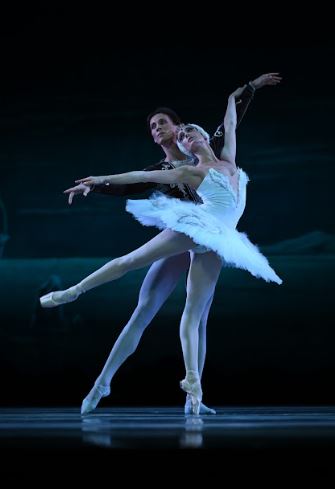
It is often said that one of the purposes of artistic endeavour is to lift us from the harsh realities of day to day living. At this time, most of us need some form of escape from the trials and tribulations of everyday life; and the State Ballet of Georgia’s production of Swan Lake certainly offers an evening of sumptuous escapism.
The company has grown in stature under the artistic guidance of Nina Ananiashvili, former prima ballerina with the Bolshoi Ballet and American Ballet Theatre, and there was a packed and expectant audience in the London Coliseum, waiting to be transported into the well-loved fairy-tale. But would it have a happy ending?
Swan Lake’s enthralling story, timeless score, and unforgettable choreography has made it the most in-demand ballet in the world, so expectations were high.
The story of Swan Lake is well known. Fashioned from an amalgam of Russian and German folk tales, it is a classic example of a love narrative, bursting with passion, betrayal, and drama.

Cursed by the evil sorcerer Baron von Rothbart, Princess Odette is transformed into a swan and condemned to a life at the lakeside, a spell breakable only by true love. Prince Siegfried, under pressure from his mother, the imperious Queen, to settle down and marry, meets the beautiful swan Odette on a hunting trip, and proclaims his love for her. But Rothbart’s scheming continues, and he tricks Siegfried into betraying Odette by professing his love for Odile, his daughter, the deceptive Black Swan. Siegfried, realising what has happened, returns to Swan Lake to pledge his eternal love to Odette.
The dramatic denouement famously has two potential endings.
In the tragic narrative, whilst Odette forgives Siegfried, she is so crushed by his betrayal that she fatally throws herself into the lake. Distraught, Siegfried decides to follow his true love to death. This tragic final act of love breaks Rothbart’s evil spell and allows Odette and Siegfried to unite in eternal love beyond the grave.
Alternatively, instead of taking her life in desperation, Odette makes peace with Siegfried, and they manage to win the fight against Rothbart. In the final scene, Odette turns back into a princess again, ready for her “happily ever after” life with her prince.

This production is a glorious attack on the senses. The combination of gorgeously opulent costumes, stunning sets, and imaginative lighting help to power along the narrative, providing the perfect structural support for the power, elegance, grace, and dextrous athleticism of a supremely gifted ballet company.
The tremendously challenging role of Odette-Odille was performed on this occasion, (four principals will share the role during the production’s run), by Nino Samadashvili, a leading Georgian soloist, and Principal Dancer at the State Ballet of Georgia.
Swan Lake is popular for its fascinating representation of good versus evil, depicted through the two opposing swans: Odette, the vulnerable, ethereal White Swan, and Odile, the seductive, deceptive Black Swan.

This has created one of the most technically and emotionally demanding roles a ballerina can perform. Not only does it require world-class dancing, but the portrayal of two contrasting characters within one performance also requires acting of the highest quality. This role is a tour de force, and thereby represents an incredible challenge for the ballerina.
Nino Samdashvili effortlessly rises to the challenge. Her Odette was graceful, elegant, and captivatingly vulnerable, but her Odile was the true highlight, dynamic, passionate and energetic, oozing menace and peril, with flashing eyes and knowing looks. The highlight of her portrayal of the Black Swan was the demanding execution of 32 fouettés as she pirouettes on pointe, apparently endlessly, in a bid to impress, dazzle and seduce Prince Siegfried, all at the same time. The astonishing series of lightning turns were delivered with breathtaking precision.

Oleg Ligai gave us a carefree and impulsive Prince Siegfried, whose love for Odette and fascination with Odile successfully anchored the narrative. His on-stage chemistry with Nino Samdashvili was powerful and convincing.
Marcelo Soares, as Baron von Rothbart, revelled in his status as the evil villain. His expressive hands and contemptuous glares, combined with his technical athleticism and flapping wings represented the embodiment of malice. He deserved the pantomime boos at the curtain call from the appreciative audience.
Swan Lake is historically one of the most demanding productions for the corps de ballet. In order to create the effect of a flock of swans, it needs to move in complete unison. Performing the ethereal movements and intricate formations requires a great deal of strength and stamina. In this production, this all worked in sublime synchronicity. Particularly noteworthy was the utmost stillness with which the swans posed to frame the central action. Not a tremor or bodily movement was discernible in the company. A true feat of technical discipline. Their movement was equally mesmerising, the hypnotic flock of corps de ballet swans moving their arms in synchronised ripples while fluttering en pointe.
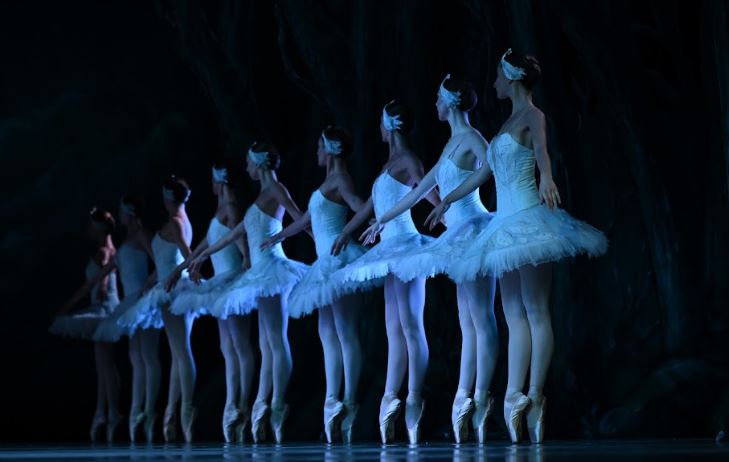
The swans trip across the stage as one, falling and flowing with every beat that emanates from the wonderful ENO Orchestra, led superbly by conductor Papuna Gvaberidze. He ensured that, at all times, the pulse of Tchaikovsky’s score meticulously underpinned the narrative, ranging from tender, gentle moments in the lakeside pas de deux, to the rousing bombast of the climatic conflict between Rothbart and Siegfried.
Swan Lake’s music is as much a star as the dancers themselves. From the sweeping romanticism of the “Swan Theme” to the celebratory waltzes and iconic national dances, the beautifully evocative score makes a powerful impact. Tchaikovsky’s genius lies in the musical embodiment of the characters: the elegance of the swans, Odette’s vulnerability, Odile’s allure, and Rothbart’s malice. The music perfectly complements the choreography and was executed magnificently.
The set and costumes, designed by Vyacheslav Okunev, also amply enriched this production. With large props and backdrops, and simple yet effective use of lights, we were effortlessly transported from a magnificent park before the palace, through its opulent halls to the enchanted, moonlit lakeside. The reflective floor was particularly striking here, memorably creating the translucent effect of water on stage. The costumes of the cast were always appropriate, colourful and with exquisite detail, especially in the costumes worn by the flamenco dancers. There were lots of clever touches, for example the white feather affixed to Rothbart’s headdress, subtly exemplifying the power he held over Odette and the other swans.

This was an opening night, and the overall sections of the show will become more tightly integrated as the production progresses. The opening act seemed sedate and appeared a tad introspective. As the company hit their stride however, the experience intensified, and we were increasingly swept along by the action, marvelling at the technical dexterity, the joie de vivre and emotional intensity of the company.
And that ending. Well, here is a spoiler alert … …
This production chose the less common staging, a happy ending. With Rothbart’s defeat, the curse is lifted, and Odette is restored to full humanity, (via an especially slickly delivered costume change), and is reconciled with Siegfried. Truly, to quote the accompanying programme note, amor vincit omnia!
Whilst opinions on the emotional pros and cons of witnessing either the tragic ending, or the victory of human love, will continue to rage, it was somehow fitting that, in these troubled times, this fairy story delivered a happy ending.
Whether a seasoned ballet aficionado, or a newcomer to the genre, this production provides a much-needed antidote to the trials and tribulations of the real world, will live long in the memory, and is highly recommended.
Harry Zimmerman, August 2024
Photography by Sasha Gusov

 Mark Aspen