
The Last Word
Powerful Portrayal of Resistance and Humanity
The Last Word
concept by Maxim Didenko
Wild Yak Productions at the Marylebone Theatre until 21st September
Review by Susan Furnell
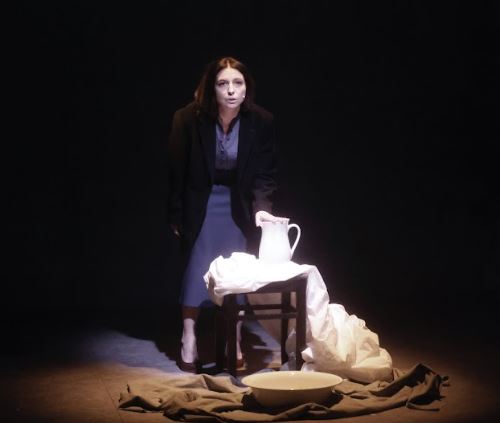
As The Last Word opens on a dark set at the Marylebone Theatre, it immerses the audience in a haunting portrayal of the cost of resisting oppression.
Directed by the acclaimed Maxim Didenko, this UK premiere (following its earlier release in Berlin), tells the stories of twelve women persecuted for their non-violent political activism in modern day Russia.
With each story, filled with heartache, resilience and profound humanity, we see the chilling reality behind Russia’s oppressive regime – a world in which the “final statement” (from the witness in a bullet proof glass cage) in the courtroom that is to sentence them has become one of the last places where the free speech is still possible. Their final statement is “the last word”.
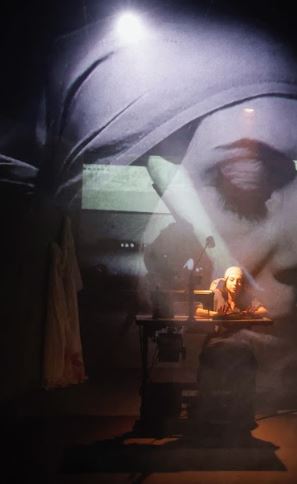
The production is based on the real life final courtroom statements from women as diverse as the lead from Pussy Riot (a progressive pop group), and an activist who simply substituted price tags for anti-war messages in a shop – all receiving disproportionate sentences in cruel conditions for unreasonably extended periods.
The play is about more than the legal proceedings and is an act of resistance in itself, since many of the women portrayed, and the creative team behind the production, are outside Russia in exile and the play is being shown outside Russia to the rest of the world. It is a cry for justice wrought out of personal experience. By selecting non-violent pacifist women to represent, it avoids clouding the issues with current Western debates about freedom of speech on social media where in some cases the perpetrator being disciplined in the West is inciting violence or offending publicly for all to see, with the issue sometimes grey rather than black and white. By contrast, the women in the play, who are being unfairly silenced in Russia, are no physical threat to anyone and are not offending anyone – they are simply criticizing a tyrannical corrupt regime, often in small ways. Thus the play successfully highlights tyrannical suppression of free speech in the most uncomplicated pure way that it’s possible to talk about free speech.
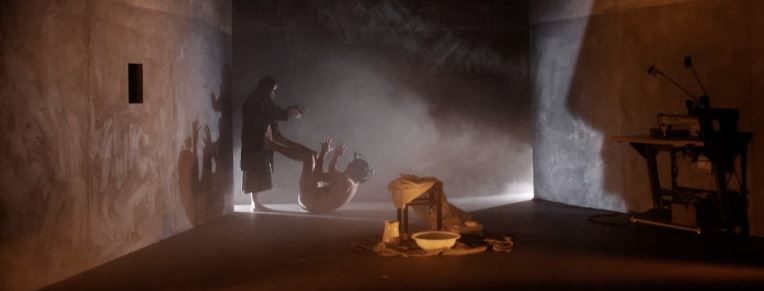
The Last Word is a powerful, genre defying multimedia experience. It’s not a traditional narrative drama, or even a documentary. Instead it us a multi-layer blend of docu-theatre, political theatre, performance art, multimedia, and high quality musical composition, which all work together to create a powerful sensory experience not easily shaken from the memory days after having seen it.
Alisa Khaxanova is both the lead performer (the only one with a spoken part) and the creative mind behind the concept. A former Bolshoi dancer, every gesture and every shift in posture, along with a well-controlled voice, conveys the emotional weight of the character she portrays – each portrayal distinctly different from the other eleven.
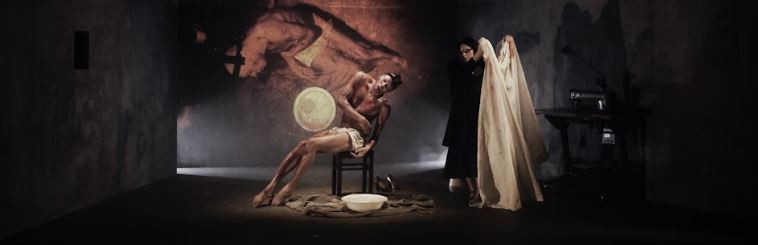
The first of the twelve women portrayed remind us to live our humanity, to stay with one’s gut reaction of right and wrong, to remind ourselves daily, by the minute even, that black is black and white is white. But Valentin Tszin (the only other actor) shows how hard this is as he commands the stage with his chilling non-verbal progression from infant through Christ-like character to oppressor with an arc that spans all twelve women’s’ stories echoing Edmund Burke’s famous words, “All it takes for evil to triumph is for ordinary people to stand by and do nothing”. Innocence can so easily be corrupted into complicity with evil and fear.
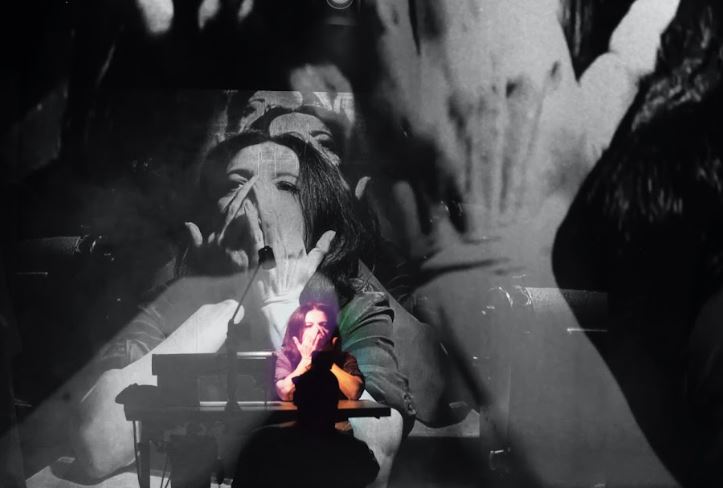
The multimedia elements in The Last Word, created by Oleg Mikhailov, weave together projections and abstract visuals to deepen the emotional impact of the stories. Much of the video is projected onto the front of the stage, creating an unsettling immediacy. The videography adds layers of symbolism and scale to amplify the stories, so that we feel the scale of oppression beyond the walls of the theatre.
Alex Musgrave’s lighting design is also an important element in creating the play’s oppressive, unsettling atmosphere. He often casts the performer in harsh isolated spotlights (like that of an interrogation) reinforcing the court room and the women’s’ vulnerability. It makes us feel like we are in the courtroom (or cell as the narrative position varies) witnessing the unjust sentencing or the appalling conditions in the cell post sentencing. We wince as we hear about the child covered in crawling cockroaches or the celiac sufferer made to suffer food poisoning every day as all the prison food has gluten and not even allowed to lie down, as inmates can only lie down between 10pm and 6am.
The soundtrack by Vladimir Ranev oscillates between eerie (deep rumblings and faint squeaky feedback) and spiritual (beautiful atonal a cappella choral music). The shifts in tone between the music and onstage action magnify the emotional weight of the stories. This is integral composition at its best, making the contrasts between beauty and suffering, between good and evil, between powerful and helpless, more jarring.
The stories are heart wrenching. We often hear and become numb to statistics. But this multi-media work breathes life into each woman’s experience, transforming cold numbers into deeply personal realities.
The collaboration of this team, many of whom fled their country following Putin’s invasion of Ukraine, adds urgency and authenticity to the production.
In a theatre as architecturally unique (and lovely) as the Marylebone Theatre, where few right angles exist, The Last Word finds a fitting home. The space itself, with its fluid design inspired by educationalist, philosopher and amateur architect, Rudolph Steiner, mirrors the performance’s themes – defying control and coercion and opening up new possibilities for expression and communication.
The Last Word is a heartbreaking and inspiring testament to the courage of women who continue to stand up for what is right, no matter what the cost is. In a world where the stakes are as high as they are today, the play feels necessary and powerful.
Susan Furnell, September 2024
Photography by Ute Langkafel, Maifoto


 Mark Aspen