
Never Let Me Go
Faith, Hope, Love
Never Let Me Go
by Suzanne Heathcote, after the novel by Kazuo Ishiguro
Rose Original Production with Bristol Old Vic, Malvern Theatres and Royal & Derngate at the Rose Theatre, Kingston until 12th October, then on tour until 30th November
Review by Mark Aspen

Faith, hope and love, St Paul’s hierarchy of the strength and longevity of emotions, is subtly and beautifully illustrated in Suzanne Heathcote’s adaptation of Nobel laureate Kazuo Ishiguro’s all-absorbing story of a society that teeters on a line between morality and expediency, between humanity and pragmatism.
The finely chiselled world premiere production of Never Let Me Go is a totally engaging memory story, a future history of what could be. It is that could-be that makes it so thought-provoking, compelling and chilling. Yet it is more chilling in the vehicle of director Christopher Haydon’s clean simplicity of story-telling.
The pupils of the exclusive Hailsham School, around whom the narrative centres, have an unerring faith in their common mission in life, which is all too literally self-sacrificing. For their hope is a soaring desire to help others by that sacrifice. Yet they also have a hope that the art that is nurtured in them has some sublime significance, and a hope that they will have the opportunity to experience those emotions that others take for granted. As they progress from childhood, to adolescence and to early adulthood, the most overwhelming of these emotions becomes love. And therein lies the humanity.
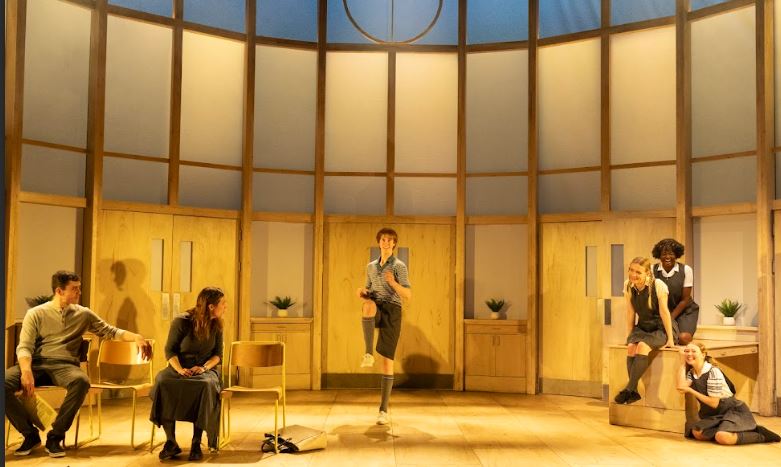
Designer Tom Piper’s set has a crispness, its high-spec beech-wood walls framing an open semi-circle with five sets of part-glazed double doors. It could be the foyer of a spa hotel, an atrium in a top private hospital, or the hall of a very expensive boarding school. In fact, it is something of all of these, and more. While its roof-lights promise the sky, the translucent windows accentuate a real world out there, unseen.
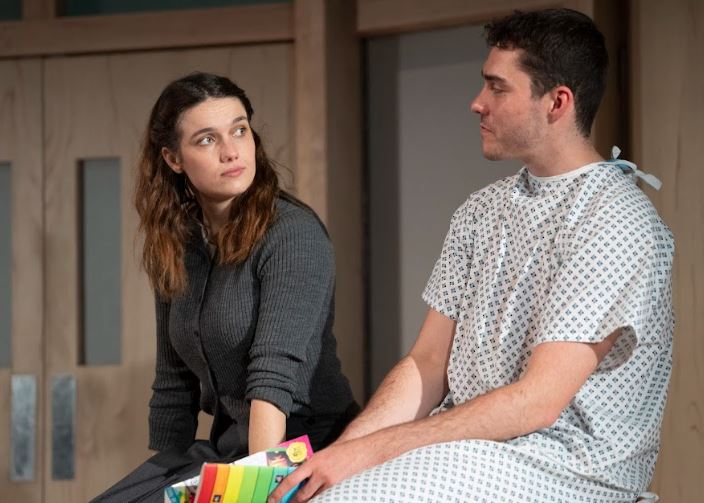
When Phillip comes as a patient into this arena, we discover that Hailsham is one of many such schools, but a special one. He teases out of his young carer, Kathy, her memories of the school. At first reluctant, she opens up to him on her mixed feelings, and a story evolves. To one not familiar with Ishiguro’s novel, it is difficult at first to untangle the significance of this hidden world of cryptonyms and euphemisms.
Gradually it becomes clear that the young people who are the subject of this play, the “others”, do not have parents, as they have been cloned from “possibles”. They have been brought up separately from other children, with one aim: to provide a harvestable source of healthy human organs. They have been taught that this is their purpose in life, and all have accepted it, almost as an honour. It turn they become “carers” and “donors”. Each “donor” can have three organs removed. On the fourth, they “complete”… fatally. All is clean, tidy … and inevitable.
One of the remarkable aspects of this production is that most of the younger members of the cast is fairly inexperienced. Indeed, two have their professional debuts here. Yet, the acting skills, without exception, are impeccable. They live these parts, not act them.
The action is focussed on Kathy H, an “other”, who is currently a “carer”, who by telling her story, becomes a de facto narrator. When, Phillip, played with edge by Maximus Evans, comes under her care, his antagonism causes friction at first, but with a light-hearted cockiness and a few Christmas-cracker jokes, he wins her over. Evans’ Phillip is stroppy yet endearing, in fine balance. He manages to wheedle out of her why the pupils and alumni of Hailsham School evoke both fear and fascination.
Kathy’s memoire is a mixed chronology of mainly short scenes, flashbacks that overlap on each other in action and dialogue. These almost cinematic cut-ins are facilitated by Joshua Carr’s perceptive lighting design and by Ayse Tashkiran’s movement chorography of running scene changes by the cast, with beds, desks and other stage props transmuting before our very eyes. In spite of all this busy-ness, there is an otherworldliness about the presentation, enhanced by a subtle soundtrack by Carolyn Downing that, almost imperceptibly, gives a feeling of unease.
Nell Barlow, a double Breakthrough Awards winner, plays Kathy in a natural unaffected manner, an outstanding performance that gives her character the feel of someone carried along by her own experiences.
The timeline of the plot spans more than fifteen years, and the change with time is very skilfully handed, children grow to adults, teachers become retirees. Ameline Abbott’s Hannah progresses from child to adolescent, while Laura, played by Princess Khumalo, at first a sweet schoolgirl, becomes a maturing young woman.
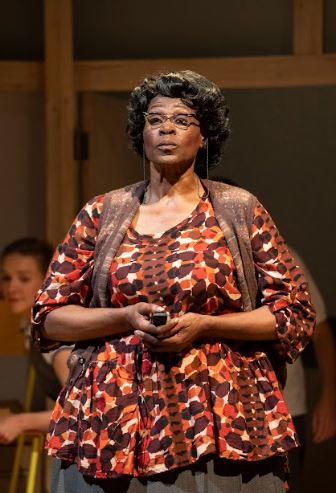
Hailsham’s headmistress is Miss Emily, strict and clipped in Susan Aderin’s up-tight portrayal. She encourages one aspect of the school life that makes it special, a concentration on the importance of art. From time to time, a French lady arrives to inspect the pupil’s work and to take samples away to a gallery in Paris. Known by the pupils simply as Madame, she presents an enigmatic figure who has contradictory feelings of deep revulsion and deep empathy for the pupils. A younger member of the teaching staff, or “guardians” as they are officially known, is Miss Lucy, who feels so uncomfortable about the situation that she is sacked for frankly warning them of their fate. Ironically, the children are unmoved; they are so inculcated to their destiny. Emilie Patry dexterously plays both Miss Lucy and Madame with accurate differentiation, sporting Scottish and French accents respectively, as she depicts the sprightly young earnest teacher and the mysterious mature mistress.

At Hailsham there are occasionally “exchanges”, that is of each other’s art, or “sales”, items from outside school. Kathy’s find is a tape cassette which includes the (fictional) Judy Bridgewater singing Never Let Me Go. She fantasises about having, holding and cuddling a baby, and is seen dancing by herself by Madame, who uncharacteristically is moved to tears. Especially for this production, composer Eamonn O’Dwyer has brought the song to life and Never Let Me Go is beautifully sung by Marisha Wallace.

Kathy’s closest friends in the school are Tommy D, a geeky “on-the-spectrum” youth, whom she at first treats with sisterly fondness, and Ruth C, pushy, bossy and bitchy, with whom, in spite of her faults, Kathy has a warm, but prickly, relationship. However, Ruth and Tommy become stronger in character as they mature into adulthood. Both have ambitions, which they never to have the opportunity to achieve; Ruth to be an office-worker and Tommy, who is frustrated by his lack of artistic skills, a sportsman. It is these three who most strongly punch home that these young people have a humanity, that a person cannot be just treated as a mechanical collection of spare parts.
As their bonds develop, Kathy’s feelings for Tommy become more than simply protective, and the growing romantic attachment between Tommy and the possessive Ruth becomes an unexpressed disappointment. They discover sex, and all of its concomitant emotional burdens. These are human beings with all the aspirations, faults and desires that come with the human condition.

Matilda Bailes makes a strong, feisty and artful Ruth, in a fine portrait of a young woman whose arrogance mellows into self-awareness. Angus Imrie shines as Tommy, the gauche awkward adolescent emerging as a thoughtful but spirited young man, sensitively interpreting Tommy’s frenzied outbursts, tantrums of frustrations.

Older teenagers are moved into accommodation with pupils from other donors’ schools, where they can have more freedom. Kathy, Ruth and Tommy go to The Cottages in Norfolk. Amongst the other students there are Chrissie and Rodney, who are “an item”, and Lenny (in a doubling role by Maximus Evans). They and their fellow housemates are somewhat in awe of the Hailsham alumni. There is a rumour that ex-Hailsham clones can have their donations deferred if they can prove that they are in love. Amelie Abbott, an ex-Rose Youth Theatre student, now fresh from the BRIT school, plays Chrissie while Tristan Waterson plays Rodney. Both actors are relaxed into the roles, as the proprietorial Cottages residents, trying genuinely to overcome their wariness of the newcomers. There is now an air of hope, symbolised by a boat they see in a nearby harbour, and the opening of all the doors to reveal a seascape. However, it is clear from the dilapidations of the vessel that it will never sail.
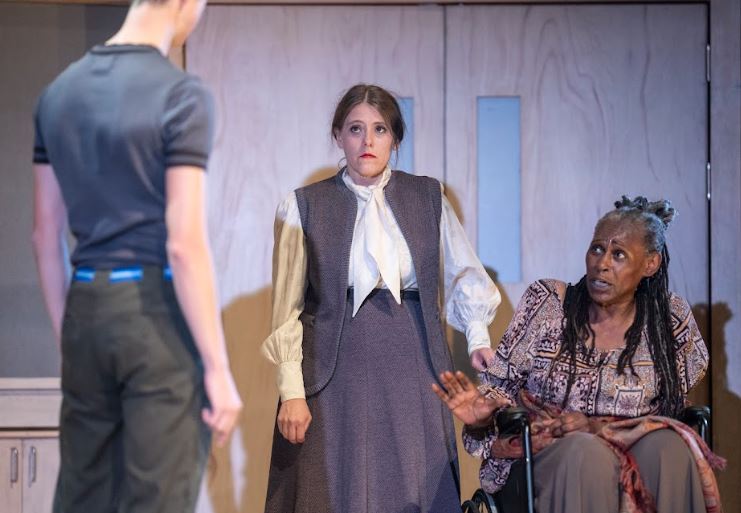
Ruth, now terminally ill from an unsuccessful donation, divulges that she has Madame’s address. Full of hope they Kathy and Tommy pay a visit to Madame, to discover that she and a frail Miss Emily are living in retirement. Tommy has brought his much improved artwork to show Madame. Then the truth is disclosed. Madame, who is Marie Claude, and Miss Emily were part of a movement that established Hailsham as model to improve the clones’ life and to show the world that they were human. The art was an experiment to illustrate that the child clones had souls. There is no deferment option.
The closing scenes are very moving, the final demise of Ruth, Tommy going to his fate, and Kathy now preparing to donate, and with her own carer, the bright and cheerful Terry. It is a skilful stroke to cast Maximus Evans, the actor playing Phillip, Kathy’s patient at the beginning, to play Terry in the final scene.
Never Let Me Go is a salient probing piece of slipstream fiction and this production shines a light to examine the slippery slope that we face in today’s world. Eugenics, a scourge of the mid-twentieth Century, comes creeping back. The rise of the far left, where a dehumanising state can even legislate away biological truths, points the way. Where abortion is accepted, and euthanasia soon will be, there the practices of farming human beings, donors to a chosen few, is more than a possibility. Where human life is devalued, the soul is too.
Virgil asserts that love conquers all, and that indeed is the message of the closing scenes of Never Let Me Go. Faith has proved a false friend in this scenario; hope is sunk like that bottomless boat; yet, with Paulian certainty, love remains the greatest of the three.
Mark Aspen, September 2024
Photography by Hugo Glendinning

 Mark Aspen
Trackbacks & Pingbacks