
Birdsong
Love and War
Birdsong
by Sebastian Faulk, adapted by Rachel Wagstaff
Original Theatre and JAS Theatricals at Richmond Theatre until 5th October, then on tour until 22nd February 2025
Review by Andrew Lawston

Tonight, Richmond Theatre goes back in time over one hundred years, landing in a period that everyone thinks they know very well. Based on Sebastian Faulk’s modern classic Birdsong, this new production of Rachel Wagstaff’s adaptation evokes France from 1910 to 1918 perfectly, and all performed against a single set of wooden slats, which is a staggering achievement given the action takes in everything from quiet country houses in Amiens to the Battle of the Somme. Thanks to pacy direction from Alastair Whatley, this three hour production whistles past in what feels like no time at all.
Retaining just enough of the novel’s contemporary plot thread to bookend the story, the play opens with a young man searching for a particular name in the war cemeteries of northern France. This provides some ominous foreshadowing to the adventures of Stephen Wraysford (James Esler, wonderfully dynamic throughout) as he visits René Azaire’s factory in 1910 Amiens, to compile a report for his guardian who wishes to buy it. The factory’s beleaguered workers are facing further hardship in pay cuts, and there are stirrings of unrest.
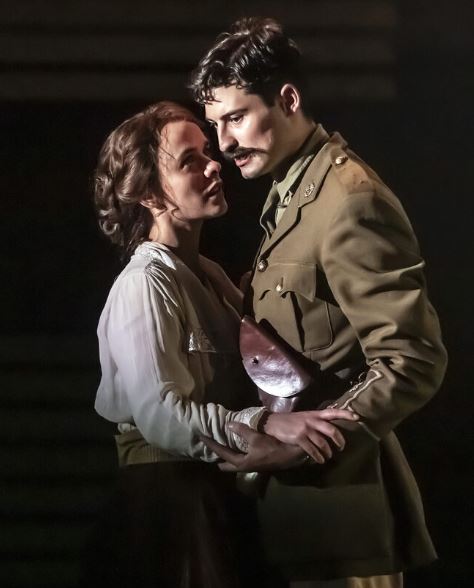
Industrialist Azaire (a clipped and menacing performance from Sargon Yelda) is suitably tyrannical, and his abused wife Isabelle (Charlie Russell, who conveys her character’s emotional turmoil through a wonderfully restrained and brittle performance) and Wraysford soon find themselves in a passionate relationship in scenes that inspired the audience’s main talking point during the first interval.
This first act, with Roger Ringrose providing occasional comic relief as the apparently avuncular but ultimately rather sinister town councillor Berard, and Gracie Follows giving an entertaining performance as the young Lisette Azaire (Rene’s daughter from a previous marriage), comes over as a relatively straightforward period piece, evoking everything from The Cherry Orchard to Germinal in its tale of complacent capitalists.
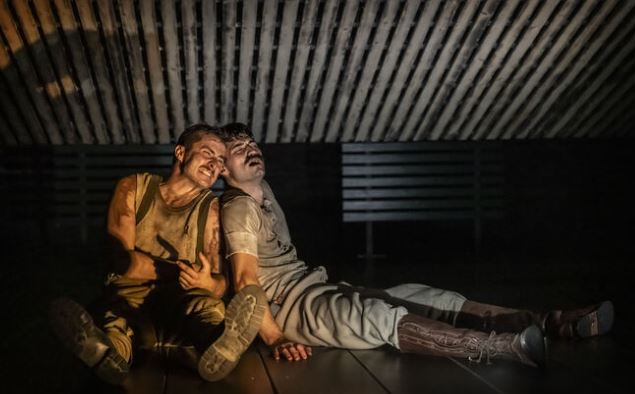
The second act switches settings drastically, however, to the trenches of 1916. With some clever changes to Jason Taylor’s lighting, Richard Kent’s set of wooden slats transforms from the high walls of a country house to the more claustrophobic setting of trenches, dug-out shelters, and long narrow tunnels.
Wraysford takes a back seat for a while as a new set of characters are introduced, primarily Max Bowden’s sensitive Jack Firebrace and his squad of sappers, or “sewer rats” as the naive new infantry soldier Tipper (Raif Clarke, who instantly endears himself to the audience) calls them. When Jack does encounter Wraysford, the officer is a long way removed from the earnest young man of the first act. His belief in fortune-telling, which seemed little more than flirtation in the Azaire house, has become something of a compulsion as he tries to read a rat’s entrails, to the bemusement of his men.

It is of course a minor point, but with a limited number of actors, one or two of the female cast don false moustaches to bulk out the soldiers on stage, and while this is a sensible and pragmatic decision, and the actors involved make every effort to move and blend in with their male counterparts, any audience member old enough to remember Blackadder Goes Forth, also set in the trenches of the First World War, will be hard-pressed not to think, “Bob,” every time they appear.
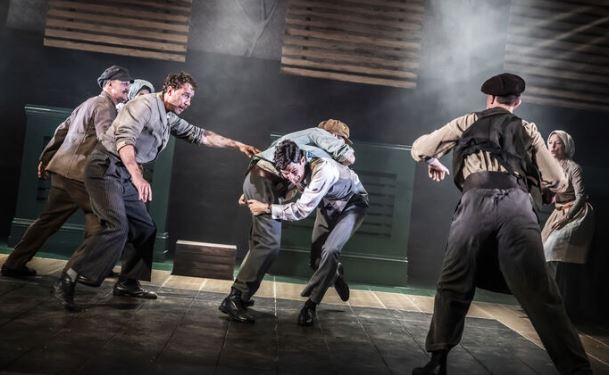
The initial camaraderie and bonhomie among the sappers and other soldiers provides some entertaining scenes, and also serve as contrast as the mood darkens. There are tragic explosions in the tunnels, and Firebrace receives bad news from home. As the second act curtain falls over the Somme, the sound effects continue well into the opening moments of the second interval, casting a subdued pall over the audience.
Director Alastair Whatley goes all out for the big action scenes, making full use of background music, sound effects, lighting, and smoke machines to evoke tunnel collapses, artillery bombardments, and pitched battles.
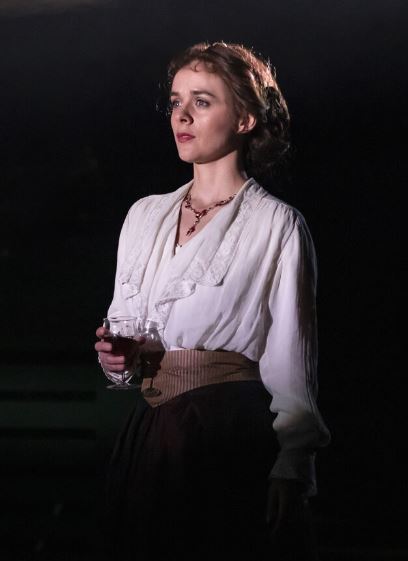
The third act moves the timescale forward again to 1918, and the very end of the war. The lingering question of Wraysford’s relationship with Isabelle is addressed, and Natalie Radmall-Quirke has the opportunity to develop her fleeting Act One performance as Jeanne Fourmentier, Isabelle’s sister.
Through superb acting and confident direction, Birdsong deftly handles the First World War without moving too far into sentimentality or nostalgia. The third act in particular shows the world beyond the front line and the trenches, where life continued throughout the conflict, and serves to bridge the period romance of Act One with the war story of Act Two, which had previously felt rather disconnected. The result is a powerful evening’s theatre with something for everybody.
Andrew Lawston, October 2024
Photography by Pamela Raith

 Mark Aspen