
Death and the Maiden
Quid Est Veritas?
Death and the Maiden
by Ariel Dorfman
Putney Arts Company at The Putney Arts Theatre until 19th October
Review by Claire Alexander

‘When crazy people have power you indulge them’ was the line that stood out for me during this brave production, by Putney Theatre Company, of the searing play Death and the Maiden by Ariel Dorfman. Set twenty years after the fall of the Chilean totalitarian regime of General Pinochet during the 1970s and 80s – a most unhappy period of Chile’s history – Death and the Maiden recounts one woman’s revenge on her own experience of torture and questioning during this most desperate time.
A word about the Pinochet regime – I visited Chile in late 1997 a few years after the fall of the seventeen year tyranny and the subsequent re-emergence of democracy. I visited the memorial to the tens of thousands of the ‘disappeared’ as those who lost their lives or the livelihoods for their beliefs or speaking up, became known. It was not in the guide books and took some finding, hidden in an obscure part of Santiago, mirroring a period of history this country would prefer to forget.
But if you have lived through it and have fallen to the Junta’s torture you never forget and Paulina Salas, the heroine of Dorfman’s play, has, for twenty years, tried to bury and live with her memories of being raped and tortured during these times. But they are violently triggered when a man, whom she believes to be the perpetrator of the crimes against her, turns up at her house having helped and rescued her husband from his broken-down car. The setting of course is in clashing contrast to the violent memories Paulina buries, a tranquil beach house where she now lives with her lawyer husband, who happens to lead the investigation into the crimes of the time.
Paulina is unshakeably convinced this now respectable doctor is the man who raped and tortured her and thus intent on ‘trying’ and killing him, as he had tried to do to her all those years ago. Her gentle husband Girardo is left to negotiate between the two and eventually the three reach the uneasy agreement that if Dr Miranda recounts and confesses to the crimes he is alleged to have committed against Paulina she will let him go. I will not spoil the suspense and the narrative for you, should you be lucky enough to have a ticket, suffice to say this is a raw and intense exploration of the very worst aspects of humanity when one woman tries to take the law into her own hands, questioning, as it does, how humans blindly allow such terror to continue – powerful examples of the Stanley Milgram social psychology research of the 1960s – in Miranda’s ‘confession’. He is paying the price as an individual for the crimes of the state. And Paulina stands for every wronged and ‘disappeared’ woman the world over.

Although Death and the Maiden is set within the context of Chilean history of the 1970s and 80s, sadly its questions of both personal and state justice, revenge and terror are as relevant today the world over and the quote I begin with ‘when crazy people have power you indulge them’ is both thought-provoking and only too true.
This courageous production by Putney Theatre Company is in their intimate studio space and makes the themes of the play even more powerful and confronting. And this is added to by the sympathetic set design by Rich Evans, which creates another stark contrast with the peace and seclusion of the Escobar’s beach house, nicely enhanced by the constant soundtrack, by Nick Wells, of waves breaking on the shore. And of course Schubert’s Death and the Maiden quartet which Dr Miranda played to make his victims experience less traumatic. Grim.
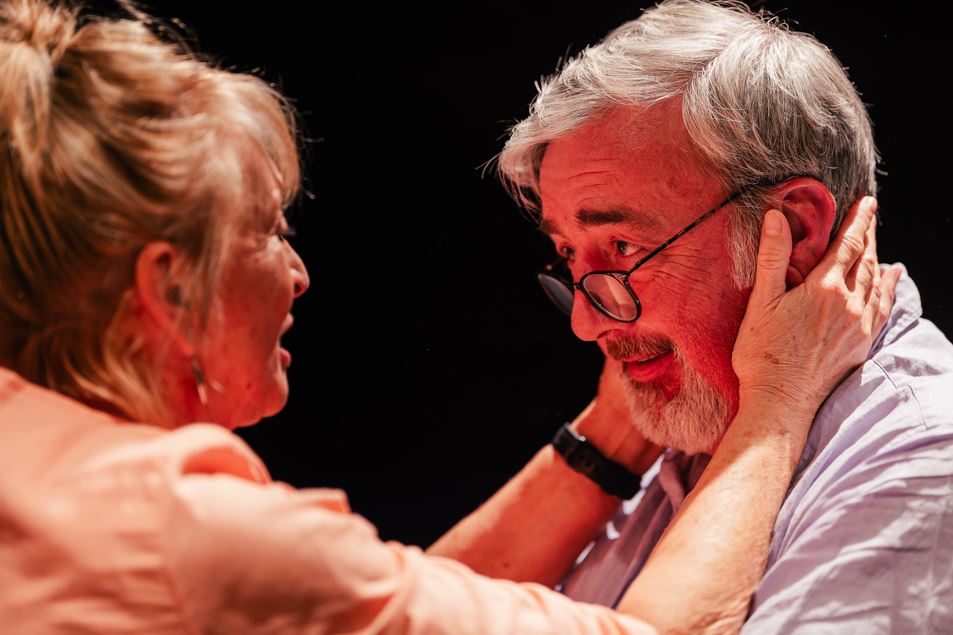
Of course an intense play like Death and the Maiden stands or falls by its actors. In this production all three gave committed and courageous performances. For me, the performance of the evening undoubtedly came from Paul Dineen as Dr Miranda. Required to spend much of the first half of the play bound and gagged is demanding in itself but this performance was unflinching and totally magnetic. Throughout you could see his reactions to what was being said, in his eyes alone. Even in this claustrophobic space he never once lost concentration and his presence was real, mesmerising and incredibly powerful. His spoken ‘confession’ in the second half was chilling in its honest simplicity. I may be being picky but, whilst the hysteria and trauma was very evident, I wanted a little more stillness and supressed anger from Sharon Czudak as Paulina. This would have created an interesting balance against Miranda. Aidan Kershaw gave a gentle and well-studied performance as Girardo, nicely bringing out his conflicted loyalties between his wife’s actions and his belief in the more orthodox approach as a human right’s lawyer. Perhaps it was the power of Dineen’s performance or maybe it was what the director or Dorfman himself intended but I found my sympathies being pulled towards Miranda as the narrative progressed. This in itself was disconcerting, as surely Paulina is the wronged one, or is she? The end is all the more powerful in its ambiguity, well handled by director Kim Dyas in this production. Dorfman has written an incredibly thought-provoking play as relevant now as it was in 1990s Chile. It deserves to be the classic it is.
I applaud Putney Theatre Company for such a convincing production. Under the assured direction of Kim Dyas, and assistant Veronika Wilson, this is indeed a compelling and impressive production. Not only with totally believable performances but leaving the audience with many questions about our human frailties.
Claire Alexander, October 2024
Photography by Steven Lippitt

 Mark Aspen
I agree! I remember sitting there and thinking: I can’t believe that Paul can say so much with only his eyes!