
The Pillowman
Murky Depths
The Pillowman
by Martin McDonagh
The Questors at the Questors Studio, Ealing until 19th October
Review by Brent Muirhouse

Despite the fluffiness eluded to by the title, Martin McDonagh’s The Pillowman is not comfortable. Thrust into an unsettling world where storytelling and terror are one and the same, the opening moments, played out against a stark, oppressive set — bare walls, a cold interrogation room — immediately signalled that the not even the plushest of pillows would soften many of the blows of the play’s nightmare scenario playing out. Through the direction of Roger Beaumont, the Questors audience in Ealing were invited to confront a symbiosis between the art of storytelling and the horrors it can both depict and perpetuate.
From The Pillowman’s first exchange between Katurian (or Katurian Katurian Katurian to give his full name, played with great presence yet fragility by Rory Hobson) and his police interrogators Tupolski and Ariel, the play’s black comedic undertones writhed uncomfortably under the surface of the narrative, which soon unfurled into a narrative of horror. We learn that Katurian is an author, but soon learn he writes morbid, child-murder-filled tales, masterfully balanced the fragile line between victim and villain, with each monologue delivered like a ghost story told at midnight—captivating, chilling, and laced with menace. His ability to draw out nervous laughter from the audience, only to extinguish it with a chilling revelation, speaks to the power of McDonagh’s writing in full force.

The supporting cast was equally worthy of praise for keeping the narrative within the brilliant margin of the finest of lines between unspeakable and must-be-told. Simon Roberts as the brutish yet bizarrely charming detective Tupolski (a sort of dystopian law and order version of Ray Winstone) provided much of the comic relief, his deadpan humour landing with expert precision, while still managing to maintain a palpable sense of threat. Counterbalanced by the volatile performance of Dan Dawes as Ariel (a sort of dystopian law and order version of a high energy Vampire’s Kiss-era Nicolas Cage), the two created a psychological pressure cooker, in which every exchange with Katurian seemed like a game of Mouse Trap, only one small shake away from seemingly random coloured pieces getting set off in ordered chaos. Throw into the mix Katurian’s brother Michal (the excellent Adam Hampton-Matthews), in the next interrogation cell, the question was when, not if, that final red cage would drop from a great height down a crinkly yellow tower and trap that plastic mouse, and of course the jeopardy of the question which of McDonagh’s characters was to be the ill-fated rodent.
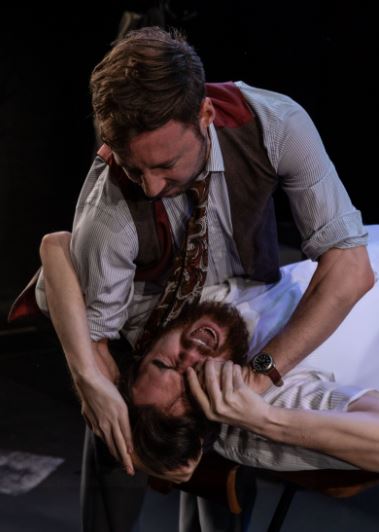
The macabre humour, if such a thing exists, of The Pillowman is unlike anything you might encounter in a typical black comedy. The laughs were often in timing or a cleverly written joke, but few didn’t have the recourse to make you shudder in retrospect. Much like some of McDonagh’s other work, there is some language that is designed to be striking but perhaps needs to be handled with some changes to avoidable offence, two decades after its original release. Nonetheless, this doesn’t detract from the production’s pacing; tightly wound like a suspenseful thriller befitting of more typical crime investigation of a Line of Duty, a Poirot or a Wallander, allowed little room for the audience to exhale. In response to this, at several moments the person next to me gasped and drew air like a surprised swimmer between strokes. It says a lot that, on reflection, moments of respite were still haunting bedtime stories (the eponymous Pillowman) and laced with an underlying threat as part of the interrogations. If you laugh, you do so glancing over your shoulder, wondering when the laughter will be turned against you. It was more like skating on a cloud than on thin ice, because there was no ‘maybe’ about the onrushing peril.
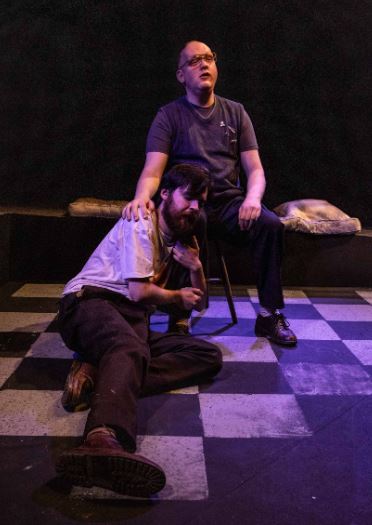
Visually, the play was striking in its minimalism. Philip Lindley’s set design used absence rather than presence, with every unlit corner of the stage feeling like it concealed something terrible (which within the story, to be fair, it usually did). Lighting designer Martin Walton played beautifully with shadow, using it to heighten the sense of paranoia and fear that lurked within the script. The use of light and dark wasn’t just aesthetic, but symbolic of the moral ambiguity that McDonagh revels in. Having recently reviewed his comparatively lighter black (steel grey?) comedy The Hangman, it is much like that story in that there are no clear heroes here, only complex, deeply flawed characters who wrestle with their own demons.
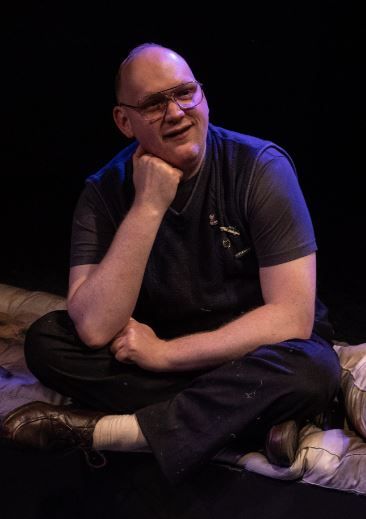
By the time the final scene arrived, after two intervals and notably a handful of audience members absent from their seats after feeling affected by the uncomfortable scenes (including my inhaling neighbour), the full weight and consequences of Katurian’s stories came crashing down, and the audience was left stunned (before snapping out of it and into a rapturous applause with several standing ovations). This production of The Pillowman was like an untitled Jackson Pollock representing art, violence, and morality blurring and splattered until you can’t tell where one ends and the other begins. The brilliance of McDonagh’s play lies in its ability to simultaneously disturb and entertain, to provoke thought while making you laugh uncomfortably. It’s a testament to the cast and Beaumont’s direction that this production captured all the bleak wit and philosophical darkness that the original award-winning text demands.
The Pillowman at The Questors Theatre is, like an octopus winning an Olympic medal in the murky ocean’s depths: an inky-black triumph. It’s a production that will haunt you long after the lights go out, and one that reminds us that the stories we tell — especially the darkest ones — have a power all their own. As I left the theatre, the cold October air did little to shake the unsettling feeling which stayed with me under the streetlights of suburbia.
Brent Muirhouse, October 2024
Photography by Robert Vass


 Mark Aspen
Trackbacks & Pingbacks