
Gay Pride and No Prejudice
Twist and a Laugh
Gay Pride and No Prejudice
by David Kerby-Kendall
Stephen Leslie Productions at the Union Theatre, Southwark until 2nd November
Review by Gill Martin
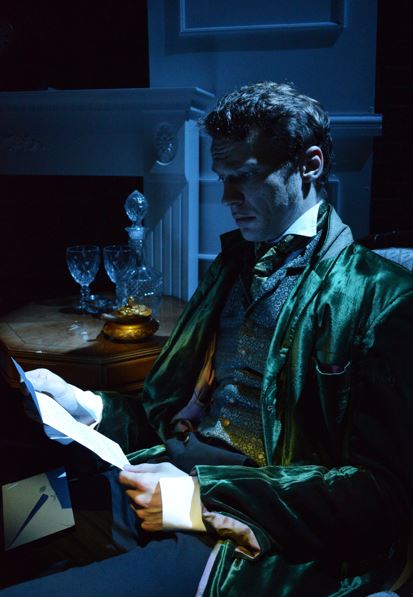
It’s certainly a twist and a half from Jane Austen’s perennially popular book Pride and Prejudice. A sassy script thanks to David Kerby-Kendall’s clever re-working and Steve Leslie’s light touch in his London debut as a producer create a masterful comedy Gay Pride and No Prejudice.
Austen’s book, written in 1796, sold twenty million copies and became inspiration for TV series and movies, a timeless romance with a cuttingly sharp wit. The social issues of that time resonate centuries later: love, marriage, passion, wealth, status, ambition, keeping up appearances, gossip, family dynamics. And to that list we can add homophobia !!
The family under Austen’s scrutiny are the Bennets of Hertfordshire, the head of which is the long-suffering and amiable Mr Bennet, his socially ambitious wife Mrs Bennet, and on stage just two of their five daughters, the demure Jane and feisty Lizzie.
The Bennets are a delight, ripe pickings for humour, at times deserving derision, sympathy or admiration. The play fizzles with wit thanks to writing by Kerby-Kendall, with the actors, director Luke Fredericks and production designer Bob Sterrett all breathing fresh life.

It is batty Mrs Bennet’s familiar line that sets the scene for this comedy of manners. ‘It’s a truth universally acknowledged that a single man in possession of a good fortune must be in want of a wife,’ she gushes.
She has just heard the news that such a man, Charles Bingley, played by the devastatingly handsome Noah Butt, has moved into the neighbourhood. He and his £5,000 a year fortune, which could raise the Bennets from genteel poverty if they succeed in marrying him off to one of their brood.
Mrs Bennet, charmingly played by Marianne March, can barely contain her delight in sharing the news with her husband who, in turn, can ‘barely contain my euthanasia.’
Writer Kerby-Kendall also takes the part of Mr Bennet. (And why not?) It’s a role he plays with dead pan sangfroid.
The outspoken and headstrong Lizzie, convincingly played by the pertly pretty Sophie Bloor, scorns the idea of settling for an arranged marriage of convenience, arguing for love, respect and equality.
Sweet sister Jane, played by Sophie Bradley, who bears a passing resemblance to a young Renee Zellweger with no need for Bridget Jones’s big knickers, is more conventional, even happy to spend the rest of her life darning socks … and is so more likely to ensnare Bingley when he hosts his first ball.
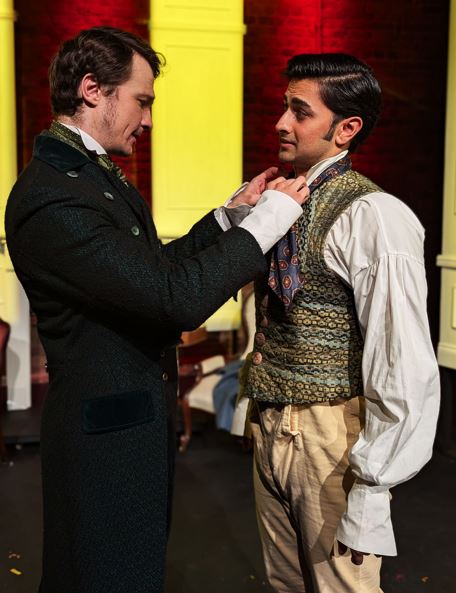
And the Bennets shall go the ball. As will Bingley’s dear chum Darcy, played with world-weary cynicism by Michael Gillette, who ‘should rather place his penis in a jar of jam and stand in a swarm of bees’ than attend.
Darcy’s default setting is entitled truculence, rude and dismissive. He meets his match in Lizzie, in the throes of writing her first novel about a woman entering politics. ‘A comedy then?’ Bingley suggests.
Darcy has loved Bingley since they were boys, initially playing innocent childish games but now dangerous desire takes over, consumed by a love that in 19th century England ‘dare not speak its name.’
Bingley has accepted society’s rule that two men must never be together, so attempts to fall for the amenable Jane, asking Mr Bennet his feelings about marriage. ‘Mrs Bennet and I were deliriously happy for 18 years…and then we met,’ is his response.
Comedy is always to the fore in this hugely engaging and thought-provoking show, played to receptive audiences in a tiny 70+ seater fringe venue with a bustling bar. But there are shocks too: forbidden passion discovered, taboo love eliciting a mixed response of disgust, repulsion, rejection and acceptance.
Producer Leslie was immediately hooked when writer Kerby-Kendall contacted him last year. ‘It was the title of this wonderful show which grabbed me,’ he recalls. ‘As well as being a brilliant twist on the Jane Austen classic, it conveys such a strong and important message and I immediately knew that this was a play I wanted to produce.
‘This is a play which entertains and delights but reminds us that, whilst there have been significant steps forward since 1812, inequality and oppression in our society still exists today. It is a message which needs to be shared, and shared again, and again. I truly hope this production can make a positive impact in challenging attitudes and inspiring further positive change.’
Mini-plot spoiler to this top star rated production: who would guess that there are more than two characters who profess a forbidden love?
Gill Martin, October 2024
Photography by Lucy Nixon
First published in Belle about Town on 21st October 2024, and reproduced with permission.

 Mark Aspen