
Arden of Faversham
‘Ardening of Hearts
Arden of Faversham
by William Shakespeare et al
Richmond Shakespeare Society at the Mary Wallace Theatre, Twickenham until 2nd November
Review by Salieri
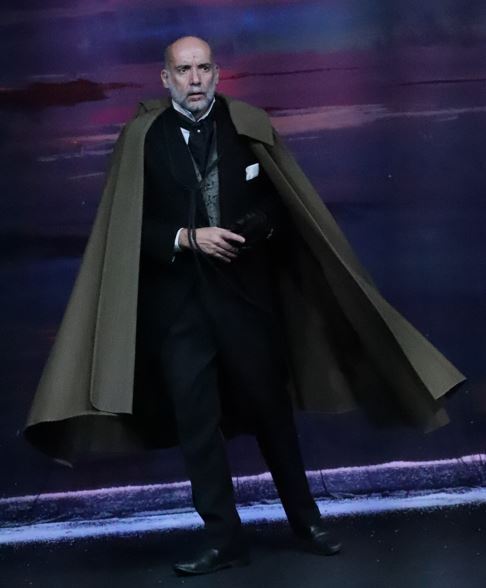
My first task must be to congratulate Richmond Shakespeare Society for selecting their 2024-25 Season to include this 16th Century play with basically unknown authors, although one of which is suggested as being Shakespeare, but I do not intend in this review to discuss whether Will had any hand in it. In fact I saw very little of him from the script’s point of view. In any event it is the performance at the Mary Wallace Theatre that is more important.
Arden of Faversham is described as being a domestic tragedy, and it is based on a true story involving Arden and his wife Alice, who intends to murder her husband so she can elope with her lower-class steward lover. When the curtains open we see just a bare stage; in fact, an actual set is not necessary, as the action takes place in various locations, so occasionally items of furniture are brought on by the cast, as and when they are required. The production is set in late Victorian England, which seems to me to be quite acceptable as the storyline does not necessarily mean it has to be Elizabethan.
The production itself was bleak and relentless, with hardly any lighter moments. Overall, the pace was good; the play “moved”, but had little attack, and diction was often poor. Some of the cast were inaudible at various points throughout the play, and the verse was often not well spoken. More attention should be paid much more to this vital aspect. As a result, many important moments in individual scenes lost their impact. The chief culprit was Alice Arden (Fleur de Henrie Pearce), who became so quiet in many places that I could not hear what she was saying at all. Indeed, her character did not come across as positive enough to account for what surely should have been her passionate desire for revenge on her husband. Her lover, Mosby (Matthew Tyrrell) was vocally powerful, so we had a balance problem in their scenes together. Tyrrell gave a sound performance, but it would have been even better without the Cockney accent. Not all stewards were born within the sound of Bow Bells.
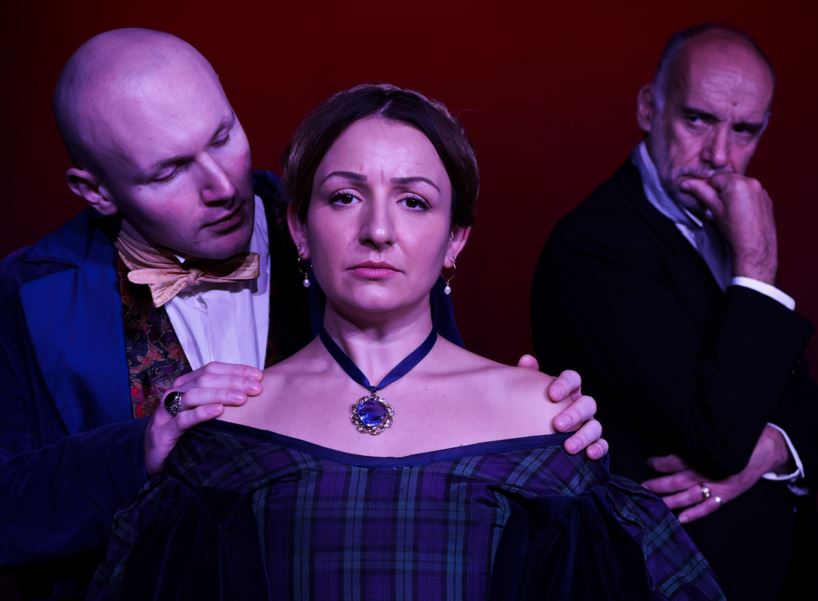
Arden himself is not a particularly interesting person. The character is not well written, and we cannot really believe in him, nor can we sympathise with him. The actor thus has a difficult time ahead, but Simon Bartlett made a valiant attempt and managed as well as he could. His death-scene was badly handled and the fight choreographer needs to get his act in order.
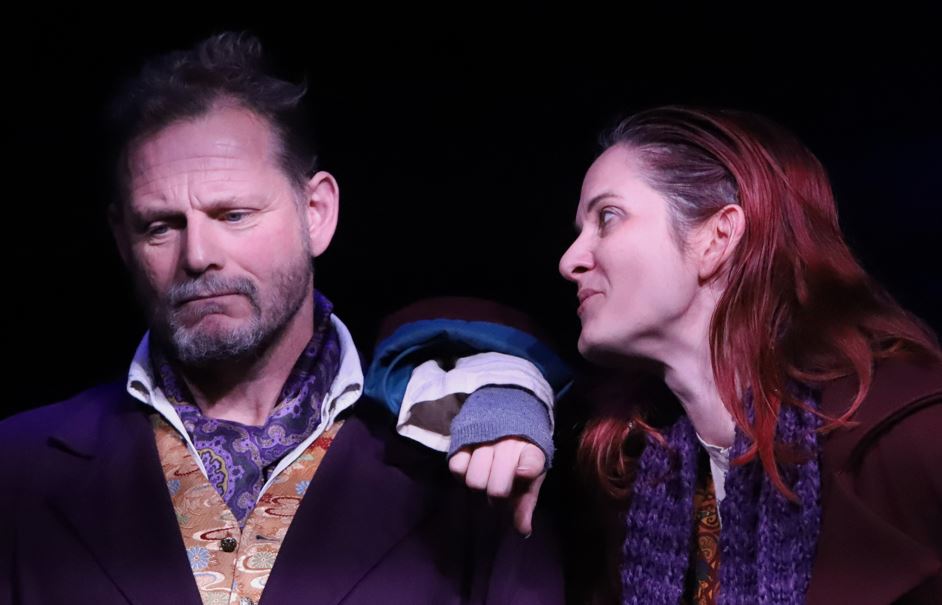
The star part was Nicola Doble as the villain Black Will. She erupted on to the stage with tremendous attack, and the audience sat up accordingly. In the second half, she nearly started to go just that bit too far, but her energy was infectious and contrasted with a lack of such in many others in the cast. Sadly, her sidekick (Shakebag) was not up to her standard, so they did not really become a double-act
However, it could easily have done so – indeed needed to become a double-act – and here I must make my major criticism: there is some comedy in this play, as director Gerald Baker states in his programme notes, but I sensed none at all here. However bleak Shakespeare’s tragedies are, there is always some lighter or even comic interludes present. Think of Osric in Hamlet or the Clown who gives Cleopatra the asp. I feel that there were many places in Arden of Faversham which could have been presented with some light-heartedness, which would make the final dénouement more dramatic. Perhaps this is another reason for rejecting a Shakespearian connection.
Other performances to note must surely include Fran Billington as Franklin (in the original text a male, but it worked here). She gave us some calm and common sense in a world where that was fast disappearing. Stephan Mirre as Michael is also one who made a good job of a part which did not provide him with overmuch material, but enabled him to appeal to the audience, which he certainly did.
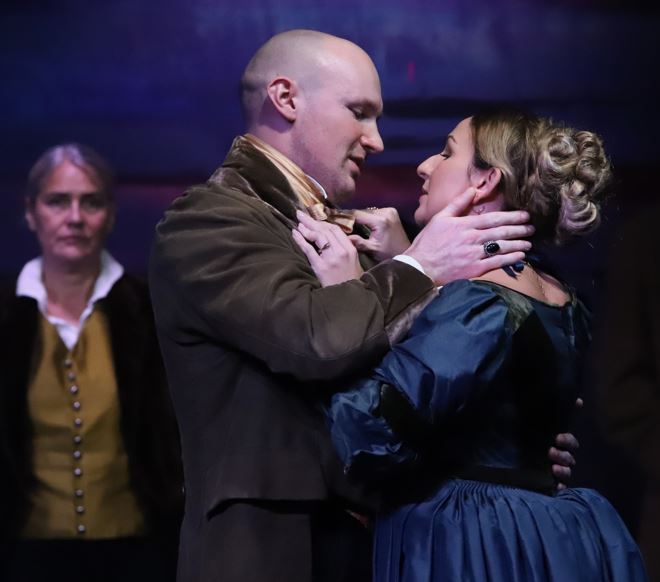
There were confusions. For reasons I could not understand, a number of the cast proceeded from stage left to stage right at the back in subdued lighting on a number of occasions. The Guide in Hell (a solid performance from Rose Bentley) appeared at the very beginning where everyone lined up, for her to bring each one downstage to introduce us to them, and enable us to follow what role they were to play in what was to come. After all this, it was uncertain what her remaining role was, which seemed to lead to an avenging angel at its very ending. The programme gives a cast headline “In Hell” listing Bentley as the Guide.
This has not been an easy production to analyse and review, and I was never sure what the Director’s aim was. We accepted the fact that those involved were mostly all executed in the “death-roll”, which formed the epilogue, but where were we supposed to go from there? I have unearthed past production plots, all of whom finish with the executions. I have not been able to find any references in past productions to “the Guide in Hell”, which seems to be a Faustian reference. The origins of the play are shrouded in mystery and if this is part of Gerald Baker’s adaptation, I take my hat off to him, but like the play, it is still a mystery.
Salieri, October 2024
Photography by Simone Best

 Mark Aspen
Thank you very much for your review. However, I have to disagree that the cockney accent from Mosby would’ve made the performance any better. Yes I agree, not all stewards were born speaking as such, but Mosby came from a very rough background originally (as I established in his backstory), and so still would’ve needed to have somewhat of an accent.
There are many other things I disagree with but I shan’t bore you with the details. Once again, thank you for your review.
Thank you very much for your review. However, I have to disagree that the absence of the Cockney accent from Mosby would’ve made the performance any better. Yes I agree, not all stewards were born speaking as such, but Mosby came from a very rough background originally (as I established in his backstory), and so still would’ve needed to have somewhat of an accent. Plus, this was something requested of me by the director, Gerald.
There are many other things I disagree with but I shan’t bore you with the details. Once again, thank you for your review.
For me this was a very successful production of this fascinating Elizabethan play – the first known domestic tragedy in British drama. I felt Gerald Baker had done a brilliant job in catching the spirit of a play with a large cast of characters which switches almost without warning from knockabout comedy to sheer horror. I went with someone who knew nothing about the play beforehand and found the production both lucid and engrossing. I had wondered myself before curtain up if the Hell concept would work but it provided a staging which gave a clear uncluttered setting and style to the play and the characters trapped in their various obsessions. I read a review afterwards of the last RSC production which apparently went for the black comedy and modern dress with Alice as a scheming Essex girl. I am so glad we saw this production instead. Even the weaker performers had a sense of purpose and knew what they were saying and why – while Mosby and Alice did full justice to the scene where they nearly break up (which I believe is the scene most confidently attributed to Shakespeare)
I beg to disagree with the above review. Despite having ‘older ears’ and in contention with very loud music from a neighbouring pub (Saturday, post match!), I had no problem with the audibility, diction or clarity of any of the performances, all of which I felt were convincing, from main to ‘minor’ characters.
The intense environment of such a small venue worked well to amplify the sense of claustrophobia, with characters damned by their desires to a cyclical Hell of their own making. The stark backdrop, lighting, and gauze were well chosen to reinforce this; the ominous Guide pacing across the stage, silently surveying the characters as they blundered, at times comedically, towards their inevitable destruction.
As well as revenge tragedy, I saw elements of the medieval morality play in ‘Arden of Faversham’: in this tradition, characters need have little depth precisely because their role is allegorical; embodying the seven deadly sins as a warning lest we succumb. Morality Play plots can seem mechanical and puzzling to modern audiences and having read Arden of Faversham beforehand, I was unsure how well it would work in performance. I needn’t have worried: strong performances, humour, imagination and, of course great entertainment resulted in an excellent production. Well done to all!
I was very surprised to read the review by Salieri. I saw the production on Saturday and left the theatre feeling that I wanted to congratulate the cast and the director on a very strong production. I read the play before I attended the performance and found that it is really rather a poor play (to which would hate to ascribe to the Bard any involvement) but I felt it was very creditably performed and sustained my interest. I had no issue with accent and thought that a taciturn Shakebag was in excellent contrast to the rumbustious Black Will. This is a production that I would have recommended to others had I seen it earlier and has caused me tell people how good I thought it was. Congratulations!