
Abigail’s Party
Beverley Ministers
Abigail’s Party
by Mike Leigh
Northern Stage, RTK et al at the Rose Theatre, Kingston until 16th November
Review by Steve Mackrell

What is there left to say? Here’s an established play that’s stood the test of time, been analysed, dissected, criticised and praised. Seeing it again is like visiting an old friend, nostalgic, familiar and fun. After countless revivals over many years, another version of Abigail’s Party has arrived, this time at Kingston’s Rose Theatre. Originally devised and directed by Mike Leigh, and developed through improvisation, the play originally opened at the Hampstead Theatre in 1977.
For those new to the play, there is always the excitement and curiosity of seeing a production for the first time – a journey into the unknown. Conversely, for those who know the play, the journey is somewhat different. It becomes more a question of how the play is presented, how it’s aged and how, or if, it’s been re-interpreted by the director. Happily, with a fresh vision from a young director, the play has aged graciously and continues to deliver a rich mix of comedy and irony.
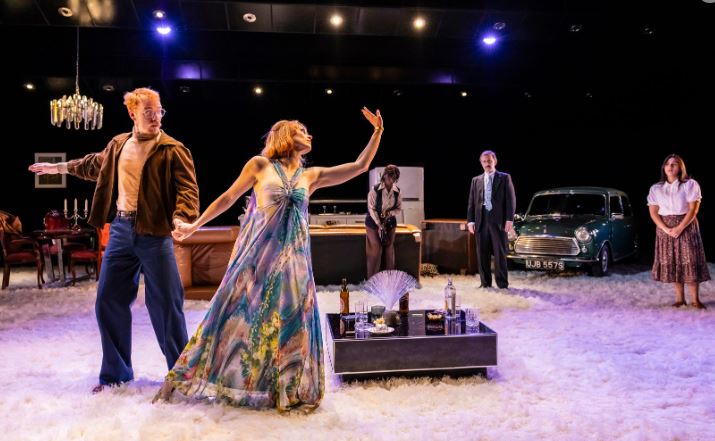
The play itself is very much a comedy of manners, lampooning the behaviour of the suburban middle-classes through the prism of a cocktail party, where five contrasting and mismatched characters are thrown together. Of all the grotesque characters, the greatest part must surely belong to the hostess of the party, Beverley Cross, perhaps one of the most iconic female roles of the modern era. The role was, of course, made famous by Alison Steadman in the 1977 BBC television adaptation.
The play itself centres on Beverley and her husband Laurence, who have invited their neighbours for an evening of cocktails. The guests are Angela and Tony Cooper, who are new to the area, and another neighbour, Susan. Abigail herself we never see, but she is Susan’s daughter who is holding a noisy party next door. As the evening progresses and many drinks are consumed, the initial uneasy small talk is replaced by darker conversations with awkward social interactions, uneasy pauses and the exposure of frustrations and insecurities. With Beverley’s flirtations, the tensions rise, and the evening slowly descends into chaos.

In this production, directed by Jack Bradfield, the self-centred Beverley is played with a bubbly charm by Laura Rogers, creating a character that is the epitome of the monster suburban housewife. An ex-beauty consultant, this is a woman who is an aspiring social climber but thinks Beaujolais should be put in the fridge, a woman bored rigid with her socially awkward husband, and a woman who dreams of romance while dancing seductively to the sounds of Jose Feliciano with California Dreamin’ and Light My Fire. Her long-suffering husband, Laurence, is played by Leander Deeny, a man whose personality is dwarfed by his wife but who recognises the finer things in life, such as art and literature, but without understanding them. With a world-weary walk, this is a well observed performance capturing the frustrations of his marriage to Beverley, and a character who probably loves his car more than his wife.
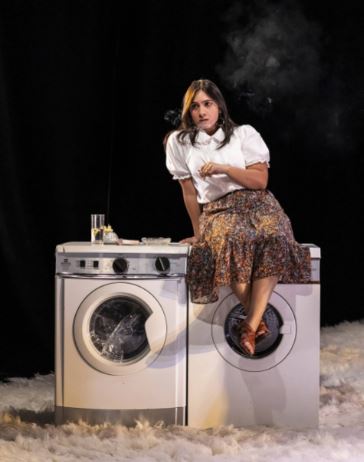
The visiting couple are played by Joe Blakemore (Tony) and Chaya Gupta (Angels), she a chirpy but tactless nurse, he short of conversation, a possible abuser but a useful ploy for Beverley’s flirtation, rousing her husband’s jealousy. Amy Rockson played Abigail’s mother, Susan, and in one very enjoyable scene, the three women sit together on the sofa ruminating about the shortcomings of men. Indeed, in Jack Bradfield’s interpretation it was clear that while the female characters were lively, talkative and inquisitive, the men in contrast were dull and taciturn. His direction was full of movement, with moments of farce brought to life by five very spirited performances.
What options then, for a director updating a play written nearly fifty years ago? Especially a well-known comedy about the social manners of that time. For example, could it be re-set to the present day? Probably not, so better to leave it frozen in time, since an update from the 1970’s to, say the 2020’s, would simply lose the comedy. As with other classic comedies of their time, they only work in the original era in which they were set. Just as Lady Bracknell is forever enshrined in the 1890’s, and Sibyl from Coward’s Private Lives is permanently stuck in the 1930’s, so Beverley is marooned forever in the 1970’s.
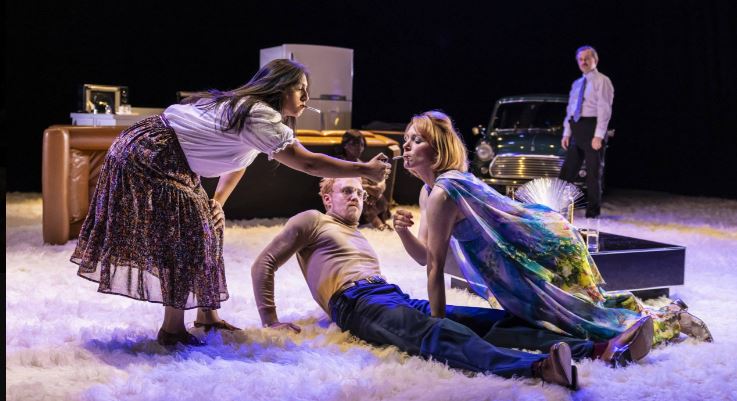
What vision then, can a new director bring to the production to help keep the piece alive? In this case, it’s a renewed sense of energy with a dynamic cast attacking the script head-on and accurately capturing the wit and foibles of the characters.
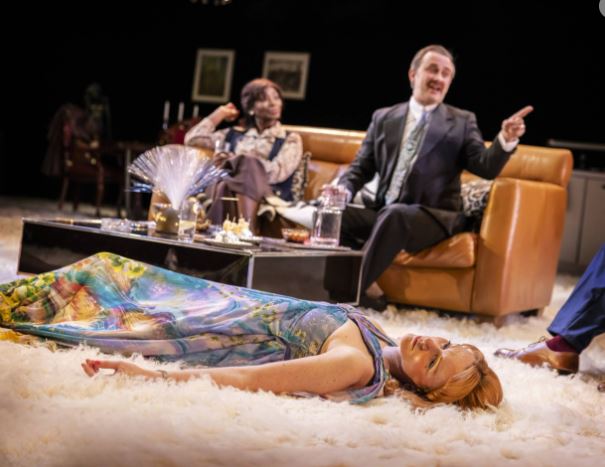
Another fresh vision is the creative set designed by Anna Yates. Gone was the usual closed box set to be replaced by an inventive open stage. This was a set without walls – kitchen, dining room, living room, utility room, garage and even the loo were on open show. At the back of the set was another star of the show, the Cooper’s car – an actual green mini of the period – UJB 557S (but, for purists, without a tax disc on the windscreen!). Beverley’s fully-fitted kitchen was also on show, full of new-fangled labour-saving gadgets that Beverley was famously incapable of using. Then, in the foreground, the main living area with all the trappings of the Cooper’s shallow and pretentious lifestyle – white shag carpet throughout like a layer of snow, the drinks cabinet, the record player, the three-piece suite complete with zebra print throw and, of course, bottles of Bacardi, LP’s and a tray of cheese and pineapple on sticks. Also complementing the production was Jaimie Lu’s sound design with dramatic music ranging from repetitive techno beats to Beethoven’s Fifth.
Did this production live up to expectations? Opinions will vary but, for me, still as funny, still as tragic and still as memorable as ever. A refreshing revival.
Steve Mackrell, November 2024
Photography by Pamela Raith

 Mark Aspen