
1984
My Truth
1984
by George Orwell, adapted by Ryan Craig
Theatre Royal Bath Productions at Richmond Theatre until 16th November, then tour continues until 23rd November
Review by Mark Aspen
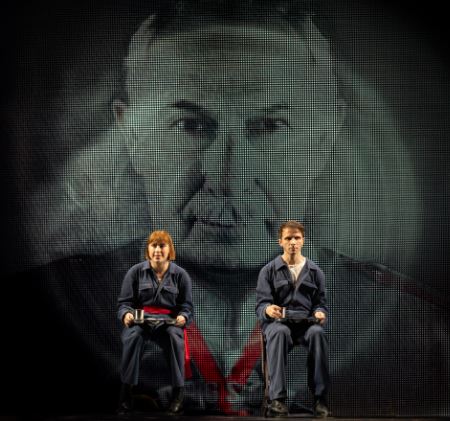
On the motorway driving down from Manchester over the weekend, a message pinged up on my dashboard, “Driver Alert! Take a break”. This may be a benign example, but it’s a little scary to think that the car you drive is spying on you. But this led to a train of thought: as we move to a cashless society, the plastic in our wallets watches us; then our mobile phones know where we are; and moreover, every street bristles with surveillance cameras, not just the motorway. What a gift this is to any repressive government that may force itself on a country!
But then again, there is the even greater danger of a gradual creep towards a Big-Brother totalitarianism. Surveillance is one thing, but we already have thought-crimes, historical negation and doubletalk, even in a democratic country like Britain, where freedom of expression is under threat. And more people work for big government, directly or indirectly, than for the private sector that creates the wherewithal for our everyday lives.
It is therefore very timely that Ryan Craig’s adaptation of George Orwell’s cautionary tale, his last novel, the dystopian Nineteen Eighty-Four, should be on national tour as a stage play, 1984.
Theatre Royal Bath’s 1984 is far from a comfortable night at the theatre. It is a play whose message hits very hard. It stings so sharply that it is often difficult to watch, but watch it you must. It is totally engrossing, with every emotion finely crafted, and all powerfully presented with consummate unadorned directness.
An uneasy atmosphere of vulnerability is created even before the play starts. The malignant, glassy gazes of video-cams scan the audience, watching and ensnaring.
Our slightest movements are projected on a big eye-shaped screen that dominates the bare stage. Justin Nardella’s minimalist design perfectly fits the atmosphere, with stage items simply trucked in, whilst backdrops are largely projected. This setting perfectly fits the atmosphere, and allows for an open stage where figures wait, watching. In fact, and fittingly for a plot featuring surveillance, much depends on the bold use of video, which is skilfully realised by Stanley Orwin-Fraser.
An ensemble (Lewis Hart, Paul Sockett, Niamh Bennett), who are the shadowy background figures and reinforce the stage crew, play various on-stage characters, including the Party members and the brutal security team, guards and torturers.
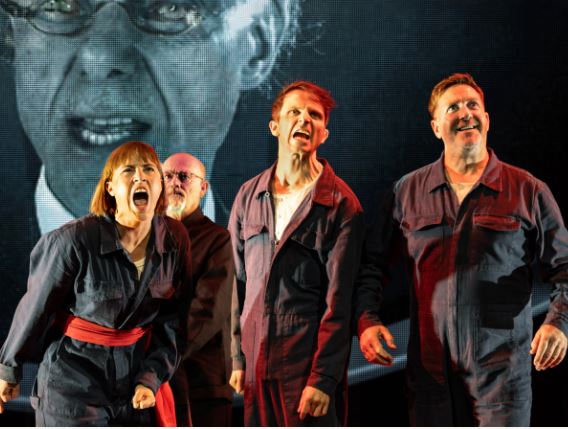
Over half of the cast never appear on the stage, but are seen and heard, larger than life as pre-recorded footage on that all-seeing eye screen. These include two of the characters who drive the plot. Emmanuel Goldstein, once one of the Party’s top men, now the counter-revolutionary figurehead, or maybe ostensibly so, for in this world of mirrors where nothing is as it seems, this archnemesis could be a set-up to act as the focus for the people’s whipped-up venom, as seen in regular collective rants against his image, the “Two Minute Hate”. Finbar Lynch plays Goldstein as a gaunt and flinty figure, adamant in his dissidence. And of course there is Big Brother, the all-powerful leader, around whom a personality cult is built by propaganda, coercion and fear; think Fidel Castro or Mao Tse Tung. We only see Big Brother towards the end, when Nicholas Woodeson portrays him as an apparently genial figure, but whose short speech has the sting in the tail, veiled threats to toe the line. The moustachioed Woodeson’s Big Brother is clearly based on Stalin, the arguably the most prolific killer the world has ever known.
Secondary characters appearing on that buzzing screen, include Gladwell; Ampleforth, Winston Smith’s colleague in the Records Department, who expunges all details of those who become “un-persons”; and Syme, an ex-colleague in the Ministry of Truth, tasked with reducing the language to a glossary of permissible words, those the most bland. All are clearly paraded to give false confessions of disloyalty, coerced from them by force. The three actors, Oscar Batterham, Mathew Horne and Zubin Varla respectively, all skilfully show the duplicity of their messages delivered under duress, and most subtly their fear, barely supressed.
The four actors play the main protagonists live on stage, interacting also with the pre-recorded actors on screen. This is no mean feat of coordination, as there is then no wriggle room in the script, but all act seamlessly and naturally with their virtual cast members.
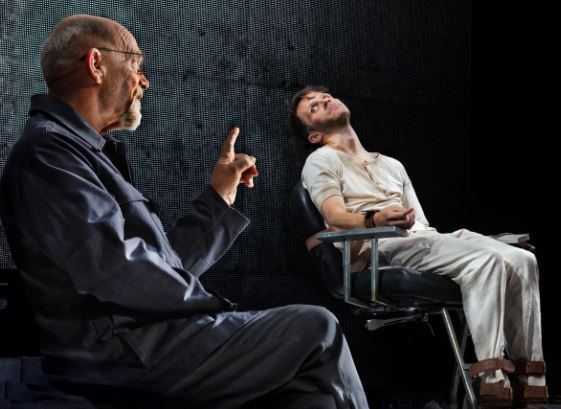
The anti-hero of 1984, Winston Smith, works at the Ministry of Truth, a middle-ranker in its hierarchy. Secretly he loathes the repressive regime under which he works and lives. However, he makes the mistake of writing his thoughts in a diary, and nothing escapes the tight surveillance of the Party. Mark Quartley plays Winston as earnest and phlegmatic, and never pushes his demanding part into overacting, even when Winston is the victim of torture.
Oh yes, torture is enacted explicitly on stage, and with a realism that is harrowing to watch. However, and here is a coup de théâtre: director Lindsay Posner has the infamous Room 101 scene with Winston facing his greatest fear, that of rats attacking him, almost totally in darkness. Horror works even better when it is in the imagination, and indeed it is Winston’s imagining being devoured by rats that is a greater horror psychologically than the physical torture that he has just endured. Posner’s juxtaposition of the explicit and the implied has huge impact.
Winston is entrapped by O’Brien, who is in fact one of the inner circle of the Party, but who poses as a senior member of the dissident counter-revolutionary resistance. The enigmatic O’Brien is played with precise emotional balance by Keith Allen, who creates an unpredictable character, urbane yet insouciant, an iron fist in a very soft velvet glove. Beware his frown. His is the torturer who knows his etiquette, and even more terrifying for being so.
As well as his thought-crimes and his being disloyal to the Party, Winston is also being punished for being human. Family, relationships, romance, love are all repressed under Big Brother, but these emotions are not easily quashed.
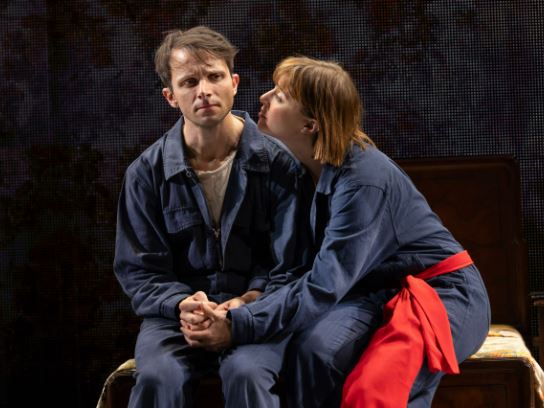
Julia is a young woman who appears to be a staunch Party member. She is one of the most vocal in the regular Two Minute Hate sessions. Moreover she is very active in the Party’s Anti-Sex League. However, all of this is a cover and she secretly rebels against the Party. When she gets an inkling that Winston may be of a like mind, she passes a message to him to propose a secret liaison. At first Winston is cautious, and he is suspicious that she may be an argente provocateurs. However, his feelings for her win, and he meets her in Golden Country, a place in a wood that she knows is unwatched, and where she often goes for the privacy to masturbate. They soon have an active physical relationship and they fall in love.
Eleanor Wyld portrays a very sensual Julia, whose passions of the heart and body can nevertheless be credibly hidden under a false fanaticism for the extremes of what Big Brother and the Party stand for. It is an accomplished performance, made even more so when seen against her deflated final appearance with Winston, their crushed minds eviscerated of feelings, even in the face of their mutual denouncements.
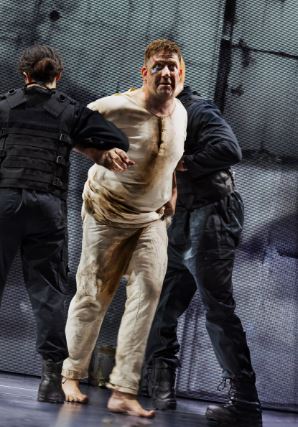
The fourth on-stage actor is David Birrell, who plays Parsons, a loyal Party supporter. He has a low social status and is suggestible. Unfortunately, he is Winston’s neighbour, and a bit of a gossip. Parsons encourages his children to be part of the Party’s youth movement and it leads to his downfall, as his own seven-year old daughter denounces him for some unintended but unguarded remark. (On press night, a Moscow court had that day sentenced an elderly paediatrician to five-and-a-half year’s hard labour, after her child patient alleged she had made negative comments about Russian soldiers.) Birrell excels as the gauche and naïve Parsons, making his mental and physical breakdown painful to see. His quivering fear as he is dragged off to Room 101 is palpable.
All four of these on-stage actors consummately portray the extremes of emotional integrity that their characters exhibit, with great subtlety and with frightening reality. The atmosphere they create is sharply enhanced by Paul Pyant’s lighting and a permeating soundscape by Gilles Thomas. There is, for example, the haunting singing of a child, Oranges and Lemons, a nursery song now washed from peoples’ consciousness by the stripping of the cultural heritage of the language. Original musical compositions by Robert Sword and Giles Thomas percolate the action with an evocative melancholy.
We already live in a world of mass surveillance. We already live in a world of doublethink, where even our most senior politicians believe that the definitions of a man and a woman are interchangeable. We already live in a world of thought crime, where even praying silently in public can land you in goal. We already live in a world where history is being rewritten. We already live in a world where freedom of expression is not permitted and speaking against the repressive dead-hand of new perceptions will lead to loss of livelihood, of reputation, of liberty. The 21st Century has brought us close to 1984, a world where humanity is crushed.
So Lindsay Posner and Theatre Royal Bath’s sharp-edged production of 1984 could not be more timely. It underlines the prescience of Orwell’s novel in a well-crafted piece of important theatre. This may be the most disturbing but educative play you can currently see, but everyone should be urged to take the opportunity while they still legally can.
Mark Aspen, November 2024
Photography by Simon Annand

 Mark Aspen