
A Man for All Seasons
More than Just More
A Man for All Seasons
by Robert Bolt
Theatre Royal Bath and Jonathan Church Theatre Productions, at Richmond Theatre until 15th March
Review by Claire Alexander
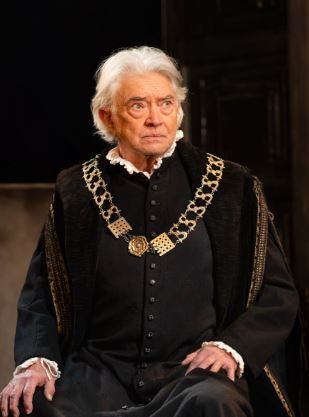
It feels as though it has ‘come home’, as Jonathan Church’s honest, confident, absorbing production of A Man for All Seasons ends its short (and only too southern) tour in Richmond (London). The many references and locations on the Thames between Chelsea and Richmond, and beyond to Hampton Court, will be very familiar to local audiences, giving the play an added meaning to the historical context.
It is 1530 and Henry VIII has grown exasperated with his marriage to Catherine of Aragon, largely because she has not provided him with the son and heir he craves. His fancies have turned to Anne Boleyn, but in order to marry her he needs the sanction of the pope to divorce Catherine. When the pope says ‘no’, Henry VIII, not one to do things by halves, changes the church! Which of course had far reaching consequences for the dominant faith and culture for the future of England. He didn’t reckon on his friend and scholar Sir Thomas More. When More is asked to sanction Henry VIII’s divorce and remarriage to Anne Boleyn, More’s unshakeable, unbending conscience is his downfall. While the court of King Henry, led by a wily Cromwell (Edward Bennett), dance to the King’s demands, at the end of the day it is only More who stands alone and cannot accede or sign the oath recognising the nascent Church of England.

King Henry’s actions have far-reaching consequences for English history. For Sir Thomas More his private conscience resulted only in his death. At the end of the day, it was his personal conviction that counted, not what other people thought, the antithesis of Richard Rich (Calum Finlay) whose unbounded ambition trumped all. And William Roper (Sam Phillips) who sold his conscience for More’s daughter, Meg.
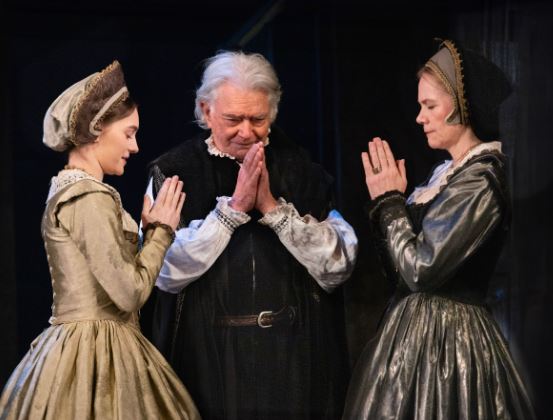
A Man for All Seasons raises many questions and moral arguments – indeed More himself can get in a twist on occasions whilst almost arguing with himself on the question of the supremacy of the law or the church – but Robert Bolts’ thoughtful and careful script is well judged, authentic and focussed in its themes.
Indeed the arguments and moral questions it raises have not changed and are as relevant today as they were nearly 500 years ago. Many men and women through history have been so brave, so unshakeable, whether through faith or political belief, that they are prepared to pay the ultimate price. Most recently Alexei Navalny springs to mind, as he walked into certain imprisonment and death against a regime that does not have the courage or the will to hear a different view. And so was that the case in the English Court of King Henry in 1530.

It is also hard to make an assessment of this play without at least a mention of its more contemporary neighbour Wolf Hall (which, it should be said, takes the same historical context although seen through the perspective of Thomas Cromwell, which does make it fundamentally different). Any audience in Richmond this week hoping to see a visual copy of Wolf Hall will not have been disappointed. This is a confidently authentic production, true to Tudor behaviour, custom and manners, but that is where any similarity ended. The relative simplicity and authenticity of this production really allowed the text to flourish so that we, as the audience, could follow and judge for ourselves the arguments: public declaration vs private conscience – More’s ultimate sword on which he fell; questions of friendship and loyalty while Richard Rich has no such concerns, since he uses his friends for his own ends; and finally is silence complicit? Was More’s dignified silence on the matter complicit or treasonable thought?

To allow this simplicity of course relies on the performances. As More, Martín Shaw’s performance is dignified, measured, thoughtful, inscrutable. It demonstrates More’s unwavering strength of character through his balance; carefully choosing, only rarely, when to raise his voice against the laws of England as they get turned against him. He never lost that dignity although his body crumpled as the years of imprisonment took their toll. Orlando James, as King Henry VIII, provides a perfect counterbalance with a subtle lively charm – a breath of fresh air from the formality of the court, and yet you know he would stop at nothing to get what he wanted. Gary Wilmot, as the Common Man, the voice of the people if you like, was engaging and amiable, as he lightly stepped from allegiance to allegiance. I also liked the twinkle in the eye of Asif Khan as Signor Chapuys, the Spanish Ambassador, as he tries to warn More against his actions. And an honest, intelligent performance comes from Annie Kingsnorth as Meg, More’s daughter, in one of her first professional roles. But above all the whole cast work as one to bring this, occasionally dense text with its complex legal arguments, to life in an easily approachable and understanding way. Congratulations.
At first I wondered whether the brown library set (by Simon Higlett) might be overbearing but it provided the perfect non-distracting background, and was cleverly enhanced by imaginative lighting by Mark Henderson, which gave us a hint of the Tudor beams of the period.
I thoroughly recommend this clear, unpretentious, engaging revival – of a play which can speak to us all on many levels – of friendship and loyalty, morality and conscience. As I understand, this is the final week of the tour – well worth a trip to Richmond to catch a final performance, and you can make a short detour down the Thames to see where the action would have taken place. Perhaps less has changed than we think.
Claire Alexander, March 2025
Photography by Simon Annand

 Mark Aspen
Trackbacks & Pingbacks