
Orfeo
Dying of Love
Orfeo
by Claudio Monteverdi, libretto by Alessandro Striggio
Richmond Opera at Normansfield Theatre, Teddington until 27th April
Review by Mark Aspen

What is it about Orpheus? The legend of Orpheus and Eurydice always has been a popular subject for opera. Earlier versions, Charpentier’s La Descente d’Orphée aux Enfers in 1686, and Orpheus and Eurydice by Gluck in 1762 tended to stick closely to the original legend. (Haydn had a crack in 1791, but it was only performed 160 years later.)
The dramatic possibilities of a story of a heart-broken newly-wed husband’s attempt to bring his dead bride from Hades, drips with the emotional juice that opera loves (and opera is often obsessed with death). Plus of course it’s all about the power of music.
By 1858, with his Orpheus in the Underworld, Offenbach added a contrary comedy twist, with its (in)famous Can-Can parodying Gluck’s. Modern versions, such Birtwistle’s 1986 The Mask of Orpheus and Glass’s 1991 Orphée have greatly elaborated on the original tale.
Richmond Opera has made an apt choice in going for the earliest known version, by the father of opera Claudio Monteverdi, his 1607 Orfeo. It also has the distinction of being oldest known opera that is still performed. It has a direct simplicity and great charm, sticking with the legendary tale; Monteverdi originally entitled it La Favola d’Orfeo, The Fable of Orpheus.
The choice is particularity appropriate in the gorgeous setting of the theatre-cum-museum of the peerless Normansfield Theatre with it beautifully preserved Victorian architecture, stage and scenery. The wonderful painted canvas backdrop and legs (actually accurate copies of the Victorian scenery which is stored in the building) take us straight into the Thracian woods where the bucolic first two Acts are set.

Stage director and designer, Patricia Gómez gives the unspecified modern costumes a folksy feel. They are colourful, men in floral waistcoats, ladies in flowery printed frocks, all corduroy and cotton. And they’re diverse, even a kilt. The principals are slightly different. Orpheus, the eponymous Orfeo (Orpheus), is ex-public school weekend: pale chinos, brown half-boots and linen jacket.
It is in these opening Acts that the acting and singing skills of the performers in the named female roles are pleasingly exhibited. La Musica, the muse of music (who is incidentally pictured in one of panels on the proscenium) parenthesises most of the action. Almost floating in white chiffon, Naomi Kilby makes an exhilarating Musica. Her lightly decorated lyrical high mezzo has a ringing clarity and strength. The engaging and lively pair of Pastorelle (Shepherdesses) Lois Heslop and Victoria Kunesch are a delight to watch and a joy to hear as they motor the story along. These twinned roles provide the emotional support to the hapless couple and a catalyst to the chorus in their comments on the action.
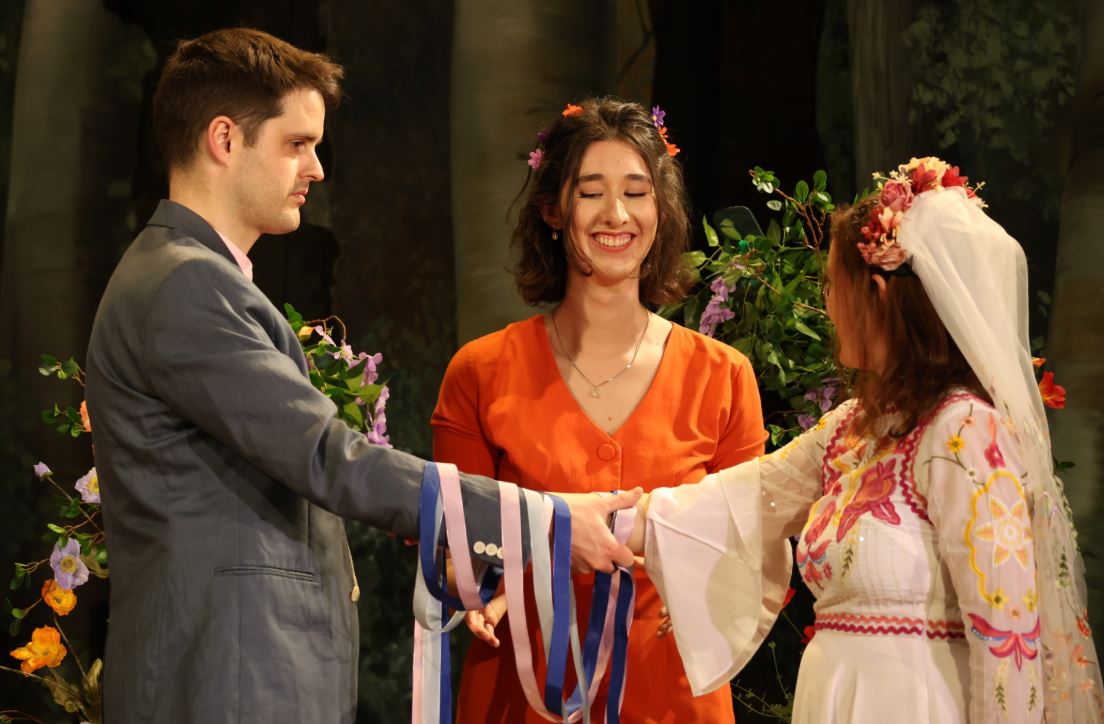
Claire Doran as Ninfa (Nymph) has a beautiful soprano voice and a bubbly charm. The part of Sylvia comes with some emotional weight, as it is she who is The Messenger who comes with a “heart full of anguish” to tell the dreadful news that the newly-wed Euridice (Eurydice) has been fatally bitten by a venomous snake whilst dancing and gathering flowers after tying the knot (literally in a lovely scene with the Pastorelle and coloured ribbons) with Orfeo. Ruth Vanni excels as Sylvia, her creamy mezzo totally moving as she imparts the worst. As Euridice’s bridesmaid and her friend, Sylvia is distraught, and blames herself as the Messanger of the sad tidings of Euridice’s death. “For ever I will flee … … in keeping with my sorrow”, she vows, and to live a solitary life.

These ladies carry the first half, together with the animated chorus. In Act One they had been clearly enjoying themselves with a sprightly dance, “Leave the mountains, leave the fountains”, but now at the devastating ending to the second Act, they express a different mood, lamenting cruel fate.
But all is not lost, for Orfeo has a god-given talent from Apollo his father, the all-consuming power of his music, from his lyre and voice. He resolves to go down to Hades to retrieve his wife by using this gift to “move the King of Shadows”, its ruler Plutone, or otherwise to remain with her in “the company of death”.
The second half has an entirely different setting and mood. We now enter Hades, the kingdom of the dead. The set is now strikingly different. Nineteenth Century scenery is overtaken by Twenty-first Century wizardry in the form of Simon Pike’s vivid lighting design. The bright purple light of Hades makes quite an impact.
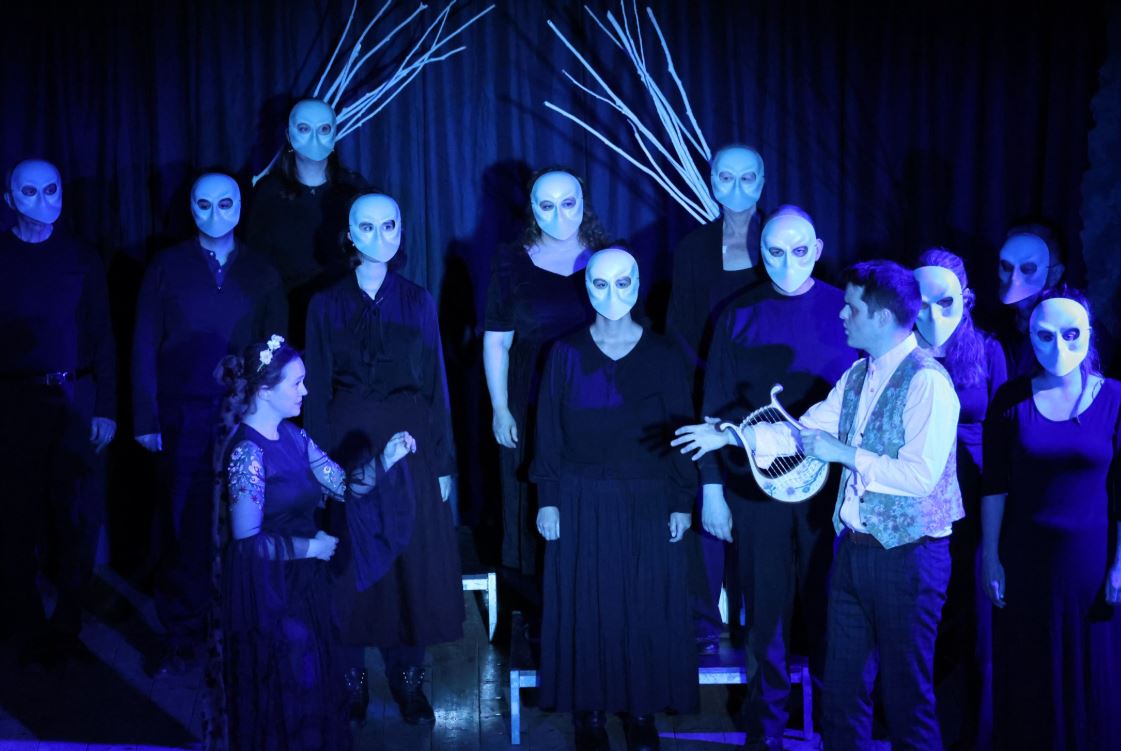
The entrance to the Underworld is guarded by Caronte (Charon) the boatman who can ferry the dead across the River Styx. Orfeo has to convince him to take a living human. John Rolt makes an idiosyncratic Caronte with his bass signing voice that has an appropriately gravelly timbre. Orfeo has to charm him and his subordinate guard to the Underworld (black clad members of the chorus in skull-like masks).
Musically, this is an interesting passage. Monteverdi has gone to town in creating a virtuoso palette, which is taken up by the orchestra and voice. As Orfeo pleads with Caronte, “O, give me my love, ye powers of darkness”, the conversation is joined in turn by the violins, and then by a pair of baroque cornetti (Alex Duncan and Kate Allsop), and, as Orfeo’s lyre does it’s magic, a solo double-strung harp, played with consummate style by Ian Cutts. These musical interjections are done with great skill by the individual musicians, underpinned in the basso continuo group by a pair of theorbos (Zoe Ansley-Green and Portuguese lutenist Fábio Fernandes).
Musical director, Lindsay Bramley has done a wonderful job in bringing such skilled period musicians and their instruments together. She conducts the thirty-strong Richmond Opera Orchestra (leader Jocelyn Slocombe) with panache, pointing up Monteverdi’s embellishments while maintaining a punchy pacing.

Having soothed Caronte and his minions into sleep (rather suddenly it appears), Orfeo can now slip unhindered into Hades. Here the chorus is an inscrutable array of impersonal skulls, reigned over by Plutone. Llewellyn St David has powerful stage presence as Plutone, and his bass voice has real heft at the profundo end of his register, but he is rather uncomfortable at the higher end. Orfeo has an ally in Proserpina (Persephone), Queen of Hades, who is so touched by Orfeo’s singing that she implores her husband to let Euridice return to the living world. Catriona Murray, who sings with sweetness and precision, is an enchanting Proserpina. And indeed Plutone grants her request, on one condition. (Think Lot’s wife.)
The success of a production of Orfeo relies heavily on the two principal roles. Erin Holmes is a star as Euridice. She really lives the part (even when dead) and sings elegantly and with delicacy and subtle vibrato decoration. Holmes is a great actor and brings complete credibility to the role. Her Euridice is a young woman clearly in love. Hugh Benson looks the part of Orefo and his singing is irreproachable, text-book accurate. However, this part needs to speak real passion to fire the credibility of the part. Benson’s style is declamatory, a style that lacks currency, but still persists in some Eastern European companies. It contrasts greatly with the vivacious natural style of Richmond Opera. Wouldn’t a young man who is willingly to go to hell, in the most literal sense, for his beloved, look into her eyes when he is declaring his love? Or face up to Caronte when he is pleading to be let in to Hades? The feel is that of a recital rather than a staged opera. There is a whole stage out there, but Benson seldom moves from one fixed downstage-left spot (exasperating when that puts the lead role out of sight behind the conductor most of the time). It is a pity as Orfeo gets some of best lines. It almost got there with the moving “vision that I longed for”, before that gasp-inducing sudden turn, the retrograde, in all senses, move.

Act Five is very much a coda, in which Orfeo seeks to come to terms with his loss in a soliloquy of lament. Then Apollo appears to try to console his son. It is shame that we only see John Hall, who plays Apollo, in the this final Act. He is a strong, confident singer with a crisp rounded tenor voice, and his convincing characterisation of the wise god has a refined and measured empathy.
The message of Orfeo is of course about the ineffable power of love, but one takes away from this production that it is also about trust. This message culminates in that final look back, Orfeo not trusting the bargain of Plutone, a lack of trust that loses him his beloved for ever.
The message also is about the power of music; and Bramley and the committed and enthusiastic Richmond Opera put that message across loud and clear, and with consummate musicality.
Mark Aspen, April 2025
Photography by Jonathan Lo
[Editor’s note: Hugh Benson and Erin Holmes, who play Orfeo and Euridice are to be married next year. We wish them ever happiness in their future life together. Just watch out for snakes after the wedding ceremony!]

 Mark Aspen