
Marie & Rosetta
Divine Inspiration
Marie and Rosetta
RTK, Chichester Festival Theatre and English Touring Theatre at the Rose Theatre, Kingston until 24th May, then on tour until 26th July
Review by Mark Aspen

In the 1970’s, I was working on a new industrial plant in Pennsylvania. One of the construction teams was from Alabama. I had difficultly in understand what they said, but then again, so did the locals. Later I drove down to South Carolina in a car with Philadelphia number plates, which was derided in Charleston as a “damned Union cor”. It was as if the American Civil War had only just finished. I realised there was still a big divide in attitudes between north and south.
This prejudicial divide across the Mason-Dixon line was even stronger thirty years earlier, when early in 1946 Rosetta Tharpe recruited Marie Knight to help revive her music style, which had had success for over a decade. Controversy over her swinging style of gospel music had been growing, so bringing in a new young and fresh voice might overcome the differing receptions her acts had across the USA.
The importance of Sister Rosetta Tharpe in the evolution of rock ‘n’ roll from jazz and blues has only recently come back to the surface and in 2018 she was dubbed the “Godmother of rock and roll” following her induction into the Rock and Roll Hall of Fame as an early influence of the genre.
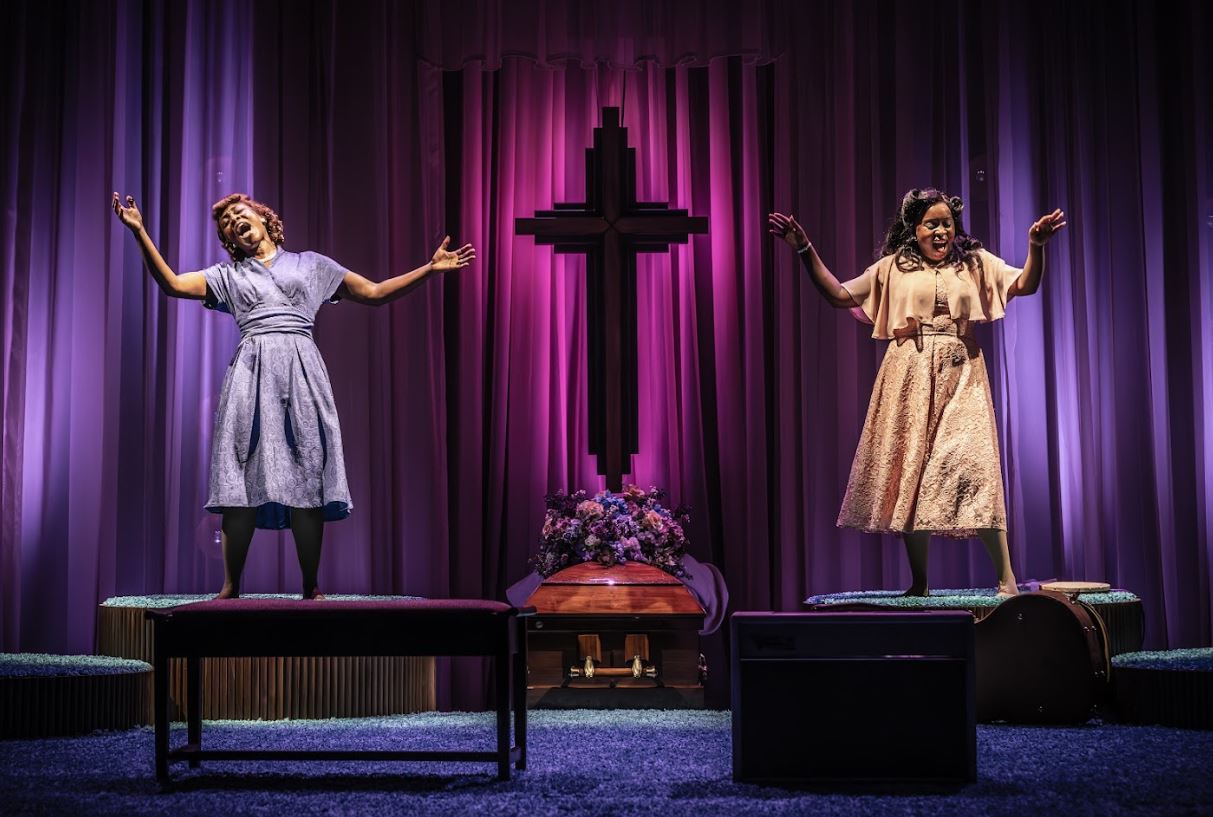
Writer George Brant has long been fascinated by Rosetta, and his musical play Marie and Rosetta distils the essence of her long career on that one evening in Mississippi in 1946, when Rosetta and her young protégée Marie Knight meet for their first rehearsal together. This focus gives a detailed and intimate exploration of family, fate and faith.
The north-south divide in America in the forties brought Rosetta condescension in Chicago and in New Orleans, outrage that jazz rhythms and gospel musical should be merged. Whereas in New York’s Cotton Club small change, busker’s money, was thrown from the balcony, here in Mississippi her music was, in some circles, considered to be borderline blasphemous.
Rosetta had seen Marie perform at a Mahalia Jackson concert in New York, and had invited her to tour with her. Rosetta hoped that, playing as a duo, the crisp clean unadulterated gospel style of the young good-looking, and clearly very talented, girl would reconcile her detractors. In the event their two styles blended with gusto and joy.

Their first concert together was due to take place in an out-of-town warehouse, such was potential hostility, and the safest place for them to meet and rehearse was in the local undertakers. Lily Arnold’s lush and stylish set design is in the pile-carpeted funeral parlour, complete with a coffin in the chapel of rest at the rear. (She has created some amazing sets for the English Touring Opera this season.) The high-spec set is all circles, symbolically circles that include or circles that exclude, or perhaps the circles of life, given this most transient funeral setting between this world and another.
Director Monique Touko has brought together a team of talented actors, musicians and creatives in a production that moves with the impulse of its music and unfolding of the intimacies of its stories. It is well-paced but unafraid to pause for reflection.
As with those Alabama roughnecks I’d worked with, the heavy deep-south drawl takes a little time to tune in to, but once there its authenticity draws one into the story.
The play runs for almost an hour and three-quarters without an interval, it is full-on and the centred and energetic performance of both main performers is unflagging.
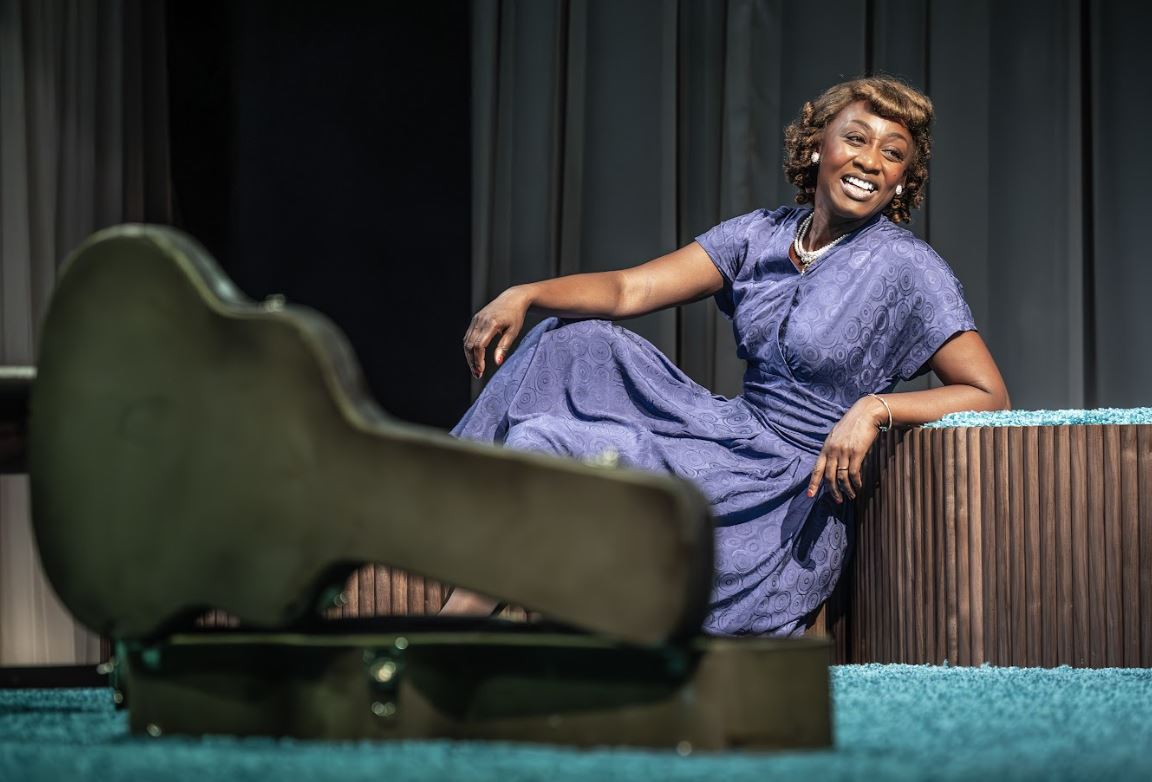
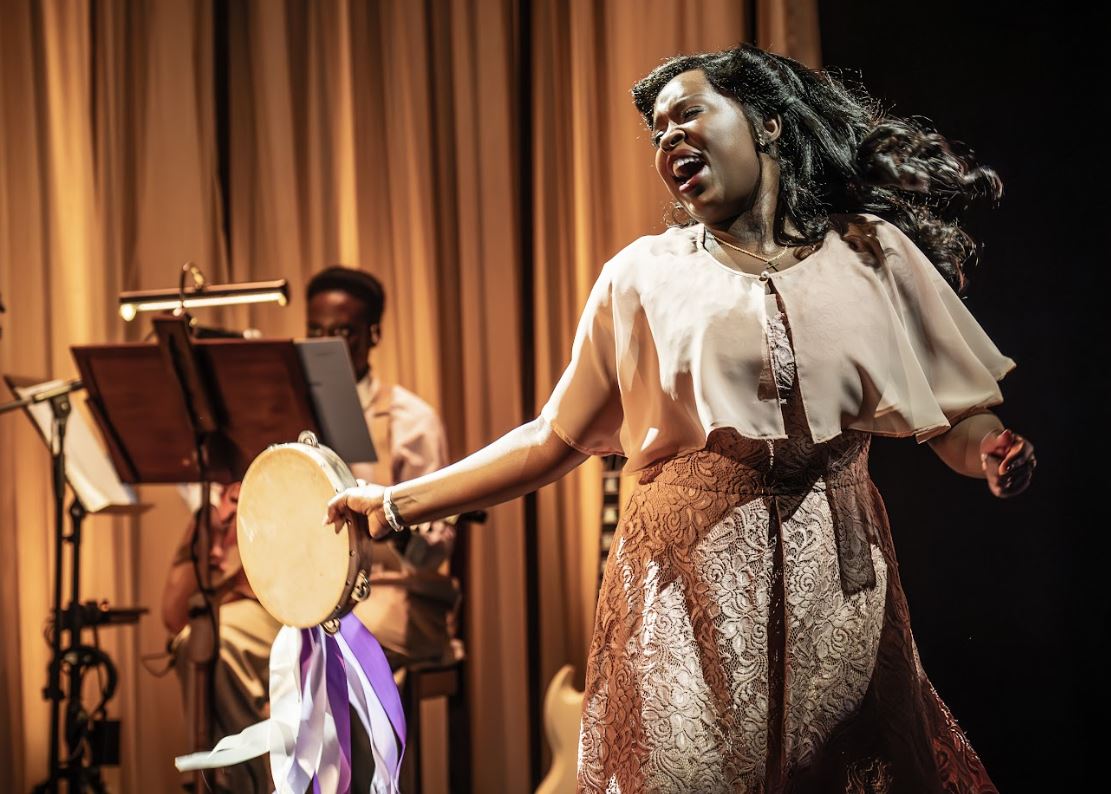
Sister Rosetta Tharpe is played by acclaimed soul artiste and actress, Beverley Knight MBE, whereas Marie Knight is performed by relative newcomer, the versatile British-Zimbabwean actress Mtombizodwa Ndlovu. Yet they gel together in the most remarkable way, both in their totally mutually engaged acting and, my, in their singing; as their characters’ lives, their marriages, their feelings, and above all their attitude to their faith, are gradually exposed.
Their opening songs stamp their pre-duo styles. Knight’s high octane rendering of This Train, a Rosetta Tharpe signature piece that she had performed in the Cotton Club with Duke Ellington, blasts off the programme of musical numbers to come with a powerful rawness. On press night it was raucously acclaimed by a whooping audience. Then, after more back-story, Ndlovu’s rendering of Were You There (when they crucified my Lord) was met with jaw-dropped silence, until at the end it was met with loud applause. Movingly sung in a rich creamy alto, this gospel song is performed with conviction, portraying a young woman with a pure simple faith in the Lord. Rosetta’s faith in comparison is strong, but of the “take the rough with the smooth” kind.
This start shows a saint and sinner vibe, but as the story unfolds both are seen as humans, flawed, as we all may be. At first their relationship seems that of diva and pupil. “My goosebumps got goosebumps”, Marie says of her first meeting with the star, but even within this one evening we see a friendship grow based on mutual generosity. And, in the same way, their musical styles intertwine. Marie at first is adamant that propriety be maintained, but Rosetta, paraphrasing William Booth’s popular Salvation Army saying, takes the stand “God don’t want the Devil to have all the good music, right?”. Soon, Rosetta is teaching her how to put the swing into numbers such as Didn’t It Rain and Up Above My Head, while Marie’s innocent approach to faith rubs off into Rosetta’s mature, nuanced yet complacent own faith.
Gradually they reveal to each other the missteps in their past, Rosetta’s failed marriages and the discovery that Marie at 23 has been married, separated and has children whom she sorely misses. But Rosetta knows her Bible and quotes Matthew’s gospel, that God forgives seven times seventy.
Then Rosetta introduces the third member the band, her electric guitar. (She was an early exponent of the instrument, which was invented a decade before.) The guitar playing is purely figurative for there is strong backing from live guitarist Shirley Tetteh’s excellent four-piece band, who are partially hidden on-set behind ruched drapes, channelling the funeral parlour’s dressing. Ishara Andrews on drums and Genevieve Namazzi on double bass are positioned above the stage, and on-stage with musical director Tetteh is the pianist, who on press night was Liam Goodwin, the arranger and orchestrator of the score from the original music.
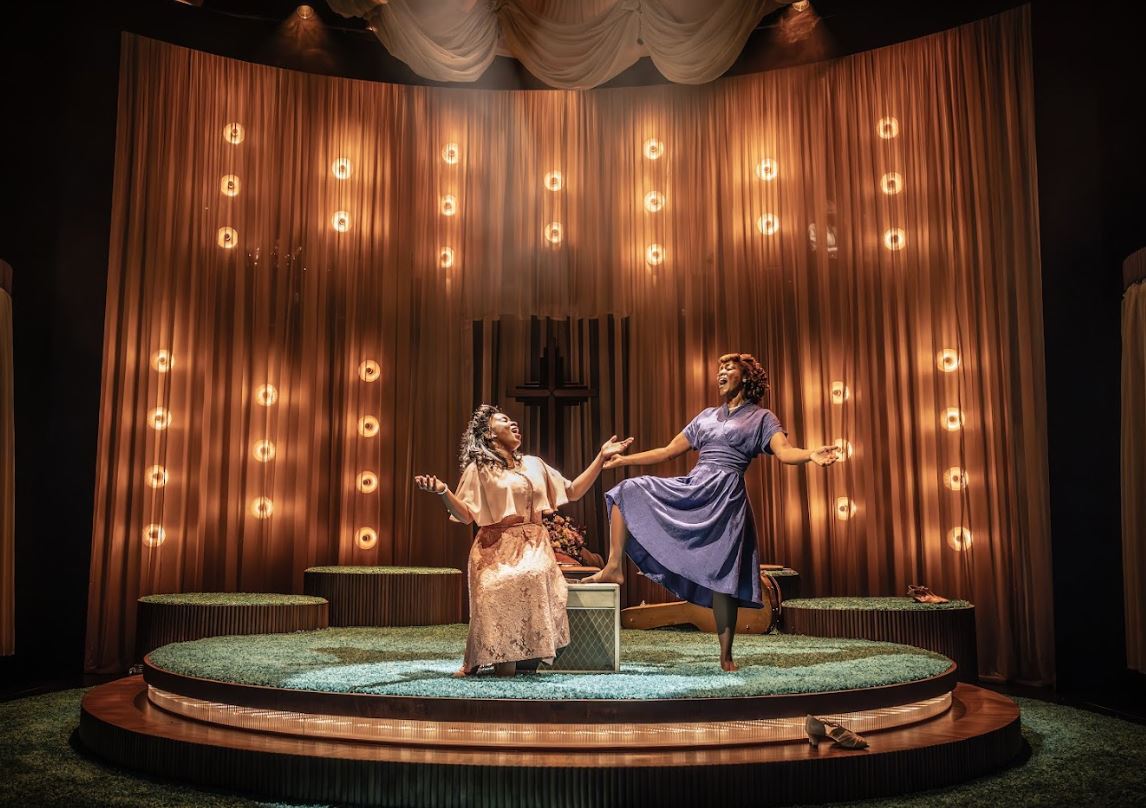
There is indeed a great deal of careful consideration of period, including costume designer Jodie-Simone Howe’s studied detail in both Rosetta and Marie’s decorous frocks of the period, which are subtly colour coordinated, and her meticulous reproduction of Rosetta’s distinctive white coat worn on her European tour (with Muddy Waters not Marie), during which she sang at the disused Wilbraham Road railway station in a rainy Manchester in May 1964. Equally well-studied are the hair styles of Marie and of Rosetta faithfully recreated by Keisa-Paris Banya and her team.
Brant’s script at times tends to drag the action with over exposition, and there is a rather clunky coda in which Marie has a crystal-ball session in foretelling Rosetta’s future life to be, including her third marriage in 1951, when 25,000 paying guest attended her wedding in a baseball stadium in Washington, D.C; and even her final illnesses and fatal stroke. It’s raison d’être seems to beto underline Rosetta’s influence on early rock-and-roll musicians, including Little Richard and Chuck Berry and on those who were to follow such as Johnny Cash and Elvis Presley, who were only children in her heyday.
It did leave one wishing for the music, for the real joy of Marie and Rosetta, notwithstanding the mesmerisingly convincing acting, is the singing, raw muscular music of established star Beverley Knight with the moving emotional power of star-to-be Mtombizodwa Ndlovu. Both have hugely wide vocal ranges and they meld in energy and melt in harmony together.
Although 21st Century theatre doesn’t often “do God”, the main message of this remarkable show is the power of the Christian faith to overcome obstacles and make this possible with great joy. Dare one say Marie and Rosetta achieves this with, in the words of the gospel song, amazing grace.
Mark Aspen, May 2025
Photography by Marc Brenner

 Mark Aspen