
Fidelio
Horrific Beauty and Lyrical Intensity
Fidelio
by Ludwig van Beethoven, libretto by Joseph Sonnleithner and Georg Friedrich Treitschke, after Jean-Nicolas Bouilly
Garsington Opera Festival at the Wormsley Estate, Stokenchurch until 22nd July
Review by Mark Aspen
Complete darkness, rarely experienced, is terrifying. Many years ago, I became briefly lost in a limestone cave, just a series fissures really, without any light. Then, that moment when I re-emerged into the living world is forever etched in my memory: grass that was oh so green, wild flowers in profusion, butterflies, and above all sunlight! That feeling of freedom was overwhelming.
Hence it is with a frisson of horror that I find deep empathy with Floristan, the cruelly incarcerated political prisoner in Fidelio.
Not only is Fidelio a towering paean to the triumph of freedom over tyranny, but also a powerful celebration of the strength of marital love. Leonore’s love propels her quest to find her husband in the deepest dungeon in the strongest prison, by disguising herself as a young man, Fidelio. It is the prime example of a Befreiungsoper, a rescue opera, and Beethoven was referencing the tyranny of Napoleon and the reports of war atrocities coming out of Spain at the time he composed it.
Beethoven, at this own admission, found composition for voice uncomfortable. He struggled to extract the opera from a symphonic structure, of which he was already the predominate master. Various versions were revisited for over a decade until the premiere in Vienna of the final version in 1814, by which time Napoleon had been defeated. But what makes this opera painfully pertinent is that it could be now. One thinks for example of Alexei Navalny’s imprisonment by Vladimir Putin, although his wife Yulia’s bold attempts to release him were not as successful as Leonore’s, or quite as audacious. Many current abhorrent examples also reflect life in art. Of course, the concept of imprisonment might itself have been a metaphor for Beethoven’s increasing deafness, an affliction that acts as an imprisonment of the self.
John Cox’s Fidelio punches hard at the concept of imprisonment in a powerful production of horrific beauty and lyrical intensity. For its second revival, director Jamie Manton has assembled a company that is well-cast to induce shudder or sympathy with an authenticity that totally engages the audience.

Beethoven can change a mood in a twinkling. Juggernaut thunderings can turn seamlessly into bucolic desperations. The opera’s opening, though, is a wooing scene, albeit one-sided. It is musically flowery, as Marzelline, the gaoler Rocco’s daughter, tends her gardening duties, planting for the future literally and figuratively. She is free, and is free to choose. Her choice is not Jaquino, the prison warder and general factotum, who artlessly peruses her, assuming a right to marry her. Tenor Oliver Johnston plays a thwarted young man (who sadly nowadays would probably be arrested as a stalker), but one can feel his frustration at being usurped. Isabelle Peters’ Marzelline is coquettish and knows her own mind. Her bubbly soprano brings a freshness to the character, who makes no bones about her choice. She loves Fidelio, and that’s who she is going to marry. Whoops! But she is full of hope.
Marzelline, Leonore, Rocco and Jaquino each have a different take on imminent engagement, and they sing in canon with similar words, since for each “es ist klar” what the situation is. This is where the music takes on a different quality, the first of many steps-up, and the quartet picks it up with great aplomb, in a musically satisfying integrated round.
But against the bright start all is ominous, and this is reflected in Gary McCann’s design which is hard and steely. All is grey, a Bentham panopticon of a prison, circular barred walkways, a circular watch tower of industrial hardness, and circular entrances to the subterranean cells, where the prisoners are denied even light.
That Fidelio is a “man” whom he can trust and rely upon offers Rocco a firm base, for in his unenviable occupation Rocco feels morally compromised. This dichotomy is accurately portrayed by Jonathan Lemalu in the role. His modulated bass has a very expressive quality that follows his character’s feelings with subtle nuance. He portrays a man coerced into a pragmatism that betrays his own innate honesty.

Don Pizarro, the flagitious prison governor, is depicted by Musa Ngqungwana as a brutish thug, devoid of any humanity. Ngqungwana has been amazingly versatile over widely differing roles. Here, his Don Pizarro, from his first entrance with a posse of baton-wielding minders, has powerful presence, and channels a more grounded Idi Amin. Ngqungwana is not only a remarkable actor but his bass-baritone resonant delivery underlines the arrogated authority of Pizarro. It is Pizarro who has captured the noble Florestan, who had attempted to expose Pizarro’s nefarious and seditious activities, and incarcerated him secretly in conditions of sensory deprivation and near starvation. Rocco says that Florestan’s life “wie ein Schatten schwebt”, just hovers like a shadow.

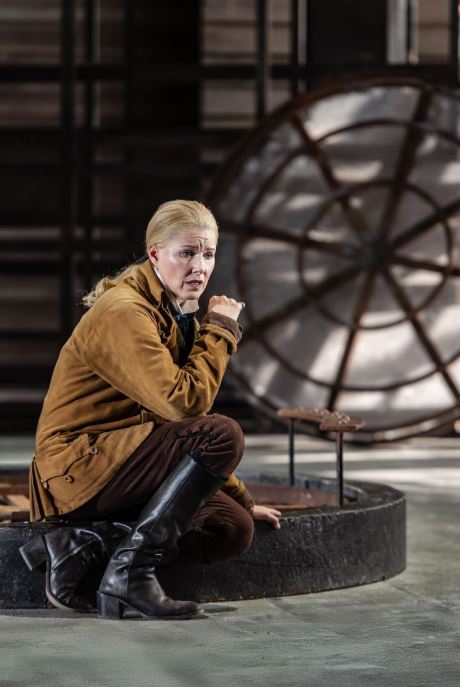
So it is against all the odds that Leonore sets out to find and liberate her beloved husband. Their bond as husband and wife is so strong that she know that love will conquer all. Renowned soprano Sally Matthews is outstanding in this role. It is not quite a breeches part, as here is a woman in disguise, but it is fraught with the difficult of playing a woman to the audience, whilst convincingly appearing as man to the other characters. Matthews achieves this seamlessly with apt movements and physical reaction. Above all, her lyric soprano range is wide and accommodates the disguised Fidelio. And she sings with a directness of passion. Fidelio’s steeliness of purpose shows through with her fervent response “Ich habe Mut und Stärke”, when she insists in accompanying Rocco to the hidden dungeon, “I have the courage and the strength”. They must dig a grave below the dungeon, as Pizarro is coming to kill Florestan, before the king’s minister Don Fernando arrives to investigate rumours he has heard. Sally Matthews’ aria on overhearing this news, Komm, Hoffnung is one of the glories of the opera, it is a soaring poem on the powered of love. “Come, hope”, its last star will not go out in despair, for her strength will derive from her wifely faithfulness and love. It really hits the heart.

Another highlight is the well-known Prisoner’s Chorus, a turning point in the opera, when Fidelio convinces Rocco to allow the registered prisoners brief access to daylight, a custom in honour of the King’s birthday. “O welche Lust, in freier Luft den Atem leicht zu heben!”, the emerging multitude of prisoners sing, “O such joy, to lightly breathe the free air”. Orchestrally and vocally this rises to a magnificent crescendo, reminiscent of the Ode to Joy in the Ninth Symphony. It is such a stirring anthem to liberty wrested from tyranny.
In this production, the Prisoner’s Chorus is made even more moving by the skill of lighting designer, Ben Pickersgill who makes use of the west-facing glass wall of the auditorium. On a glorious summer’s evening, the low sun (the real thing, only possible as Garsington) streams into the faces of the blind blinking prisoners as they ascend, and shuffle into the (real) garden. It is an amazing use of the building to augment a lighting plot that follows the narrative journey from light to deepest darkness and back to light.
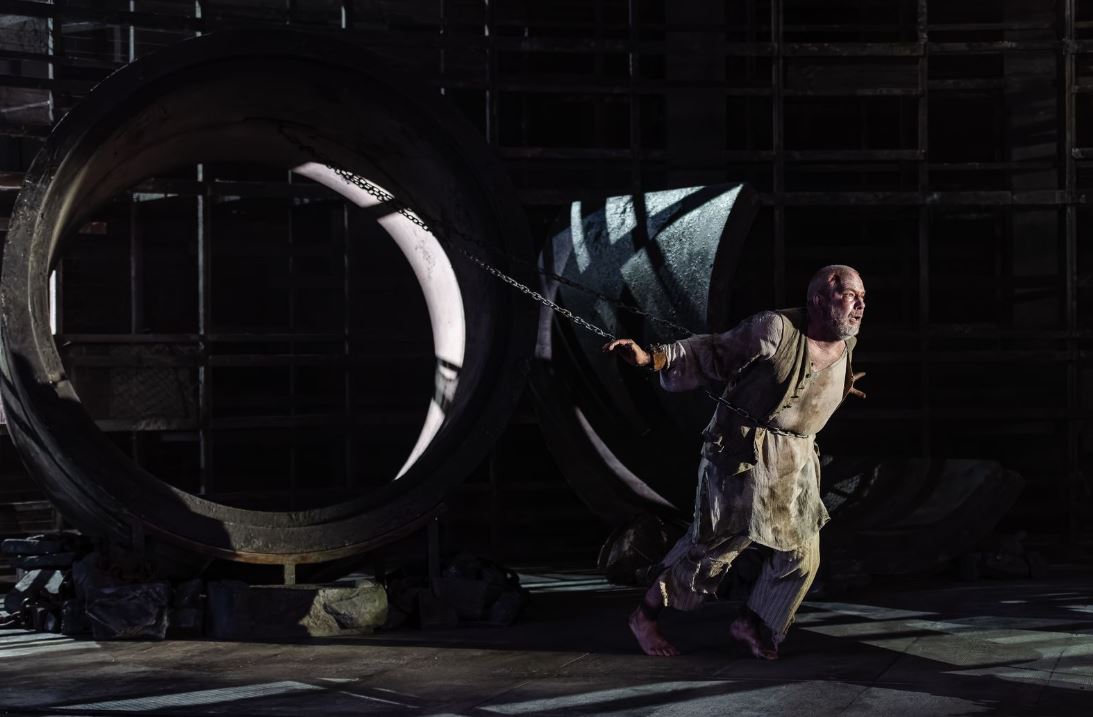
It is in this deepest darkness that we finally encounter Floristan. He is shackled and hobbled and we do not see him during the prelude to the Act. Florestan is figure of pity, but hope and courage. The redoubtable tenor Robert Murray brings an emotional realism to these aspects, with an opening cry of anguish at the dark, silent dungeon, “Gott! Welch Dunkel hier! O grauenvolle Stille!”; and grief at the cutting short of his “Lebens Frühlingstagen”, the springtime of his life. But then he imagines Ein Engel, an apparition of Leonore come to rescue him. Murray, in this aria, finely expresses all of this emotional roller-coaster.
The monumental nature, the gentle contrasts and the celebration of triumph of good in the music are very typically Beethoven. Douglas Boyd conducts The English Concert with alacrity, and into every nuance of the music as it heightens the action on stage. An oboe obligato picks up the mood of Lebens Frühlingstagen, and a solo horn underlines the hope in Fidelio’s Komm, Hoffnung. In the gruesome grave-digging scene there is a sense of urgency, a cantering pace that one hears in Beethoven’s symphonies. And when the critical confrontation comes with Pizarro, who intends to silence forever the weakened Florestan with one thrust of a dagger, “ein Stoss und er verstummt”, the music teeters between victory and disaster. Then there is silence, poised, hanging in the air, another of Beethoven’s trademarks. Perhaps with increasing deafness, he knew the power of silence.

Swiss baritone Richard Burkhard makes an imposing entrance as the King’s minister, Don Fernando, a deus ex machina arriving in the nick of time. Clad in white, he is the symbol of good triumphing over evil, and freedom over tyranny, representing the political, moral and philosophical points that preoccupied Beethoven throughout his life.
The joyous finale, with The Garsington Opera Chorus giving full wellie, as it had done with the Prisoners’ Chorus in a different mood, is magnificent, and just as emotionally overwhelming. And the orchestra at full power dials up Beethoven at his meatiest.
However, the last word is to married love, as shown by Leonore, Wer ein solches Weib
Stimm’ in unsern Jubel ein; whoever has such a wife, rejoice with us. Leonore has faith and hope, but, as St Paul reminds us, the greatest of these is love.
Mark Aspen, June 2025
Photography by Julian Guidera ©

 Mark Aspen