
Les Indes galantes
Volcanic
Les Indes galantes
by Jean-Philippe Rameau, libretto by Louis Fuzelier
The Grange Festival at The Grange Northington, Alresford until 2nd July, then on international tour until 4th December
Review by Mark Aspen
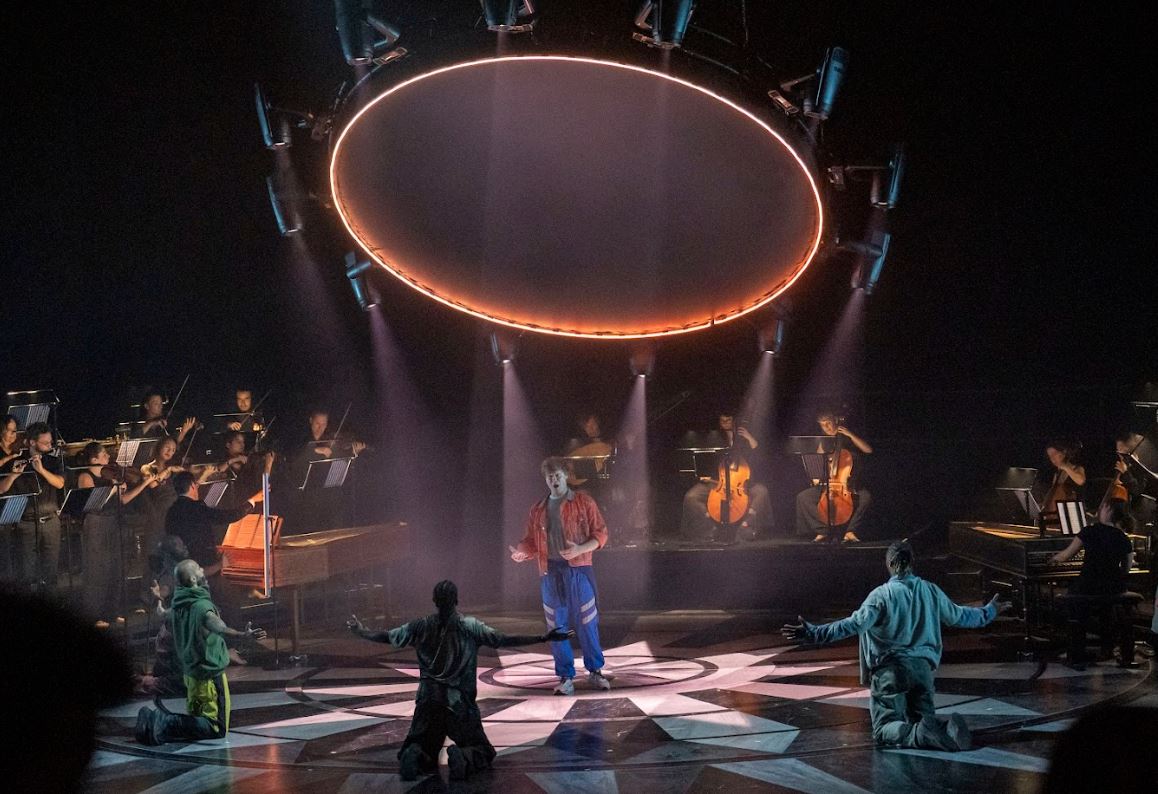
With temperatures soaring towards the highest ever in Hampshire, it seemed almost redundant for Rameau to take us on a musical journey to hotter climes, but this proved to be a most remarkable voyage of discovery.
Incredibly, although Les Indes galantes, written in 1735, is one of the most recorded of Rameau’s works, this is its first fully staged production of the whole opera ever presented in the United Kingdom. It is, however, an opéra-ballet, a form that has certain complexities that, nearly three centuries later need addressing with ingenuity. These include intricate techniques, unfamiliar today, that make heavy demands on the singers; a tightly interwoven musical score set for large orchestration; and the fully integrated expression of dance within the action. These hurdles are brilliantly overcome by the unlikely combination of ensembles; the baroque orchestra Cappella Mediterranea, using period instruments, and the baroque choir, Chœur de chambre de Namur; with the contemporary dance company Structure Rualité, based on hip-hop and street-dance styles.
Rameau himself was a mould-breaking composer, whose controversial non-compliance with the musical norms of the day led to his followers being dubbed “Rameauneurs”, chimney-sweeps when spelt ramoneurs. He would have loved this production, which defies categorisation, but is brilliant.
The structure of Les Indes galantes is a prologue and four entrées, episodic Acts, any of which could stand alone. The narratives may be different, but they cover similar themes, in essence love triangles (quadrilateral in one case) involving people of different cultures. Far from being a divisive concept, it is seen though the open eyes of the Enlightenment, which aimed for understanding and reason in all things. Human beings are seen as all having the same basic needs and emotions, and the same weaknesses and faults.
This production of Les Indes galantes has strong synergy between music, song, dance and design. Perhaps this was, or should have been, always so, as baroque music has clear bright rhythms. One cannot desist from foot-tapping when listening to it, so it is a natural for dancing to, and particularly works with rhythmic contemporary dance. In the France of King Louis XV, opera was expected to be an exuberant entertainment involving all the arts. The King himself set aside vast budgets for such extravaganza. This production achieves the exuberance by ingenuity.
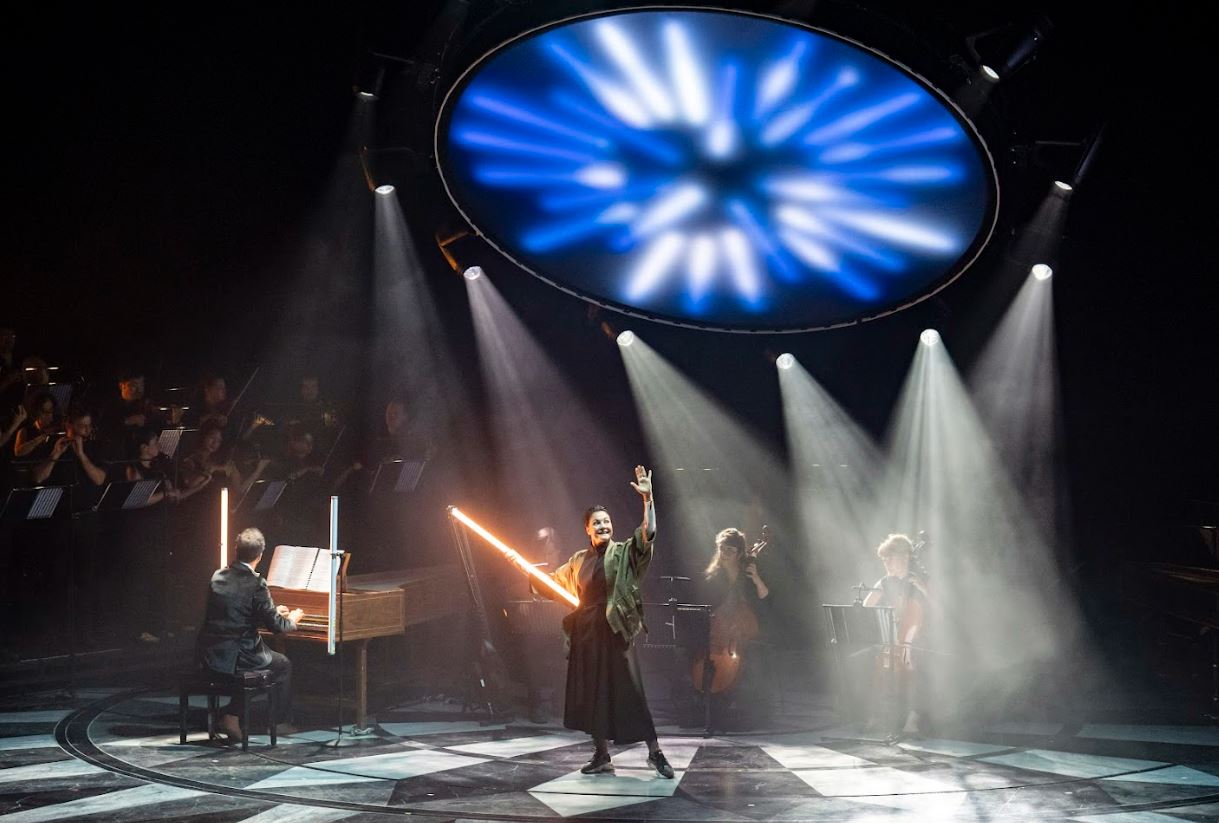
The setting is a polished circular performance space with the musicians and choir in an extended semi-circle upstage. The foundation of the design is Benjamin Nesme’s inspired and innovative lighting. It’s central element is a large suspended rig, comprising a central disc with an array of a dozen itelli-spots and a series of detachable lit batons. It can be raised, lowered and tilted, while the spots can swivel in all directions. The concept is an optical analogue of the Metropolian Opera’s “Machine”, a mechanical leviathan created for Robert Lepage’s staging of The Ring Cycle, but Nesme’s optical version is far more nimble and far more versatile. That it can become sea, sky, sun, a rose fountain, a forest, or most excitingly a volcano, makes the disc a living part of the performance. Combined with more conventional break-up gobos and mist-diffused spotlights, it is kaleidoscopic. Frustratingly though, why does Nesme put the orchestra so much in the dark, even when there is no stage action, as in the overture? One of the joys of live music is its visual experience. And is it a good idea to blind the audience from time to time?
The eclectic costumes created by Charlotte Coffinet are modern. The dancers’ costumes are androgynous and seem to have been sourced after an explosion in a charity shop, but its eccentricity is part of its charm.
Rameau’s sweeping look at the world outside of France encompasses the then exotic locations of Turkey, Peru, Persia and North American, especially their indigenous peoples. Three of the embedded stories, The Generous Turk, The Incas of Peru and The Savages have strong narratives around the central theme. The fourth entrée, The Flowers is more a reflection of love in the beauty of a Persian garden, having been trimmed of some of the action to make a topiary of the achingly beautiful music.
The action spills frequently into the auditorium, giving it an inclusive and embracing feel … and a few surprises. Consequently the conductor, Leonardo García-Alarcón perambulates around the stage to be where the action is. He is barefoot (as are many of the orchestra), grounded, and is totally immersed in the unfolding work. He has an ubiquitous fluidity that infuses the integral nature of the work.
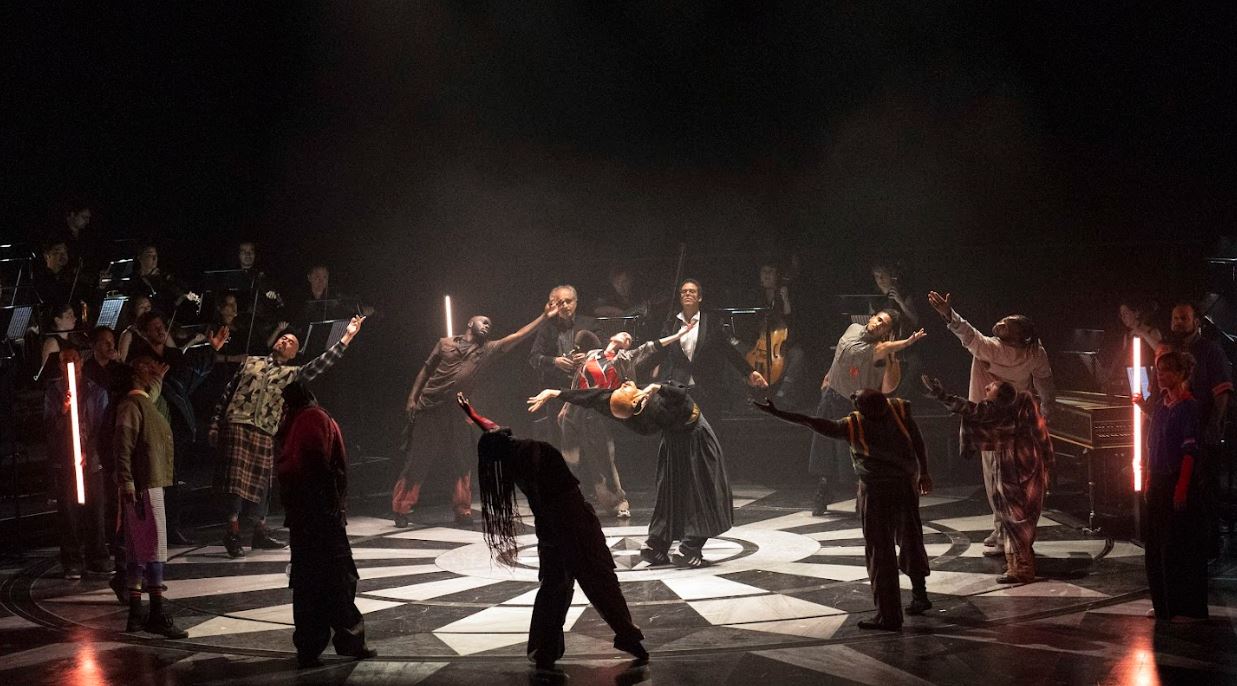
This radical production of Les Indes Galantes was co-conceived by García-Alarcón and its director and choreographer Bintou Dembélé, based on their earlier collaboration on the piece for the Opéra Bastille in 2019. Dembélé has become a well-known name in France for her strikingly imaginative use of street dance and completely new interpretation of movement in contemporary dance. Dembélé herself is seen on stage, on the sidelines or taking part in the massed ensemble dances. Her choreography blends remarkably with Rameau’s baroque masterpiece, in spite of the three centuriesbetween their creation. It does not jar in the slightest and addresses all those complexities of the baroque opéra-ballet form. The dancers use staccato and percussive street-dance moves, stomping, krumping, popping and waacking and the long travelling movements of break-dancing. Against the lively sparkle of Rameau’s score they are not in any way out of place. The dances build and build with activity until they explode with energy.
A dance highlight is at the end of the second entrée, The Incas of Peru . The dance to celebrate the Sun Festival at the brining of the Act is a colourful spectacle, but as the plot progresses the dance becomes more frenetic, as the mass of dancers whirl and gyrate in an evocation of an erupting volcano, culminating in the disgraced Inca priest Huascar throwing himself into the volcano’s mouth. To say this dance is hot, in many senses, would be an understatement. The ambient temperature at the Grange topped 32℃ on press night, and several members of the audience succumbed to the heat in the (air-conditioned) auditorium, but the powered energy of the dancers never flagged.

Similarly the final entrée, The Savages, which is set in North America, has some wonderful ensemble choreography in the Dance of the Great Peace Pipe, as differences are resolved. There are sequential wave moments thorough the body of the dance, culminating in the set-piece chaconne. The closing aria by Zima, a native American princess sings, régnez, plaisirs et jeux, triomphez dans nos bois (let pleasure and merriment reign and triumph in our woods). However, bafflingly, the dance is packed with aggressive movements and has a woman sitting on the floor weeping. It seems rather contarary to Rameau’s thesis that the spirit of the Enlightenment brings universal understanding.
The four principal singers, two sopranos, tenor and bass, are wondrously dexterous in their skilled rendition of Rameau’s sinuous vocal score, with its highly decorated musical athleticism, including all those soprano trills.
The scenario is set in the Prologue, in which Hébé, the goddess of youth, deplores the seduction of youth by Bellone, the goddess of war, who promises them glory in battle. Hébé calls on Cupid to send his winged followers to the far corners of the earth to search for true love. Portuguese Soprano Ana Quintans’ Hébé is first heard from the middle of the stalls, from which the excellence of her delivery can be closely enjoyed.
Quintans is a charming Émilie in The Generous Turk, set on an island in the Indian Ocean, where Ousmane the Turkish pasha has fallen in love with her, a French girl whom he has taken captive. A storm and a shipwreck, another great opportunity for Nesme’s lightning design, brings the survivors, who include Emilie’s beloved fiancé Valère, all of whom are now also enslaved. Valére is played by Australian tenor Alasdair Kent in the bright French high tenor style. Ousmane recognises him as the one who had once liberated him from slavery and then in gratitude frees him and Émilie. The duet, then taken up by the chorus, in which they call on the wind to take home together, volez, Zéphyrs, tendres amants de Flore (fly, breezes, gentle lovers of Flora) is an uplifting song of joy.
The similar love-triangle in The Incas of Peru has a much different outcome. Kent plays Don Carlos, a Spanish officer, is in love with the Inca princess Phani. He is planning to elope with her, but she is fearful of Huascar, the high priest. Soprano Laurène Paternò is a charming and spirited Phani, whose first appearance in this Act is from the dress circle slips.
German bass-baritone Andreas Wolf has an outstanding powerful profound voice, rich and resonant. His portrayal of the overzealous Huascar is Olympian. As the Inca high priest, he is the vocal lead in the Sun Festival. His brillant soleil aria, a worshipful paean to the sun, evokes fevered reactions as the chorus echo his words. He is overbearing in his insistence that the gods have declared her to be his, comes in with quite a punch. “Vous allez me connaître” (You are going to know me), he sings with intensity, “suivez l’amour jaloux”. A volcanic eruption seems to confirm the wishes of the gods, but when it is discovered that he has triggered the eruption by having rocks thrown into the volcano’s vent, the ignominy of his deceit leads to that self-immolation within its magma. Wow! Torrid heat outside the auditorium, and what a torrid climax to the first half of the opera inside!
The second half opens in an entirely different mood, with The Flowers, an Act that is beauteous and lyrical as it foregrounds the music and singing over all the frenetic action of the previous Act. The narrative recedes to concentrate on the romantic interlude when Tacmas (Kent), Zaïre (Quintans), Fatime (Paternò) and Ali (Wolf) all meet in a Persian flower garden. The staging becomes, for a moment, more like a recital than staged opera, but, my, how esquisite! The quartet, “tendre amour, que pour nous ta chaîne dure à jamais” (gentle love, may your bonds last for us forever) is showstopping in its sublimity.

In The Savages, Adario a native American chief, and the Princess Zima are in love. In the verdant forest Adario, whose tribe has been defeated, is sealing a peace agreement with a celebratory gathering. Here, though, Zima is wooed by two victorious nobles, Kent’s seductive French commander the inconstant Damon, and the Spanish Don Alvar, captivating but jealous. Wolf plays both Alver and Adario, which needs some concentration, since he wears the same costume. (In fact, all the principals wear the same costume throughout.)
Damon and Alvar plead their cases for why they deserve the love of Zima, but she rejects both. Alvar loves too much, Damon too little. (Vous aimez trop, et vous, vous n’aimez pas assez.) She tells Damon that faithfulness in married love is important. The self-deprecating (for a French company) aside, when he replies not for the French, causes wry audience laughter. Zima eventually chooses the genuine, uncomplicated love shown by Adario. The mutual marriage proposal, expressed beautifully by Paternò and Wolf in the duet, Hymen, viens nous unir d’une chaîne éternelle, is another gem.
In a production with huge visual appeal, García-Alarcón and the Cappella Mediterranea, electrify the musical appeal of Rameau’s score, adding the visual bonus whenever they reappear from the gloom behind the sunshine of the disc dominated dancers’ stage, with rarely seen period instruments, including many unusual, in the 21st Century, stringed instruments. And we may often see a theorbo in a baroque orchestra, occasionally valveless trumpets, but it is rare to see a musette de cour, the bellows-blown bagpipe of Rameau’s time, with its unique shuttle drones, played with aplomb by Patrick Blanc.
There is so much to take in in this bold and innovative production. It is full of ingenuity and inventiveness and bursts with energy. Yet never are the beauty of Rameau’s music and Fuzelier’s words lost. This is an Indes galantes, spiced with the new and exotic, full of excitement and energy that is not just hot, but volcanic!
Mark Aspen, July 2025
Photography by Richard Hubert Smith

 Mark Aspen