
Macbeth
Power, Passion and Punch
Macbeth
by Giuseppe Verdi, libretto by Francesco Maria Piave after William Shakespeare
West Green House Opera at the Green Theatre, Hartley Wintney, until 20th July
Review by Mark Aspen
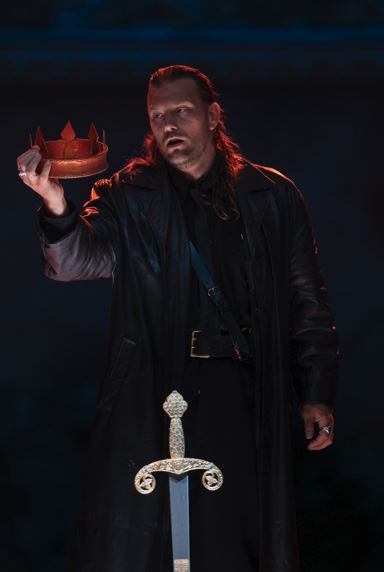
Here’s something that packs some punch: Shakespeare, Verdi and a concentrated distillation of a dark psychological melodrama.
Shakespeare was a hero of literature for Verdi who always kept a copy of Rusconi’s Italian translation of Shakespeare’s complete works by his bedside. When he wrote Macbeth, Verdi was a 34 years old rising star. Yet he was an elderly man before he wrote another opera based on the Bard’s works, Ortello in 1887 (aged 74) and Falstaff, a rare dip into comedy for the octogenarian Verdi, in 1893. Sadly his ambition to write Re Lear never materialised. It is almost as if the intensity of Macbeth burnt out his creative urge for Shakespeare. Nevertheless, his youthful 1847 version was to be revisited up to the definitive Paris version of 1865, now presented by West Green House Opera. Macbeth buzzed around inside his head for two decades and Verdi often described it as his favourite of his operas.
It is the intensity of director Richard Studer’s production that makes it stand out. In Verdi’s Macbeth there is no romantic tenor lead, no soprano heroine, as one might expect in an opera. In fact there are no heroes at all. The two leading characters are real people who suffer for their over-vaunting ambitions, progressively tremulous, triumphant, terrified and ultimately torn apart by their guilt as they are sucked into a spiral of evil of their own making.
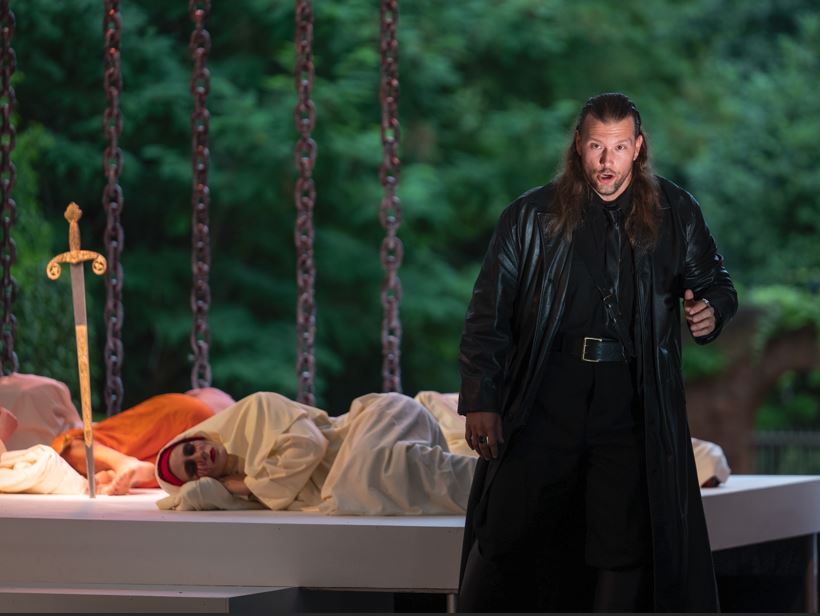
This is what produces the power of the piece. In spite of its title, it is Lady Macbeth who is the prime mover, determined and ruthless, and who is fired up by the prophesy that her husband Macbetto (Macbeth) can become much more than the hereditary Thane of Glamis. These two conspiratorial aristocrats, together with the honest Lord Banco (Banquo), the Thane of Lochaber, form the volcanic core of this production.
The thought-provoking design, by Studer, and cleverly lit by the ever-inventive Sarah Dell, is set against the facade of West Green House (perhaps too finely-chiselled to be a Scottish ancestral pile), which is seen through the open wall of the Green Theatre, where rows of chains hang. Chains confine, but as the plot progresses most are removed, for chains can also pull, and chains can anchor, as the Macbeth couple become more and more morally adrift. Around a central dais are tall purple and black cabinets. These can represent walls in the castle, or niches for assassins to hide, or spy rooms for the Doctor to observe Lady Macbeth’s mental disintegration. However, they are lined in stuffed and deep-buttoned satin, padded cells perhaps, or looking again, spiky iron maidens to crush dissent.
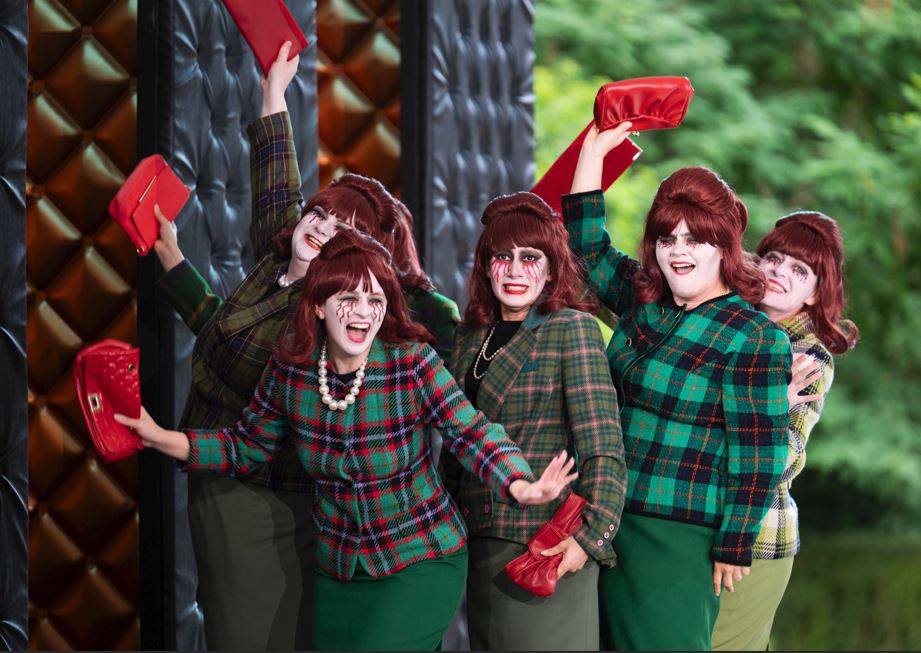
After the minor mode musical prelude, which gives a taste of what is to come especially the grand scena di sonnambulismo, we meet the witches, a half dozen formidable females, that make you sit up in your seat. They are a burlesque, designed to catch you off-guard. With narrow skirts and pinched-waist jackets in colourful tartan tweeds, and bright red hair, these lasses are robustly Celtic. Blood-red tears streaked across their faces are unsettlingly sinister.
Jill Rolfe’s wardrobe team has produced some striking costumes, including Macbeth and Banquo’s long leather-like greatcoats, with armadillo sleeves; and Lady Macbeth’s gorgeous gowns with sensational tulle cockades on one shoulder (beats a chip on it).
The six witches (who also double as apparitions and form part of the chorus) equally also take Macbeth and Banquo off guard when they encounter them after a battle. “Salve, o Macbetto”; they know his name, and he is to be Thane of Cawdor, soon to be proved true; and most significantly, King of Scotland.
Jean-Kristof Bouton as Macbeth and Simon Wilding playing Banquo create a powerful presence that has immediate impact. We are treated to them in full flow right from the returning battle victors’ fateful meeting with the witches, in the La mano rapace non alzerò duet in which Macbeth ironically promises never to raise a predatory hand to seize the throne.
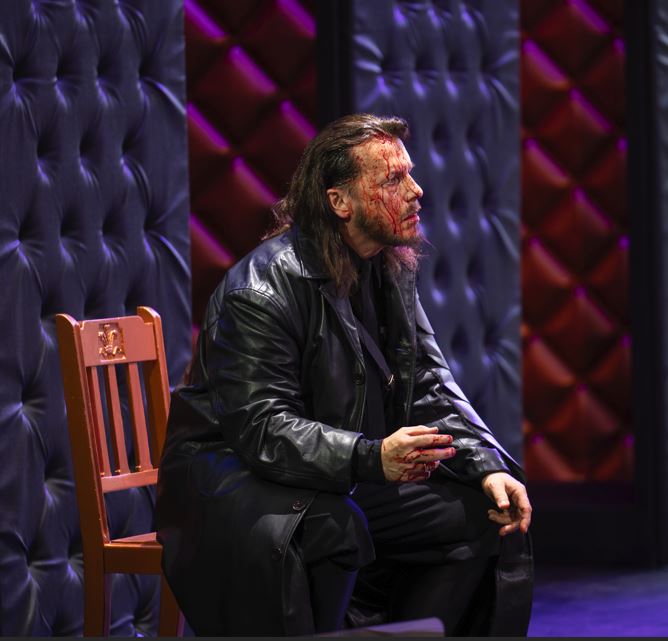
Wagnerian Simon Wilding really has some heft with his richly luxuriant bass. One regretted that Banquo is killed off so early in the opera, but he makes a horrifically omnipresent ghost with his blooded and battered face constantly staring at the terrified Macbeth. Here is a performer who can really act as brilliantly as he can sing.
Franco-Canadian baritone Jean-Kristof Bouton has great versatility and is an equally good actor. The potent resonance of his voice subtly follows the unravelling of Macbeth’s mind, culminating in the final Act in his aria pietà, rispetto, amore, in which he realises that compassion, honour, love will never again be his even in his old age. Then there is his final hollowing out, in his indifference to the death of his wife, È il racconto d’un povero idiota; vento e suono che nulla dinota, Verdi echoing Shakespeare’s words that life is “a tale told by an idiot, full of sound and fury, signifying nothing”.
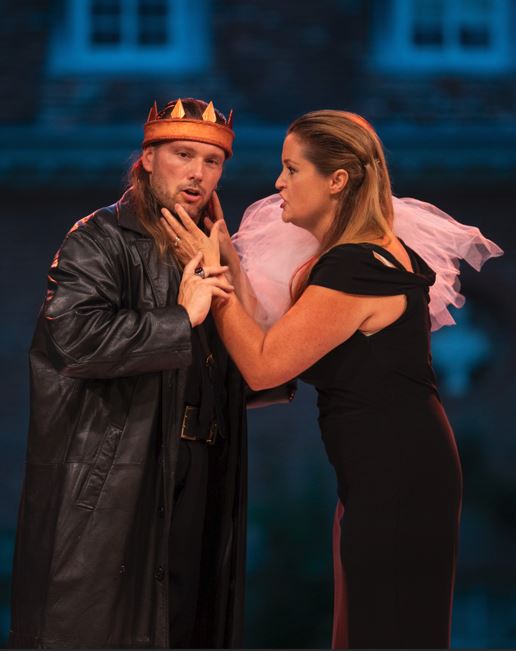
Bouton’s presentation really works in synergy with Mari Wyn Williams’ Lady Macbeth. The evil chemistry of their characters is fully charged in their duets. After having stabbed King Duncan to death, Macbeth returns to say “all is finished”. Bouton’s Tutto è finito hits the “finito” with a tormented semitone that propels the opening fatal mia donna duet. Here we see Lady Macbeth take over the action with ruthless resolve, as she orders him to be bold, while he ruminates that on a “pillow of thorns” he has “murdered sleep for ever”.
Lady Macbeth is a jewel of a part for a soprano. Verdi himself knew what he wanted of the role, even writing to a producer of an early production that he did not want Eugenia Tadolini, the foremost diva of the day to play the part, because “Tadoni’s voice has something angelic, but Lady Macbeth’s voie should have something devilish”. Mari Wyn Williams would fit the bill for Verdi. Her entrance aria reading Macbeth’s message about the witches auspicious prophecies excites her to encourage him to bold deeds. Accendere ti vo’ quel freddo core! “I will light a fire in your cold heart” she sings. Williams’ athletic soprano expresses this fiery excitement in leaps and forceful coloratura. And with her we follow Lady Macbeth’s gradual psychological disintegration. This culminates in the well-known sleepwalking scene, the sonnambulismo, following Shakespeare’s “out damned spot”, una macchia è qui tuttora…via, ti dico, sung by Williams with soft-toned delicacy. This nocturnal scene is observed by Lady Macbeth’s Lady in Waiting, a sympathetic role by mezzo-soprano Rebecca Afonwy Jones and under the professional psychiatrist’s eye of bass Jerome Knox’s Doctor.
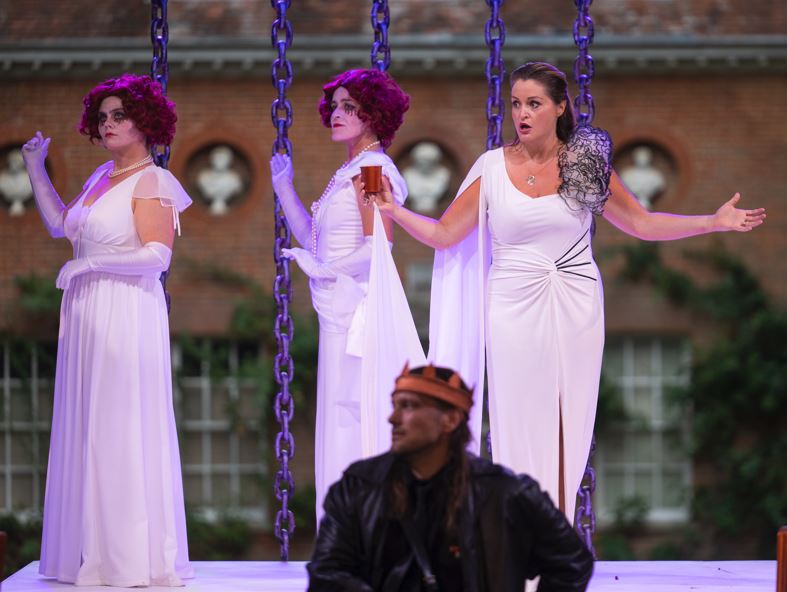
In contrast, we had seen William’s Lady Macbeth in flagrant remorseless mood, leading a brindisi drinking song, and continuing to lead it, even when their arranged murder of Banco is being carried out. Note that Verdi’s more famous brindisi in La Traviata, written between the original and revised versions of Macbeth also portends a death (Violetta’s own, of consumption).
Macbeth offers wonderful opportunities for chorus and ensemble pieces, the brindisi with all the Lords being entertained by Macbeth as their new monarch, being a good example. The party is of course interrupted by Banco’s ghost appearing to Macbeth, who reacts with manic frenzy.
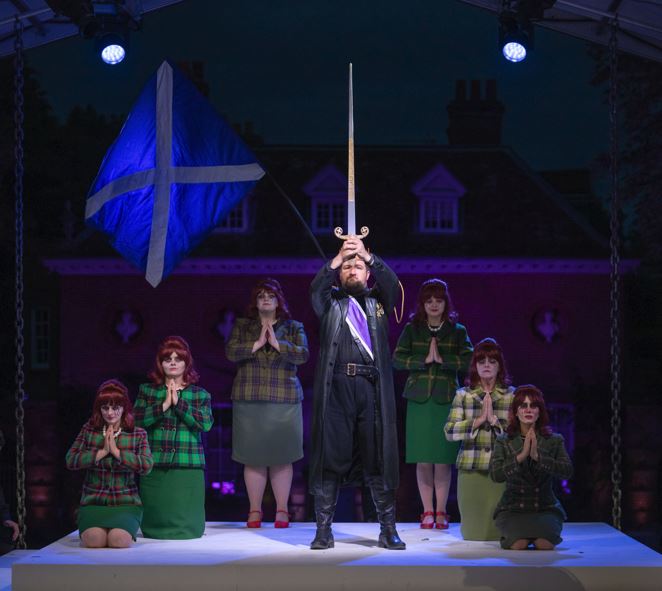
The Mid-Wales Community Chorus join with the characters on stage in set pieces. A dozen plus full-throated chorus on a small stage provides a number of impressive scenes, such as the beginning of the opera, praising with some reservation the new Thane of Cawdor. More so, at the conclusion of the opera, is the song of victory, salve, o re, lauding Malcolm, Duncan’s son, as King, and Macduff as the hero saviour of the Kingdom, which is a triumphant crescendo from the soldiers and people of Scotland after the death of Macbeth. Velvety tenor Thomas Elwin (currently also Artistic Director of West Green House Opera) makes a grounded, calm and regal Malcolm as he proclaims everlasting joy from this victory, La gioia eternerò per noi di tal vittoria.
The chorus’ most touching scene as displaced Scottish refugees stream across the English border, is enacted with measured pathos, as the sing in unison for their oppressed homeland, patria oppressa. As they sing of the deprivations visited on them by war, one is brought up with a jolt, thinking of our present world. These could be Ukrainians or many other persecuted peoples. Amongst them is Macduff, the Thane of Fife, whose wife and children have been freshly slaughtered by Macbeth’s squad of assassins. Robyn Lyn Evans is tragically magnificent as the bereft Macduff. His solo Ah, la paterna mano, non vi fu scudo, o cari, lamenting that his fatherly hand was not there to shield his loved ones, is the only tenor aria in the whole opera, and Evans imbues it with a deep anguished intensity. It is Macduff who finally puts and end to Macbeth, in single-handed combat. There is a very poignant touch, as Macduff kisses the pictures of his wife and children before letting them fluttter down onto the body of the vanquished tyrant.
The band of assassins, lead by bass Henry Saywell, who have murdered Macduff’s family, and earlier had brutally killed Banco, are a musically and visually arresting element. For the attack on Banco, and his son Fleance who escapes, they gather with rhythmical movements to Verdi’s stark staccato themes. A solo clarinet indicates Banco’s foreboding, but he is hugely outnumbered. The ensemble are clad in black uniforms and jackboots, reminiscent of Mussolini’s Blackshirts.
Awkwardly the same costume is worn by all the soldiers, making it hard to tell “goodies” from “baddies”. But the is a lot of doubling of both costumes and roles in the minor parts.
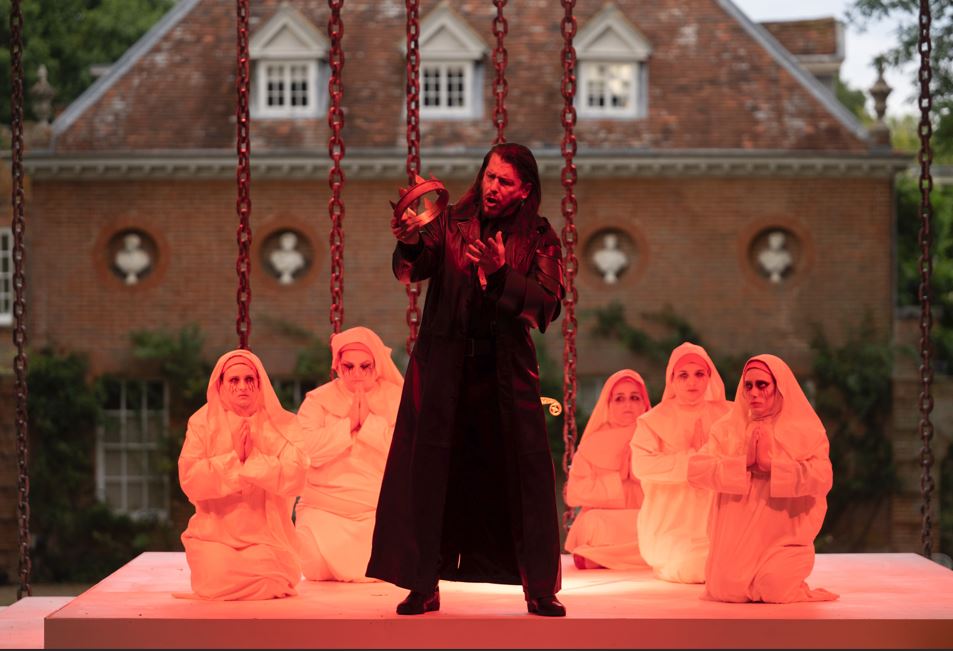
With its depth of emotion and intensely dramatic arias and chorus, the music of Macbeth expresses the power of the opera. Conductor Jonathan Lyness takes the nineteen strong West Green House Opera Orchestra on this emotional journey with insight and passion, to create a musical ambience that follows not only the plot, but the psychological state of each character.
This Macbeth is formidable package of passion and power, that captures the full intensity of Verdi’s masterpiece, and portrays the evil quintessence of tyranny.
As part of its silver anniversary season, Macbeth brilliantly showcases West Green House Opera’s artistic flair for quality opera, seen over the last twenty-five years.
Mark Aspen, July 2025
Photography courtesy of WGHO

 Mark Aspen
Trackbacks & Pingbacks