
Don Giovanni
Monochrome Mozart
Don Giovanni
by Wolfgang Amadeus Mozart, libretto by Lorenzo Da Ponte
Ensemble OrQuesta for Grimeborn Opera Festival at the Arcola Theatre until 30th August
Review by Patrick Shorrock

There is a fine line between authentically rough and ready and not really good enough. It gives me no pleasure to say it, but Marcio da Silva’s production of Don Giovanni is on the wrong side of that line.
Mozart’s opera is a hugely demanding piece, with fearsomely difficult roles that require immense vocal proficiency and theatrical charisma. Unless you have a vocally well equipped cast, you shouldn’t even be thinking of putting this opera on. With romantic and modern opera, sheer volume and intensity can cover a multitude of sins, but that is not an option for Mozart, where beauty of tone and fluent coloratura are also needed.
This story of a philanderer being dragged down to hell for respecting neither God, women, nor class divisions is not easy to stage. There are lots of changes of scene and requirements for big theatrical effects that are hard to bring off in a small space like the Arcola. This small space can often result in increased dramatic focus, but da Silva’s production seemed to require the cast to avoid looking at one another in a rather unconvincing way in order not to recognise one another before they were required to do so by the drama. It also seemed to repeat a number of tricks from previous productions of his such as laying out candles on the floor to mark a passageway. Leporello’s list of Giovanni’s conquests was an improvised tablecloth. When confronted by the masqueraders, Giovanni stayed sat-down and ate chocolate cake, walking off at the end in a way that was decidedly underwhelming. Never has the action of this opera seemed quite so implausible.

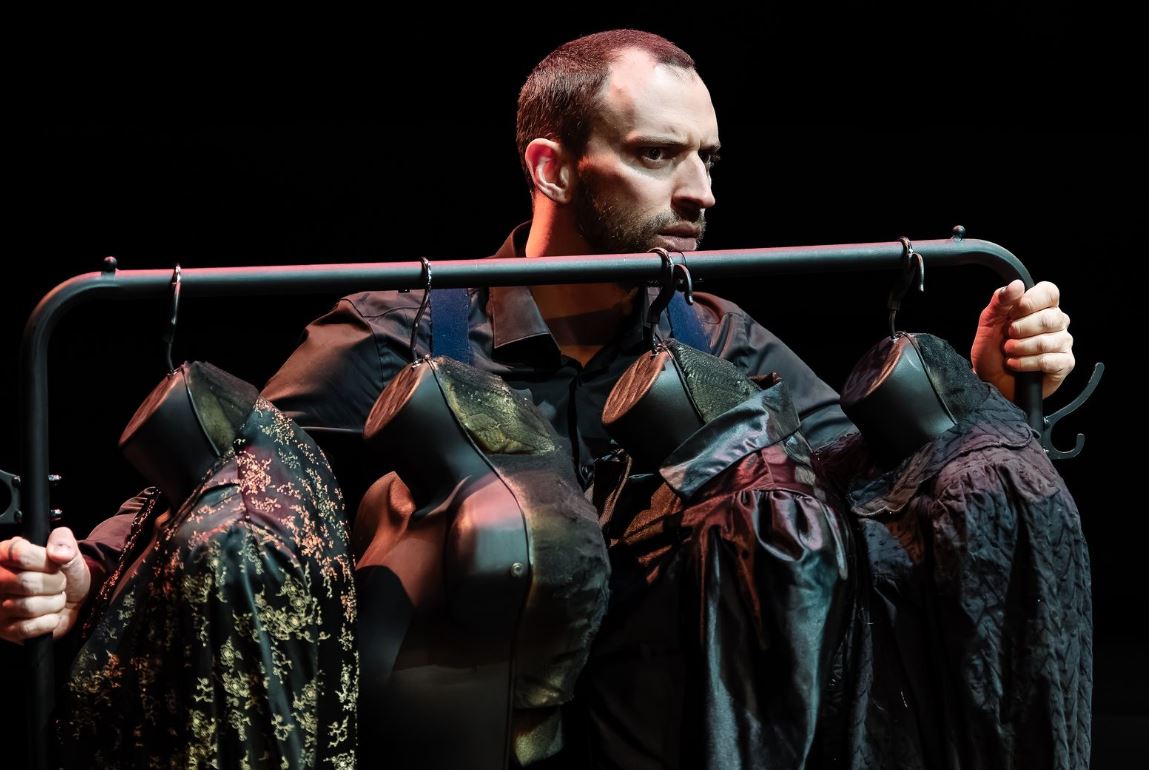
All the cast wore black — costumes by Gill Jenks — which was quite effective visually. There were several black headless and legless mannequins hanging from racks that were periodically wheeled on an off and wearing sequinned or lacy dresses or penguin suits. Giovanni periodically made love to one of them, a good way of indicating that he is pursuing the generic woman rather than any individual woman, although little was made of this.

The main issues with this performance were musical. In previous years, Ensemble OrQuesta have fielded a period band. Here we had the Hastings Philharmonic Orchestra Ensemble with just five string players, three woodwind, and no brass. This did the score no favours at all. The players did their best under Beth Fitzpatrick — on other nights da Silva and Andreas Levinsianos get to have a go — but there was rather too much wayward intonation and tuning. And the impact of the act one finale with an on-stage band playing against the orchestra lost its effect.
The singers were all challenged by their roles. Da Silva has presence but his Giovanni is too inclined to shout. John Twitchen should never have been asked to sing Ottavio, as he has none of the mellifluousness required. Flavio Lauria, Jay Rockwell, and Vedat Dalgiran were just about adequate as Leporello, Masetto, and the Commendatore, but rarely vocally pleasing. Rosemary Carlton-Willis had the required vocal attack for Donna Anna, but was not always easy on the ear. Helen May pushed and forced too much as Elvira. Anna-Luise Wagner was a rather knowing and sophisticated Zerlina, but was at least able to make something of her musical opportunities.
Patrick Shorrock, August 2025
Photography by Julian Guidera

 Mark Aspen