
God of Carnage
In a Stew about Scraps
God of Carnage
byYasmina Reza
Teddington Theatre Club at the Coward Studio, Hampton Hill Theatre until 27th September
Review by Steve Mackrell
Two married couples, a physical fight between their children, then a verbal fight between the adults. That’s the backdrop to Yasmina Reza’s comedy God of Carnage currently being presented by Teddington Theatre Club at the Hampton Hill Theatre.
Originally written in French, and translated into English by Christopher Hampton, the play was first performed in Zurich in 2007 and follows her earlier notable plays Art in 1994 and Life x 3 in 2000. In Hampton’s translation, we are in North London, firmly located in serious bourgeoisie territory, with four fully paid-up members of the Camden chattering classes. We meet two sets of parents, four diverse characters in all, each with their own distinct personality, views and social attitudes.
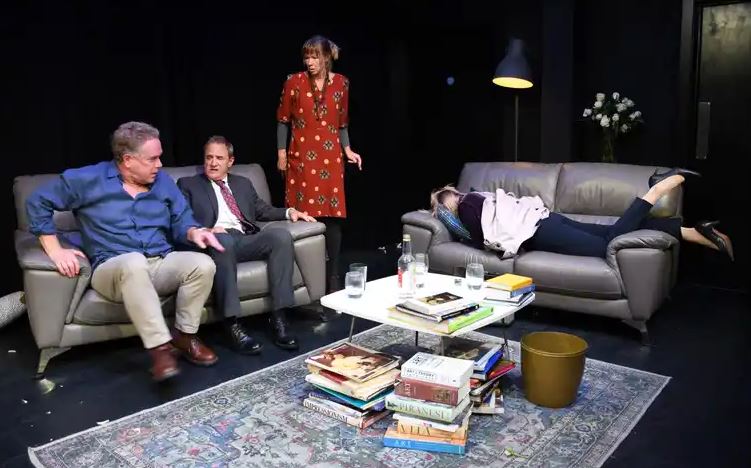
The catalyst for the two couples coming together is to discuss a reconciliation following an incident, where one couple’s eleven year old son knocked out the two front teeth of the other couple’s eleven year old son, in the school playground. And so the scene is set for this black comedy with the two sets of parents meeting for a civilised conversation about their children’s conflict. To start, all remains calm and rational and in the first twenty minutes one could ask, where’s the drama? However, as the evening progresses, the veneer of politeness slowly evaporates with the initial polite small-talk disintegrating into chaos, or indeed, carnage. Exchanges between the couples become increasingly blunt and intense as the mood in the sitting room starts to resemble more a clinical court of law.
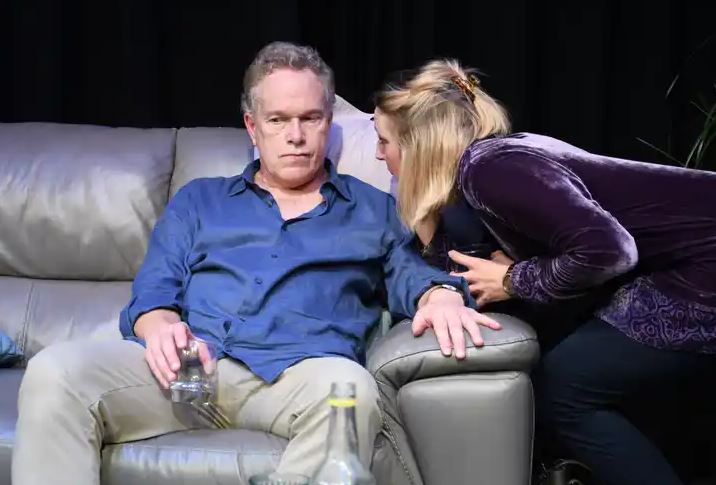
After resorting to drinking straight vodka, all sense of reconciliation evaporates, so providing a trigger for further anger, where more sensitivities are exposed with accusations, name-calling, tantrums and insults. What’s not to like? Yes, we seem to have arrived in a land of Edward Albee, with characters at war, spitting brutal verbal venom at each other in the style of some bizarre Who’s Afraid of Yasmina Reza.
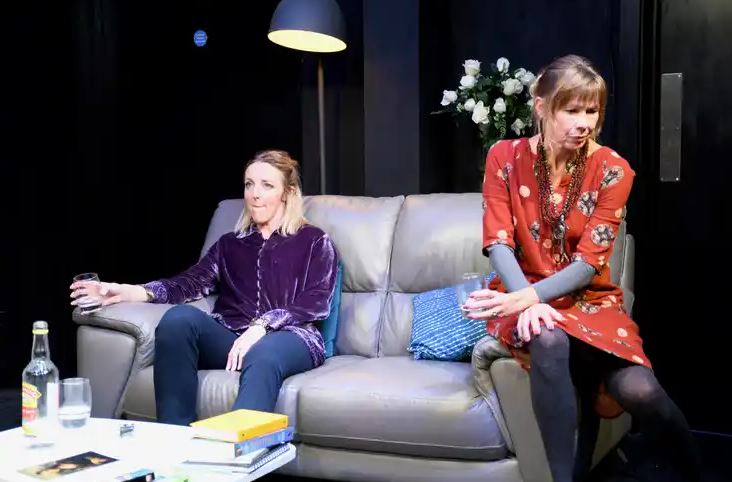
Clearly, the success of the play is very much dependent on a slow ratcheting-up of tension as the conversation proceeds and this is perfectly captured in Sally Halsey’s riveting direction. She creates a fluid and continually moving mosaic of the four characters as they relentlessly circle each other in the small intimate space, all adding to a sense of unease as the characters weigh each other up. The set itself, in the Coward Studio, is minimal with simply a couple of matching two-seater sofas, two vases of white roses and a myriad of scattered art books.
The strength of the production also lies with the quartet of actors and here are four pitch-perfect performances as they engineer their way through eighty minutes of real time. The host couple, with the bullied child, are Veronica and Michael Hollis, played by Melanie Richardson and Peter Hill respectively. Together they flesh out an extraordinarily truthful married couple while portraying the dual sides of their characters, from convivial hosts to warring couple.
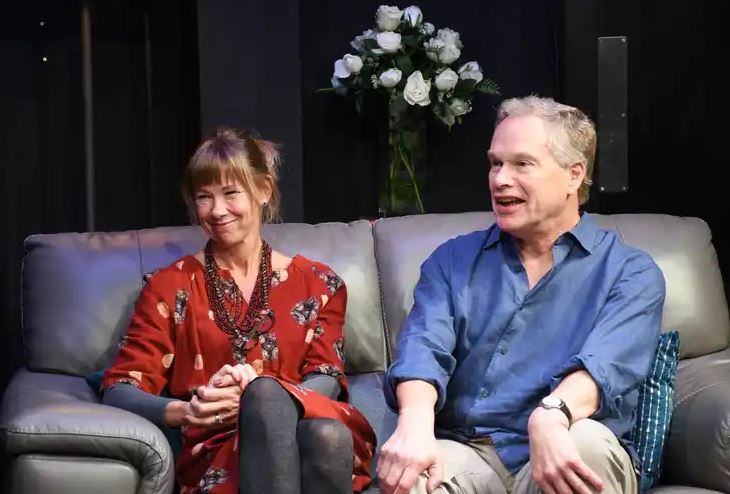
Melanie Richardson creates a sympathetic character striving for cultural and artistic ideals. She keeps her performance under control, despite her moods ranging from passive to assertive and from calm to anger. Her elegance and intellect clearly outshines that of her husband, played by Peter Hill, a self-made entrepreneur running a business supplying domestic hardware. Peter Hill captures the essence of this down-to-earth character who is flummoxed by the bullying of his son. With eyes darting, mouth flinching and facial expressions to reflect every twist and turn of the plot, his is a truly mesmerising performance.
The visiting couple, with the aggressive child, are Anna and Alan Reilly, played by Lucinda Springett and Dave Brickwood respectively. Lucinda Springett, as a wealth fund manager, initially appears down trodden and obliging, but after struggling with her own frustrations, she finds a strong voice to express her true feelings. One of the central dramatic moments of the play occurs when her character, Anna, realistically vomits over Veronica’s prized rare art catalogue. There’s also some touching chemistry between the two women as allegiances change in an excellent scene where Lucinda Springett’s Anna sides with Melanie Richardson’s Veronica.
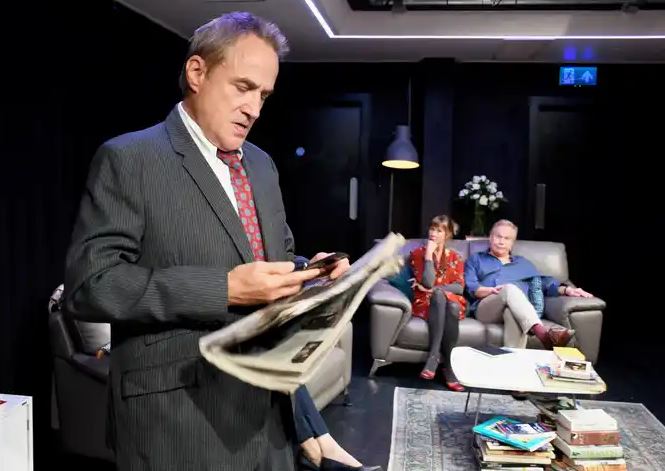
Dave Brickwood plays Alan Reilly, the laid back and laconic lawyer who is constantly irritating his companions by breaking away from conversations to talk on his mobile phone. Dave Brickwood fully fleshes out his character of a curt, high-powered lawyer who struggles to deal with his son’s aggression. He exudes a world-weary boredom with the whole incident under discussion much preferring to be totally consumed by his legal work.
The fascination of this production lies with following the relationships between the four characters; random alliances are formed then quickly dropped and the cracks in both marriages begin to be exposed. This darkly funny comedy skilfully reveals how civilised behaviour can rapidly deteriorate when under pressure, giving way to a more sinister and darker side of human behaviour. It also begs the question of how we react to disputes and whether adults, despite all their accumulated experience, are any wiser in problem solving than eleven year olds. It is perhaps the adults who are in the playground.
Steve Mackrell, September 2025
Photography by Sarah J Carter

 Mark Aspen
Trackbacks & Pingbacks