
Turandot : Preview
Timeshift Turandot in Turan
Turandot
Instant Opera at the The Courtyard Theatre at TownHouse, Kingston University, on 11th and 12th October
Preview: Opera critic Helen Astrid discusses the forthcoming production of Puccini’s Turandot with Instant Opera’s Artistic Director, Nicholas George
HA: Puccini’s last opera Turandot is often described as both monumental and enigmatic. What draws you personally to this opera?

NG: Instant Opera productions have steadily increased in scale since we emerged from the pandemic in late 2021. This has evolved organically rather than a deliberate move. We’ve proved that we can now tackle grand operas convincingly and, naturally, we wanted to mark Puccini’s centenary year. This began with our production of his Il Tabarro in October 2024, so what better way to end it with his final epic masterwork Turandot in the centenary year of its composition. Personally, it is an opera that draws me because has everything on a cinematic scale: overwhelming musical power and emotion, for example the astonishing finale of Act One; heartbreakingly tender moments, with Liù’s exquisite arias; and some brilliantly conceived scenes of grotesque, almost ‘Tarantino- esque’ black comedy in fine commedia dell’arte tradition!
HA: Has your relationship with the work changed over time?
NG: Musically, my appreciation of the work has grown over time, both from seeing various performances of it and from performing in it. Most recently, I have come to appreciate the Alfano ending more and more. But the nice thing with Turandot is there is something for everyone to enjoy coming to see it, even if they only know Calaf’s famous Nessun Dorma aria through football! New opera goers then have the opportunity to see this in dramatic context, and then come to love the rest of the opera.
HA: This production of Turandot, first seen in March this year (2025), now returns in a new and exciting venue, an amphitheatre in Kingston University’s TownHouse, designed by Grafton Architects for which they won several awards. This marks your Turandot as the premiere production in this space. How have you approached using the architecture and environment in the staging?

NG: The Courtyard amphitheatre at Kingston University TownHouse is a stunning new space deserving of its awards. When I first walked in there, towards the end of last year (as a Judge at Kingston University Enterprise Hub), I was immediately struck by its ‘indoor arena’ potential for staging opera. It has perfect sightlines and a clear resonant acoustic, so I got very excited at the thought of staging Turandot there! As things turned out we ended up first staging it at Normansfield Theatre last March, where we had to work hard to utterly transform the space to match my production concept of a dystopian, post-apocalyptic future. Our ‘futuristic’ new space at Kingston is far more suited to my concept than the old theatre. But restaging our production presents us with significant new technical challenges. The theatre is about as different from Normansfield as it is possible to imagine. The constraints of the tiny old Nomansfield stage required some truly excellent movement direction from Valeria Perboni, the original stage director. But we now need to think out of the stage box and ‘in-the-round’ in staging it and also vertically as the audience will be above us. Our Restaging Director, Ian Henderson, is relishing the challenges involved and creating some really innovative new ideas. We are also completely rethinking the set design, using less scenery to preserve sightlines and leaning in on the use of technology for the first time instead. So we’re really in new territory and, hopefully, our audiences will be in for another treat!
Tickets available now at: https://www.trybooking.com/uk/EWUF
HA: Many people associate 20th Century opera with modernism and dissonance, yet Turandot is full of sweeping melodies and grand romanticism. Do you think audiences are surprised to learn it was written in the 1920s?
NG: If they ‘know their Puccini’ as many audiences do worldwide, then they will be aware that most of Puccini’s operas, from Tosca onwards, were premiered in the 20th Century. Puccini is certainly the master of sweeping melodies and romanticism, but what is also interesting is that he was obsessed with the musical innovations of the new, brash, dissonant century he matured in, and he agonised how he could incorporate them compositionally within his essentially romantic idiom to create atmosphere and mood. Perhaps this was because of his growing awareness to match the developing phenomenon of film during this era. Turandot is the most vivid example of this with musical influences strongly in evidence from Stravinsky, Debussy, Schönburg, Strauss, as well as from less well widely known composers like Korngold and Symonowski.
HA: Do you feel that Puccini was engaging with or resisting modernist trends?
NG: Turandot has been described as the glorious sunset of Italian opera. During its composition, Puccini became also increasingly aware that it was going to represent his own mortal sunset too and apparently crammed in a lot of tunes he had stored up over the years to ensure his immortal legacy. So, although Puccini was very much engaging with modernist trends, he was also astutely careful not to discard traditional ones.

HA: That said, Instant Opera’s production brings a sci-fi lens to Turandot, a fascinating blend of opera and speculative fiction set in 2184. What inspired that choice, and how does the sci-fi aesthetic shape the way we understand the story and its characters?
NG: The story has been described as a grotesque fairy tale with some ‘problem’ components judged by today’s sensibilities. But, in mainstream media, so is Snow White appearing as a Broadway play in 1912 and then as Walt Dysney’s classic cartoon premiering eleven years after Turandot, and other ‘Grimm’ tales similarly adapted. Closer to home, Stravinsky’s Rite of Spring, Strauss’ Salome and Elektra and Berg’s Wozzek all predated the premiere of Turandot, and all contain similarly grotesque elements, yet they all seem to have escaped relatively unscathed, critically, compared to Turandot.
Like many fairy tales, grotesque or otherwise, Turandot contains its share of archetypal characters. For example ‘one bound and he was free’ heroes. Then there are heroines and heroes falling hopelessly in love at first glance, malignant baddies, misguided stooges and their opposites representing innocence, purity and justice. But these characters are representational and, importantly, transferable. They are neither fixed in place nor time. My thinking was that, as many ancient tales, or traditional fables have gory, dark origins when ghastly things happened only in the distant past, why not present this as a potential vision of the future too. Of course ghastly things are going on now, around us, all the time. We don’t seem to have learnt from our fables, fictions and cautionary tales, but keep repeating them. The difference is now we have the power and technology to bring about the end of civilisation, through war and climate change, or change it beyond recognition with, say, AI and genetic engineering.
Coincidentally, shortly after the premiere of Turandot, Sociobiologist Edward O Wilson once defined the problem of humanity as “… we have Palaeolithic emotions, medieval institutions and godlike technology ..” Our take on Turandot is not so much ‘sci-fi’ tale, but ‘a warning from the future’.
Regarding the traditional story, even in the most adverse circumstances people continue to be attracted to each other and develop romantic relationships. They also cling onto their cultural identity and institutions even more tenaciously having survived conflict. In the backdrop of a post-apocalyptic shipwreck this is evident in our Turandot as it is in the traditional version, so the story works equally well within the futuristic concept in which it is presented.

HA: Nick, you have a new international cast this time around. When casting a monumental opera like Turandot, where do you start? Is it with Calaf, the tenor lead, or Turandot, the dramatic soprano in the title role?

NG: You certainly need serious singers to tackle the three main roles of Turandot, Calaf and Liù. I believe we have these in spades. For casting, like many companies we seek to find the optimum blend of experience and new talent. We hold auditions before every production and are always amazed at the talent that walks in. Our chorus has knocked us out with their ability and represents many young artists in the making. We have a number of very capable artists covering the main roles among them.
HA: Turandot herself is such a complex character, icy, powerful, yet ultimately vulnerable. How do you think she approaches her transformation across the opera?
NG: The only time when this transformation may be visible is at the end of Act Three, after she has witnessed Liù’s self-sacrifice for love and when she is left alone with Calaf (although she has no doubt been thinking about things during the preceding night following Calaf’s offer). This turning point is the most challenging part of the opera and the hardest part to pull off. It is well known Puccini himself struggled for months with it, with his famous “poi Tristano” scrawled into his autograph manuscript in reference to the transformation of Isolde in Wagner’s Tristan and Isolde. It says it all, or rather it doesn’t, because unfortunately he did not live to fulfil his aspiration.
One of the joys of opera is that the music does much of the emotional heavy lifting. This allows the audience to imagine and experience their own personal feelings to such conundrums without a prescribed conclusion spelling things out, say as in a classic novel. Alfano’s ending, derived as it is from the musical fragmented sketches that Puccini left, does a fine job, but it remains so intriguing to imagine what Puccini would have done. We will never know!

HA: The role of Liù often moves audiences deeply, with her two beautiful arias. What role does she play in this interpretation of the story?

NG: Liù and her master Timur are escaping refugees from one sector to another in our version. It is not difficult to imagine the relevance to current events. Don’t miss the wonderful new talent of our new Liùs – American-Romanian Eva Gheorghiu and Claudia Chin Haussmann who will break everyone’s hearts with their renditions of this memorable, plaintive character.
HA: The setting of Turandot is a fantastical, stylised version of ancient China. In today’s cultural climate, how have questions of representation and Orientalism been approached in the staging?

NG: For questions of representation, one of the pleasures of Instant Opera is celebrating our multinational cast and the sheer talent we attract in greater numbers with every new production. For this Turandot we have, in the title role: Meeta Raval a former Cardiff Singer of the World finalist and Eleanor Greenwood, an international soprano from our original production, from Melbourne, Australia. Our Calafs are equally well represented by international Indian tenor Anando Mukerjee and the up and coming Moldovan Grigore Riciu. Other cast and artists in our production represent China, Japan, Argentina, Italy, Norway, Lithuania and Ukraine. Multiculturalism is not some lame corporate platitude for us, it is in our DNA!
Interestingly the story of Turandot is of ancient Persian origin — the daughter of Turan. It was not adapted to a Chinese setting until Carlo Gozzi’s play in the mid-eighteenth century. I would personally have no problem also staging it, as Puccini intended, in ancient China, but thought it more interesting to timeshift and placeshift it to the future for the reasons I mentioned. (If you want to know exactly where we have staged it, the clue is in the coordinates contained within the our programme note ‘Eastern Hemisphere, Central Zone, Sector 52/08 – 93/54’.)
HA: Puccini’s score is rich with musical colour and a real sense of Chinese influence; from eerie atmospheres, the humour of Ping, Pang and Pong to the grand choruses and the famous aria Nessun dorma (None Shall Sleep Tonight) often heard far beyond the opera house.
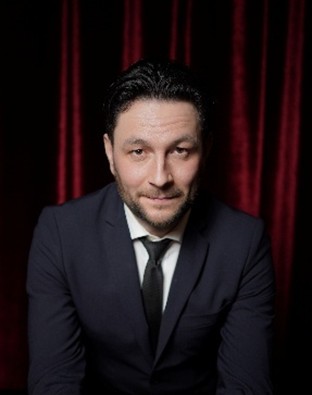
NG: There are well documented Chinese influences within the musical score. But, in the future, it is quite possible that western tonality no longer remains the musical lingua franca and a more pentatonic and rhythmic form of music re-emerges. Let’s hope Nessun dorma is preserved for a while though. It was and will be most epically performed by Anando Mukerjee and Grigore Riciu in our shows!
As for Ping, Pang and Pong. Again, with their character’s weary sardonicism and their toadying acceptance of authoritarianism, they are entirely transferable in time and space. Does that ring any bells? Yes Minister!
HA: What do you hope audiences will take away from your production of Turandot especially those seeing it for the first time?
NG: Just enjoy the experience and let the magnificent music wash over you. It’s not every community opera company that gets to perform in a mini indoor Arena di Verona, so enjoy the spectacle too.
We are delighted to be working with Kingston Ballet School again and their incredible troupe of dancers. Then there’s the adorable children’s choir joining us again who brought the house down last time.
And, without doubt, what audiences will enjoy from the first chord is our magnificent orchestra conducted by Kelvin Lim.
Finally as most of Puccini’s operas have tragic endings, at least this Turandot offers a candle flame of hope for our future!
Helen Astrid, September 2025
Photography courtesy of Instant Opera and Grafton Architects

 Mark Aspen
Trackbacks & Pingbacks