
The Elixir of Love
Coddled
The Elixir of Love
by Gaetano Donizetti, libretto by Felice Romani, after Eugene Scribe
English Touring Opera at The Hackney Empire, 27th September, then on tour until 22nd November
Review by Mark Aspen

Surely, we know were are in for a fun evening when at his first appearance Nemorino is wearing a cod piece. No, not that sort of codpiece, (sorry to disappoint) but a big-head fish costume, his advertising gimmick for his struggling seaside fish-and-chip stall.
And in follow the ensemble, some in sandwich-boards with ads for the ailing attractions of a seaside resort now neglected by erstwhile visitors. The soul of this pre-loved English seaside town is accurately captured in April Dalton’s nostalgic set. Its well-structured promenade and pier entrance speak of the shunning of these wonderful places, old friends cast aside as now being infra-dig. Yet here is the art-deco theatre, its faded bill boards pointing towards a past dipping of the toe in the water of culture, in its long past production of Wagner’s Tristan and Isolde.
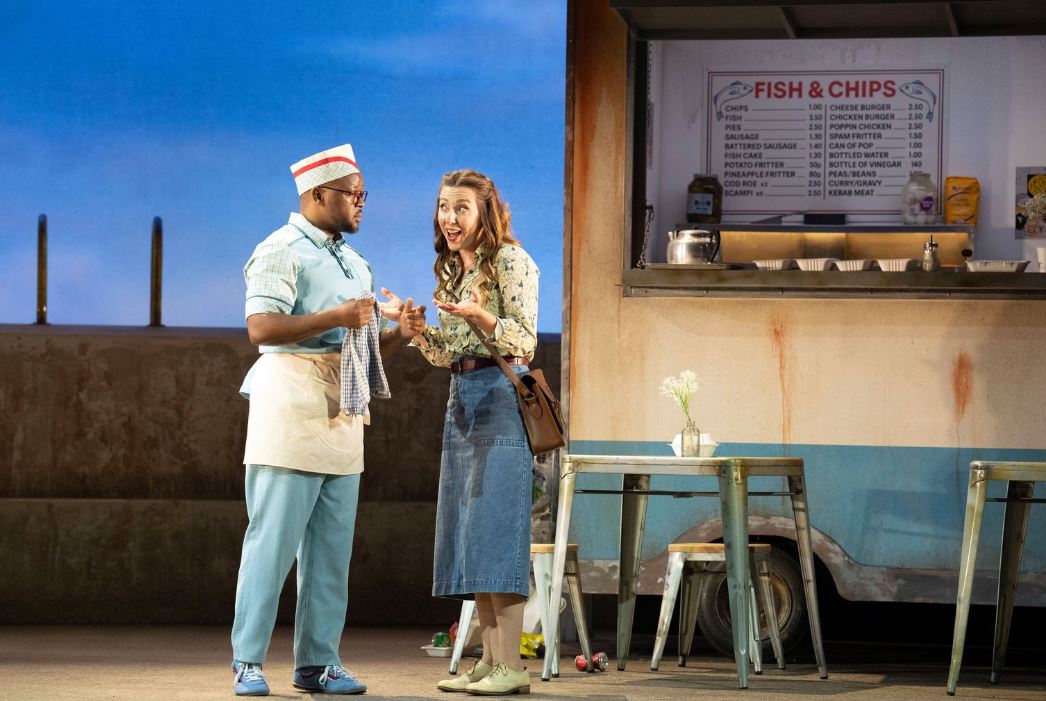
Fish and chips is perhaps a good metaphor for the lovelorn Nemorino, warm, wholesome, underrated (and, one might add, well battered at the hands of the belligerent Belcore). South African tenor Tamsanqa Tylor Lamani makes an endearing and wistful Nemorino, desperately in love with Adina, who is unattainably on a different level. His aria Quanto è bella, rendered as “She’s so lovely, so beguilling” has a quavering delivery full of uncertainty. Yet, his una furtiva lagrima, when it seems to him that the fabled elixir has done the trick, has an arresting beauty. Here, it is “I saw a tear . . .”, and after the bassoon introduction to set the mood, Lamani seems to hold a suspended moment away from the bustle of this most phrenetic of operas.

It is Tristan and Isolde that sets the whole thing smouldering; an impromptu reading on the steps of the run-down theatre by the bookish Adina of a modern version of Malory’s mediaeval romance. It quickly attracts an audience of the townspeople of this down-at-heel place, where even the lifeguard is on crutches. Maybe they look for an encouraging story with a glint of hope. The idea of a potion that could guarantee love ignites hope in Nemorino’s unsophisticated mind.

His hopes are frustrated by the arrival of the swaggering sergeant Belcore, announced by a military drum-roll. Boastful, blustering and bold he is the antithesis of Nemorino, who, while astounded, secretly wishes he too had his confidence. Timothy Nelson seems to have cornered the market in Belcores this year (at Layer Marney and Holland Park to name a few) as the soldier who lacks only modesty. And he has made the part his own with a combination of his rich baritone, which has both richness and edge, and hiscommanding presence. From his come Paride entrance, comparing himself to Paris with the apple, right through to his pragmatic shrugging-off of his defeat when when his ploy of a firing-from the-hip romance does not win him the girl, Nelson’s Belcore is full-on with arrogant braggadocio.

Dr Dulcamara, the quack doctor is gift of role for the lower register who can play the role larger than life. This is a part that cannot be played over the top, the most roguish of lovable rogues. Dulcamara arrives on a pale blue scooter tricycle, heralded by a fanfare, much to the excitement of all in this seaside town where little happens any more. Emir Wyn Jones eats this part with relish, his flamboyant persona, and stentorian bass-baritone making Dulcamara the centre of attraction, as he touts his extravagant claims for a panacea that cures toothache, wrinkles, impotence, asthma, rickets, dandruff and smelly socks et alia. Donizetti was one of the early 19th Century composers who mastered the opera buffa patter song, half a century before G&S. Jones has the aplomb and the acrobatic tongue to pull it with apparently effortless ease. Dulcamara’s syringes of blue balm sell like hot cakes. Of course he is soon approached by Nemorino enquiring about the fabled elixir of love to enhance his chances with Adina.
Natasha Page brings a freshness to the role of Adina. Hers is not the femme fatale or the vivacious vixen of so many Elixirs. This Adina is a demure, studious, nice girl-next-door. She is flustered by the obsessive attentions of Nemorino, and flustered by her own feelings. We are treated to her lightly-decorated, soaring soprano, and she certainly knows how to hold onto a note for dramatic effect.
Apart from her captivating solo singing, Page excels in Adina’s duet opportunities. In Nemorino’s duet with her, countering her suggestion that “If you ask the breeze” it will blow your affection this way and that, so why not look at other girls, he is adamant that “I you ask the rushing river” it cannot change its course. After all she capriciously plays the field, if only in her heart. Nemorino can only be unwavering in his affection for Adina. Where the world sees an obsessive fixation, he sees only faith and loyalty. Both Page and Lamani convincingly bare their characters’ souls in this lovely duet.
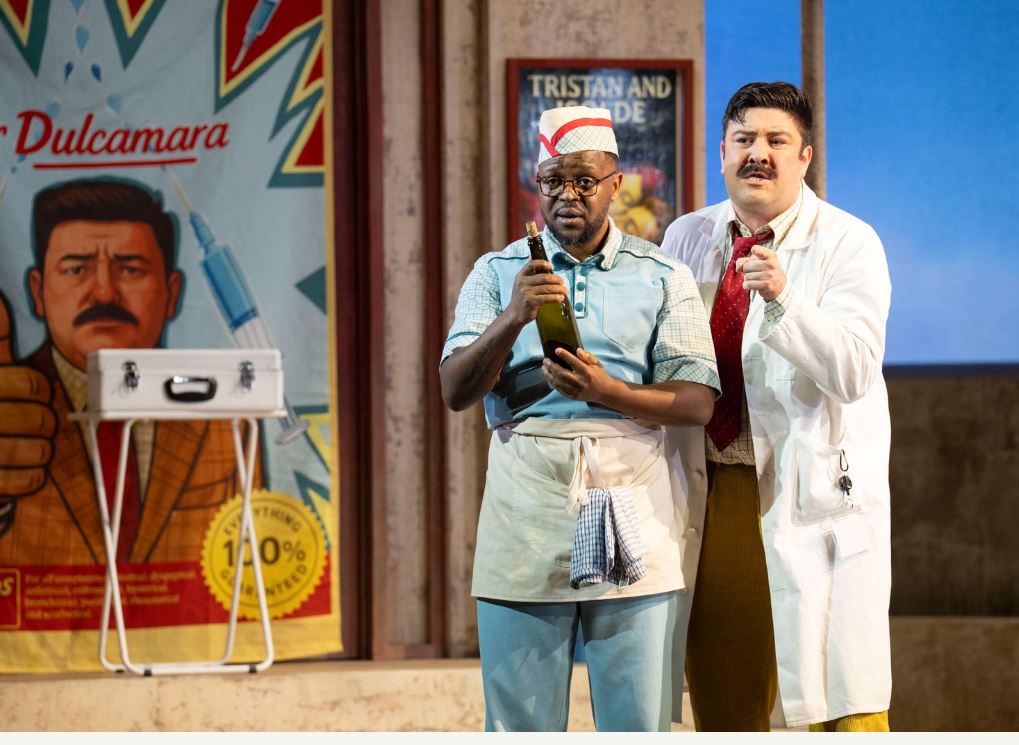
In a different mood entirely is Adina’s duet with Dulcamara, part of the celebration party leading to her reluctant wedding with Belcore (which is soon cancelled). They act out fictitious roles as a young girl and a wealthy man, the barcarolle duet Io son ricco, both Page and Jones sing with great panache in this play within an opera, which hints at further developments, “I am rich, and you are pretty” Page though, through fine acting and subtle modulations in her singing voice, of the anguish arising within her the Nemorino in nowhere to be seen.
One cannot not help but to be drawn to Rosie Lomas’s Giannetta. It is small role, but she makes the most of it, and without intruding, singing in a sweet soprano, but with punch. Her Giannetta is the fiesty, bossy young chip-shop manager and general factotum, emerging like a butterfly from her chrysalis at the lure of Nemorino’s new charm. This charm is his money, newly inherited from his deceased uncle, the plot twist that prefigures its denouement.
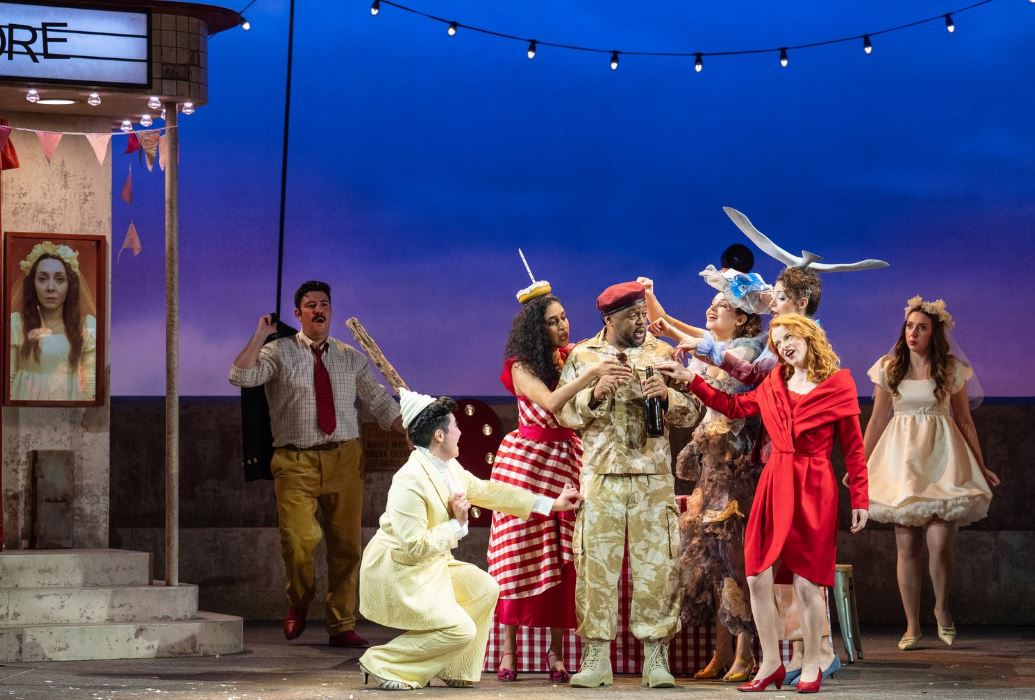
The mood changes in the action are skilfully underlined in Jamie Platt’s subtle lighting, while Amanda Holden’s junty English translation finds extra humour is it keeps the action on its toes.
Conductor Alice Farnham bring a vivacious life to the score, taking her energetic orchestra into this jaunty action in a performance they all seem to be enjoying.
In spite of it being so full of life and so funny, one cannot help thinking that not one of the characters is squeaky clean, Adina’s playing with Nemorino’s affections, he guilt tripping her, Belcore’s self centred shallowness, and Dulcamara’s fraudulence. But simultaneously one cannot help but like every character (to a greater or lesser extent). However a stripe of cruelty runs thorough most humour, for laughter mollifies pain. It is the banana skin joke.
What director Martin Constantine has so consummately achieved in this Elixir of Love, is a great sense of fun, without losing the pathos; and without losing the suffering, the huge sense of comedy, the laugh out loud humour that has made the opera a perennial favourite.
Mark Aspen, September 2025
Photography by Richard Hubert Smith


 Mark Aspen