
Les Vêpres siciliennes
Gold Plated Behemoth
Les Vêpres siciliennes
by Giuseppe Verdi, libretto by Eugene Scribe and Charles Duveyrier after Le Duc D’Albe
The Royal Ballet and Opera at the Royal Opera House, Covent Garden until 6th October
Review by Michael Rowlands

This operatic French-Italian mongrel, The Sicilian Vespers, is on it’s third outing at The Royal Opera House and in this revival a third change of cast, with the lovely Lebanese-Canadian Verdi specialist Joyce El-Khouri singing Helene, replacing Marina Rebka. Valentyn Dytiuk replaced Soek Jong Baek as Henri, Ildebrando D’Arcangelo sang Jean Procida and Guy de Montfort was sung by Quinn Kelsey who was in the original casting.

The bloodlines of this 1855 behemoth are genetically far apart. Verdi at the top of his form, after La Traviata (1852), Rigoletto (1851), and Il Travatore (1853), produces a wonderful Verdian score that, presumably deliberately, does not have the fully composed-through music of his successes but, at times, reaches as high as any of his work. The other bloodline is, to us, and probably to Verdi too, an outdated operatic straitjacket that was just the genre Verdi was reacting against. Napoleon III was heading a prosperous, rapidly industrialising country, that had opera at its cultural heart, so big was better. Meyerbeer was the man to beat, which meant a five act grand opera, usually based of a quasi-historical event (in this opera a revolt on 30th March 1282 in Palermo), with opposing sides, and with a personal family, duty or love conflict. It was to have a ballet after the interval, and one that also has dramatic spectacle.

The basis of the libretto was written twenty years before, and with a quick change of venue moved from the Flanders to Sicily. To many, the four-hour running time is the epitome of excess, but it was created at a time when everyone had longer than our current attention spans, which have even diminished since this production in 2013. It’s an operatic opportunity to embrace and savour Verdi despite the deficiencies in the plot. The music is coupled with an expensive set and lavish costumes, that we are not going to see any time soon in these financially strained times.

Stefan Herheim, the director, moved the setting from 13th Century Sicily to a representation of the Paris Opera House of the 19th Century, and moved the action to the conflicts between artists and the public – a simile that’s stretched to incomprehension. However the set looked beautiful, enhanced by the insertion of a Degas-inspired corps de ballet. The evening had been freed from the requirement of forty minutes of ballet music, so the ballerinas added a lot more to the atmosphere – and they deserve a special mention for their technique and poise. The director made the right decision to use the same set of the inside of the opera house with variations throughout the whole evening, with ballet barre and mirror, tiered seating with ornate gold-leaf balconies, which could be moved in various configurations.
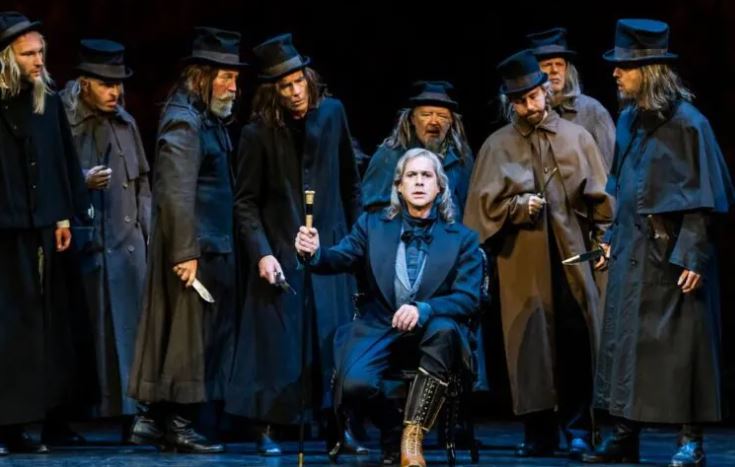
The conductor Speranza Scappucci never flagged during the long evening. She conducted with verve and precision, and she brought warmth and contrast out of the orchestra, supporting the singers and fully revealing the Verdi score.

Joyce El-Khoury, in her first time in this role, was excellent and sang superbly through the evening, rising to the challenges of the Fourth Act, utterly confident with the French libretto. Valentyn Dytiuk lacked gesture at times, but more than made up for it in the last two acts where his qualities were apparent. Quinn Kelsy was a star throughout, and Ildebrando D’Arcangelo was at home on the stage, but perhaps was somewhat the weakest of the very strong cast.
This vêpres siciliennes made a great night of well conducted Verdi, with a strong cast, and an attractive set, enlivened by the ballerinas who were on stage in most acts. However, Herheim’s interpretation added confusion rather than clarity to a long evening.
Michael Rowlands, October 2025
Photography by Tristram Kenton

 Mark Aspen