
Albert Herring
Scaled-down Herring, Big Catch on Humour
Albert Herring
by Benjamin Britten,libretto by Eric Crozier
English National Opera at the London Coliseum until 16th October, then at The Lowry, Salford until 22nd October
Review by Helen Astrid

English National Opera has entered its twin-city era, moving part of its operations to Salford while maintaining a reduced programme at London’s Coliseum. Its first joint venture, Antony McDonald’s semi-staged production of Britten’s chamber opera Albert Herring, opened on 13th October in a slimmed-down format.
ENO has long been a champion of Britten’s work – it famously premiered Peter Grimes in 1945 – yet this marks its first performance of Albert Herring. The choice seems a bid to reach new and broader audiences, with economy central to its approach. For a chamber opera, however, it verges on grand-opera scale, running to 140 minutes excluding the interval.
Written in 1947, Albert Herring is a whimsical tale set in a fictional village in Suffolk, Britten’s home county. When the annual May Queen of unimpeachable virtue cannot be found, the townsfolk – convinced that none of the girls is sufficiently pure – settle instead on the painfully shy greengrocer’s son, Albert, thus crowning a May King. The comic fallout from this decision unfolds with typically Brittenesque wit.
Based on Guy de Maupassant’s novella Le Rosier de Madame Husson, the humour arises from the clash between small-town moral pretensions and human weakness, a hallmark of Maupassant’s irony.
There were slight parallels with Mark-Anthony Turnage’s recent Festen at the Royal Ballet and Opera, though a far darker theme, where family and friends gather for a birthday celebration yet turn a blind eye to their hosts’ shocking behaviour, a thread that continues to dominate our current tabloid headlines!
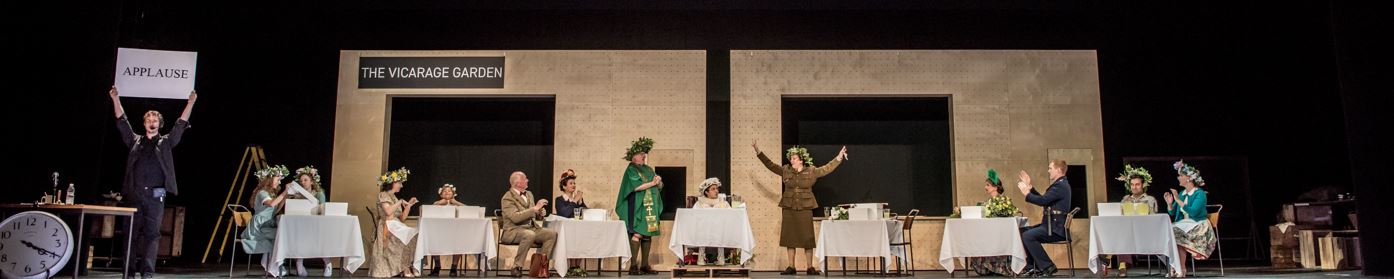
Antony McDonald’s set design lacked depth. Its lightweight, cardboard-like texture evoked something closer to a giveaway in a children’s cereal-box, easily assembled, and just as flimsy. The onstage presence of the Deputy Stage Manager proved an unnecessary distraction; with wings as generous as those at the Coliseum, there is little justification for such an intrusion. We were reminded of the production’s bare-essentials by placards indicating each setting — The Vicarage Garden, Herring’s Grocery, Mrs Herring’s Shop — and even when we should applaud.
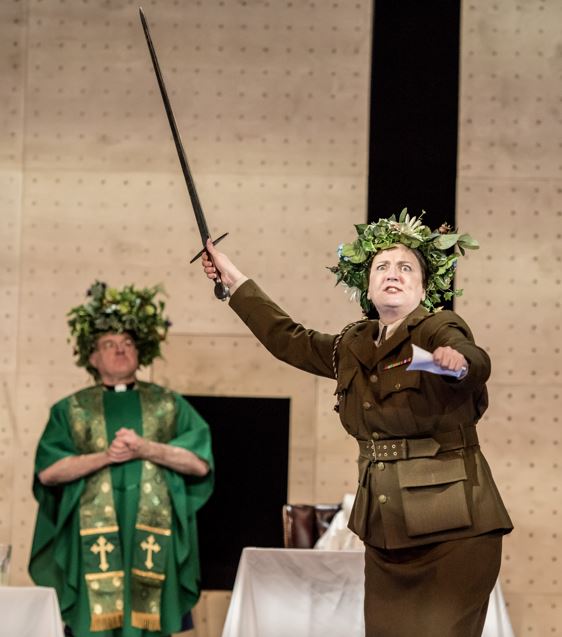
Given the unusual brevity of the rehearsal schedule, the singing was first-rate, with several standout performances. Emma Bell’s commanding portrayal of the majestic, militaristic Lady Billows set the tone for the parochial village ensemble. She is the opera’s quintessential small-town moral busybody, and when she boasts “I’m full of happiness”, the initial joyous tone evolves into a frantic and high-minded lecture.
The eponymous hero, Albert Herring, sung by Caspar Singh, commanded the stage from his first entrance, toning his upper body with a resistance expander, no doubt to prepare for the giant sack of turnips he must lug around. His Act Three monologue, “And I’m eternally grateful to you all,” where he reflects on his newfound independence and rebellion, was delivered with eloquence and brilliance.
The young lovers, Sid (Dan D’Souza) with his slicked-back D.A. hairstyle and sideburns, and Nancy (Anna Elizabeth Cooper) in a 1950s floral skirt, could have stepped out of the recent immersive Grease experience at Battersea Park; at times her lush voice seemed ready to slip into Hopelessly Devoted to You. Britten cleverly assigns most of their duets in unison, a musical shorthand for youthful complicity.
Eddie Wade, as the Rev. Mr Gedge, was sensational. His crystal-clear diction and velvety tone shone, particularly in “Is it virtuous? Yes or no.” Equally, Aoife Miskelly’s pert and poised Miss Wordsworth was everything one could wish for in a schoolteacher. Her prim gift to Albert — Foxe’s Book of Martyrs, to occupy his rainy afternoons — made our hearts leap up with joy.
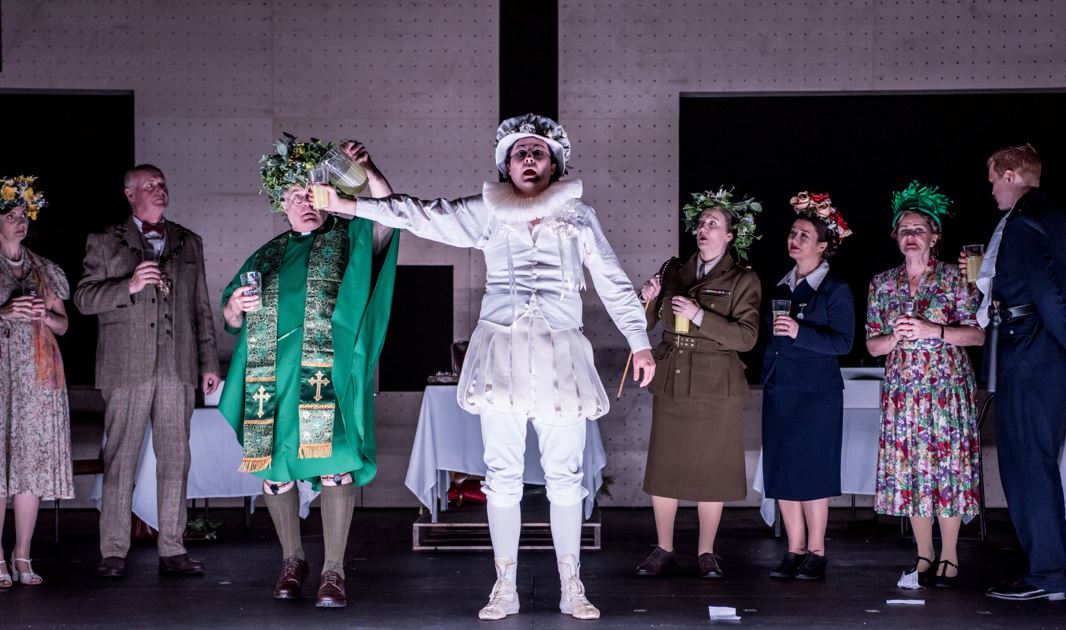
There were moments of genuine hilarity and others of deliberate awkwardness. Carolyn Dobbin’s Florence Pike delivered “country virgins” with such clipped precision that one hardly knew whether to giggle or wince.
Britten is, of course, a master at portraying those at odds with society, as we see in Billy Budd and Peter Grimes, or the marginalised figures in Albert Herring, Curlew River and Death in Venice. Eric Crozier’s masterful libretto has a sharp ear for class; his speech patterns lend the text a natural musicality even before Britten’s setting. His humour gradually gives way to empathy, a hallmark of Crozier’s humane style, with its fast-paced exchanges and overlapping dialogue.
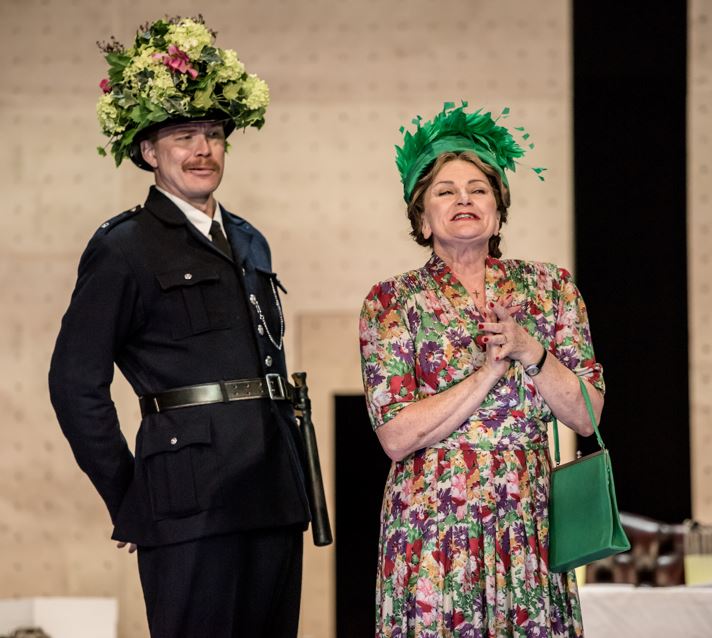
The poignant mock-threnody in Act Three — a pseudo-lament for Albert, whom the villagers presume to be dead — captures their exaggerated response while underlining his clever escape from their control, prize money in hand. It was an intense ensemble moment, beautifully sung and full of feigned grief and unintentional irony.
It’s clear that Britten was an admirer of Wagner; his recurring harmonic patterns reveal a kinship with the leitmotif idea. There’s even a quote from Tristan und Isolde in the Act Two banquet scene, when Albert drinks his spiked lemonade and succumbs to hiccups, Britten’s parody of grand opera at its most hilarious.
The ENO ensemble of fourteen players, conducted by Daniel Cohen, played with lucidity and colour. Certain instrumental touches hinted at psychological states, the harp, for instance, symbolising Albert’s innocence.
Ultimately, the opera affirms that rebellion triumphs over hypocrisy. In this witty, sharply observed production, ENO reminds us that self-discovery and moral courage can flourish even in the most provincial of settings.
Helen Astrid, October 2025
Photography by Genevieve Girling

 Mark Aspen