
Die Rheinnixen
Nixed but Triumphant
Die Rheinnixen
by Jacques Offenbach, libretto by Charles Nuitter and Alfred von Wolzogen
Gothic Opera at the Battersea Arts Centre until 2nd November
Review by Patrick Shorrock
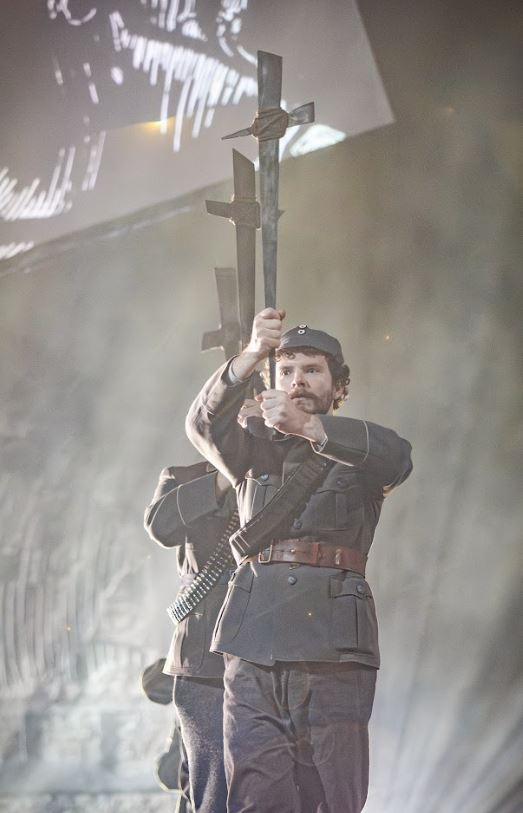
This operatic exhumation by Gothic Opera is another triumph for this enterprising company. Who knew that Offenbach – responsible for all those naughty French operas comiques like La Belle Helene, Orpheus in the Underworld, and La Vie Parisienne – had written a deadly serious opera in German?

I must admit that the title had led me to expect a Wagner parody, when what we are given is much more like a sneak preview of Les Contes d’Hoffmann. As well as a heroine who is obsessed with singing herself to death (just like Antonia in Hoffmann) we are presented with Offenbach’s first rendition of the famous Barcarolle, which we associate with Venice and Offenbach’s final work, rather than here where it is sung by the mysterious enigmatic yet benign spirits of the German forest. Offenbach in serious mode is really rather good, with some wonderful music, glorious duets, and a splendid concluding ensemble. The big numbers do have a habit of fizzling out rather than coming to an applause-generating climax and make exorbitant vocal demands, which Gothic Opera’s cast met with considerable panache. This was music that was well worth hearing and received impressive performances from a cast of talented young singers
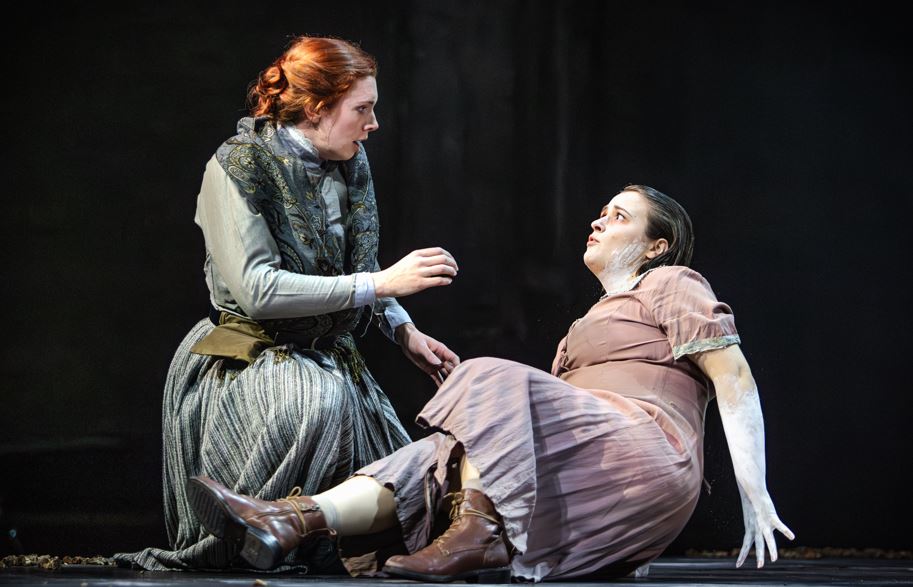
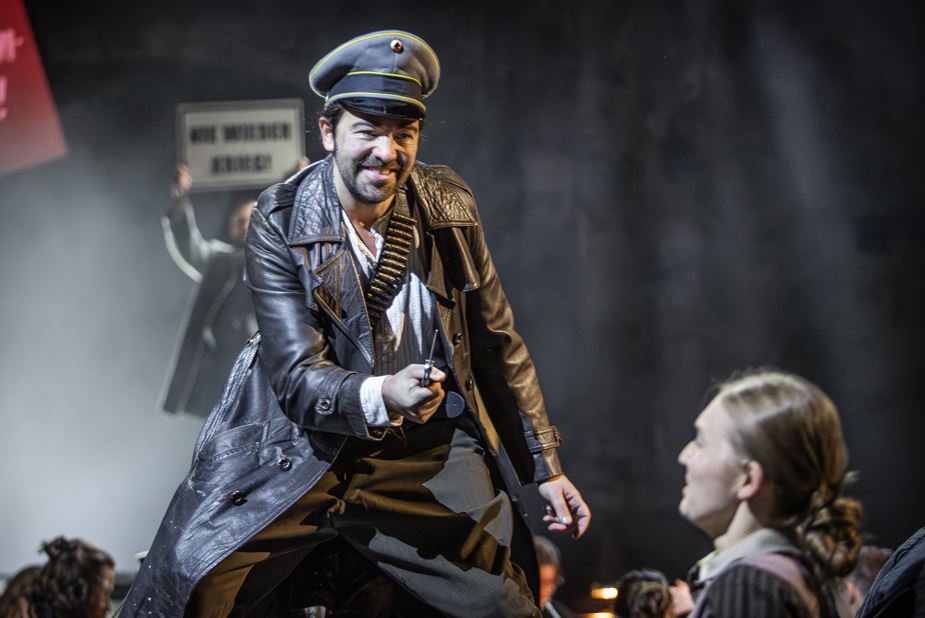
Hannah O’Brien as the hapless Armgard was magnificent in a demanding and exposed part that required flexible coloratura as well as well as strength and security. She has a gloriously fresh sounding voice, but deserves some less challenging repertoire to give her voice time to mature. Katie Stevenson provides some dark but firm tone as her mother Hedwig. Sam Utley did well in the heavy tenor part of traumatised mercenary Franz. Samuel Lom attained to an almost Verdian grandeur as the villain who morphs into a repentant father, but neither music nor libretto make the most of the potential for rich drama here.
The score, arranged by Leon Haxby, had been reduced to a chorus of eight and a string quartet plus flute, harp, and bassoon: whilst not quite the real thing, it sounded immensely rich and appealing, and Hannah von Wiehler conducted with considerable finesse.
The main drawback to the evening was the plot and the libretto. The country is being marauded by mercenaries headed up by Conrad and including Franz who is in love with Armgard but has lost his memory. Conrad forces Armgard to sing for the troops and she swoons and is thought to have died. Instead, she wanders into the forest as does her mother. For reasons that remain obscure, when she bumps into her mother she pretends to be a ghost, but eventually Franz gets his memory back, Conrad repents and is reunited with the daughter he never knew he had, and everyone is all reconciled. They are all about to get massacred by the mercenaries, when the eponymous Nixies somehow sort things out. If I sound a bit unclear, there was no synopsis in the programme and I am relying on the surtitles.
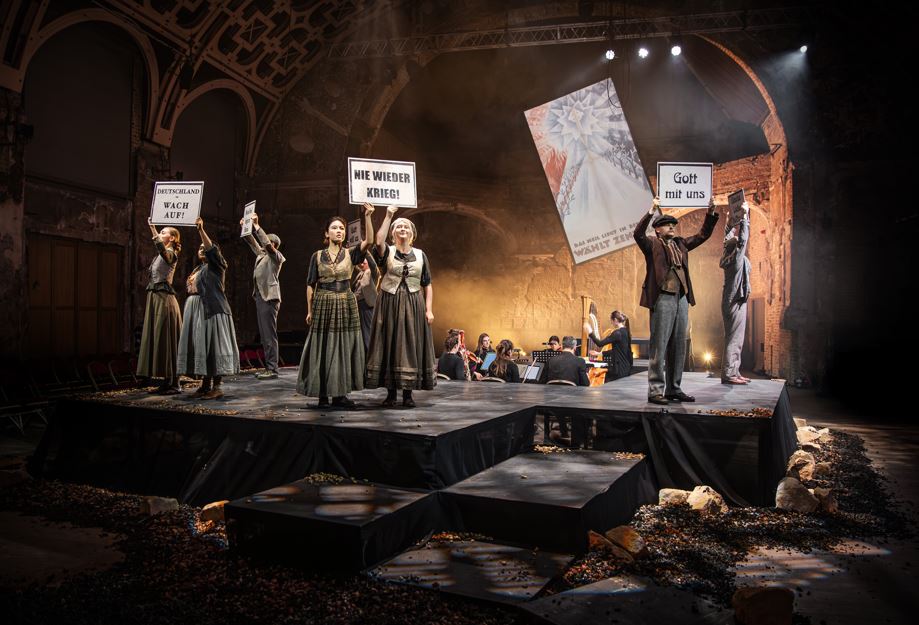
Staging this nonsense would be a challenge for anyone, let alone on a budget. Isabella Van Braekel produced an atmospheric set, aided by the beautiful Battersea Arts Centre’s interior – organ pipes one end and stony wall with an arch to the side at the other. This, along with Wilton’s Music Hall, must be one of the most alluring auditoriums in London. Amber Cooper Davies provided some animations in place of a ballet. Max Hoehn’s production made effective use of the space too, and made most of the action work, although I was less convinced about transferring the period from the 1522 Peasants’ War along the Rhine to the post First World War Weimar Republic, which made the pacifist happy ending even more unconvincing. There were lot of contemporary posters and placards all in German, which added to the atmosphere but didn’t aid comprehension. For some reason, the cast all appeared at one point with white paint smeared onto their faces. All of these were forgivable, as I doubt that any director could convincingly salvage this piece, for all its wonderful music.
Patrick Shorrock, October2025
Photography by Craig Fuller

 Mark Aspen