
Emilia
Dark Lady Shines
Emilia
by Morgan Lloyd Malcolm
Questors Productions at the Judi Dench Playhouse, Ealing, until 8th November
Review by Claire Alexander

‘There is volume in our silence’ is a phrase that has resonated with me and is repeated throughout Morgan Lloyd Malcolm‘s text of Emilia, presented at Questors theatre this week. It is a part fact, part fiction account of the life of Emilia Bassano, a woman born in 1569 in Elizabethan London, and a poet and trailblazer for what women could achieve, at a time when they had no say and were more often restricted to a life governed in every possible way by men. The phrase speaks volumes indeed and this play shows us in an accessible and sympathetic way how women had no power, however talented or and abused. Emilia’s own mission is to have her talent and poetry noticed and published, and the play nicely contrasts Shakespeare’s success versus Emilia’s invisibility.

Emilia takes us on a journey through our heroine’s life: from her early days learning deportment and curtseying in preparation for a life at court on the arm of the man chosen for her; from her brief taste of freedom as Shakespeare’s muse (she is often thought of as the ‘dark lady’ of his sonnets), and fleeting literary freedom in Lady Margaret Clifford’s household as tutor to her daughter; to destitution following her casting out from court when her husband (in name only) dies and in debt. In fact some of the more touching scenes come later on in the play when Emilia is befriended by the washer women of Bankside. Ultimately there is no difference in the disempowerment and disenfranchisement of these the poorest people in London and the ladies of the court. But the washerwomen have an unshakeable community that helps them survive the harshest of times.
Interestingly Emilia was premiered by the Royal Shakespeare Company at the Globe and I can see a power presenting this play on the very shores of the river that still runs through the city, much changed, but so much the same over 400 years later.
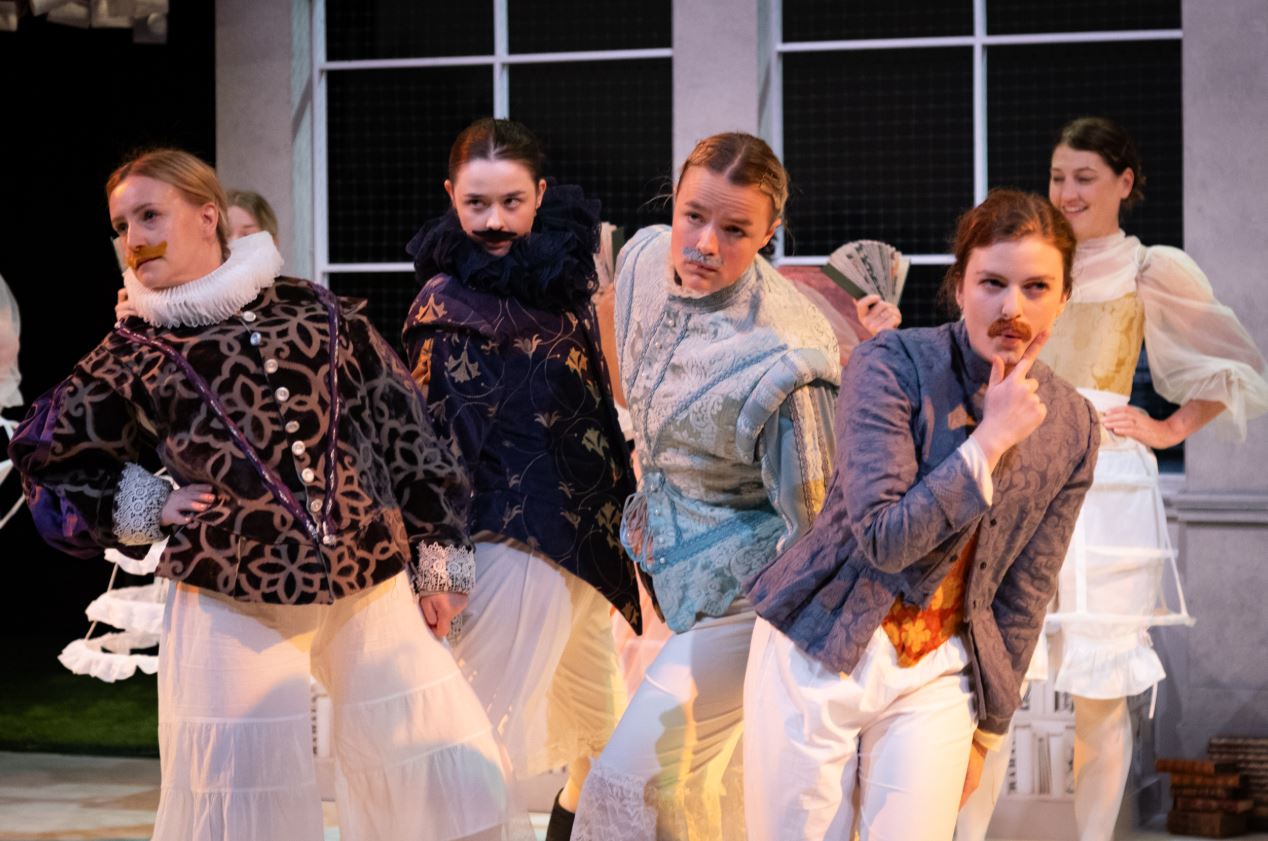
In Questors’ delightfully visual production everything from the false formality of the court, to the agony of birth and rawness of death is captured with simple yet very effective physical theatre music (carefully curated by Russell Fleet) and movement. I particularly enjoyed the scene when the ‘primped and plucked’ girls from the court were introduced to the awkward and louche men . . . their potential suitors. The girls danced to perfection while the men were all ungainly and wooden! There are some powerful tableaux too; the death in infancy of Emilia’s second child (widely rumoured to be Will Shakespeare’s) is particularly memorable.

The costumes (creatively designed and with originality by Hannah Victory) were a nod to the formality of the Elizabethan hoop skirt and ruff, but cleverly pared down to the skeleton of the hoop (almost giving us the impression of an armour that the girls put on to protect themselves from the wishes of the men!). The colours of Emilia’s dresses moved from the feminine pink of youth to more muted shades of brown as she aged. All of this worked wonderfully well with Bron Blake’s pale set of a floor of painted sheets of sonnets and piles of antique books. The overall effect with Graeme Kaye’s almost ethereal and warm lighting design gave the set a gentle mellow impression.

Emilia is very much an ensemble production using a cast of thirteen women, all of whom take on several contrasting roles. It would be unfair to pick out particular performances as everyone painted different characterisations with gentle humour and thought. Kerala McGrail brought a lovely languid confidence to Will Shakespeare for example. Emilia is played by three different actresses, which adds texture to the play, and has the effect of accentuating Emilia’s response to her predicament as life happens. Shekinah Singh brought a fresh innocence to her portrayal as Emilia at her youngest; Yasimin Nankya brought out the anger and frustration of her repression in an honest performance of Emilia in her middle years; and finally Sunita Dugal brought a wisdom and a depth to her performance as the older Emilia. In fact it was Sunita’s performance that brought the real gravitas to the production as she looked back on her life from the perspective of years.
Pam Redrup has directed this play sympathetically with a light clear touch when the script could at times fall into the trap of yet another feminist narrative from the 21st Century to the 15th!
I thoroughly enjoyed this thought provoking and enchanting presentation of Emilia , whose message remains even today. The final few minutes show us a montage of women through the ages who have broken through expectations and society’s rules with joy and a beautiful empowerment.
Claire Alexander, November 2025
Photography by Carla Marker

 Mark Aspen