
Messiah
Messiah as Drama
Messiah
by George Frideric Handel, libretto by Charles Jennens
Merry Opera Company at St Luke’s Church, Eltham Park and on tour until 6th December
Review by Patrick Shorrock

Performances of Handel’s Messiah at this time of year are as ubiquitous as pantomimes. But Messiah doesn’t stop at Jesus’s birth – but goes on to recount his death and resurrection – and is probably more suitable for Easter than Christmas. But if it’s performed in the build up to Holy Week, it tends to get crowded out by the Bach Passions, which I suppose it why Advent performances of Messiah have become almost a tradition.
Attempts to stage Handel’s oratorios where the text is dramatic – Semele, Theodora, Jephtha, Saul – are quite common now. What is rarer is deciding to stage Messiah, which is a reflective rather than a dramatic piece – even if the events it alludes to are nothing less than the redemption of all creation – where the text consists entirely of quotations from scripture. That said, English National Opera did it in 2009 and the Merry Opera Company are doing it now, and Wild Arts will be doing it next month.
It’s an impossible task, frankly, and is never going to succeed in conventional dramatic terms, but this attempt is always interesting and crammed with insight. The sheer conviction of the performance sweeps away any niggles and resulted in a standing ovation from this highly appreciative audience at the close.
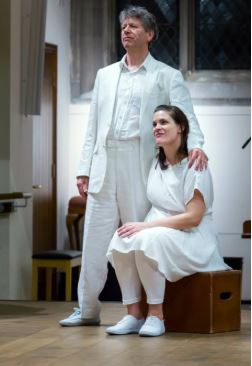
It is not an evening for musical purists, perhaps, with organ (an impressive Martyn Noble) rather than orchestral accompaniment and eleven soloists who double as the chorus. Arias are shared between soloists, which works perfectly well in this context, and reinforces the sense of the performers sharing a communal experience. My preference for music of this period is at the one-voice-to-a-part end of the scale rather than the Huddersfield Choral Society way of doing things, so there are no complaints from me about this. It is marvellously refreshing to hear these well-known choruses turned into duets, trios, and quartets, with the notes emerging with glorious clarity instead of being sucked into a massive vortex of sound. There is still a sense of increased scale when all the voices combine. For the final choruses the singers took up positions all round the Church and the impact of the choral surround-sound and well as the security of the ensemble were thrillingly effective.
And there are some fine singers here in this vocally demanding music who take moving around the church and singing from a variety of positions in their stride, while music director Panaretos Kryriastzidis unobtrusively holds everything together from the sidelines. I know that the words are well known, but the care these singers took with ensuring that the text was clearly enunciated sets an example that many others would do well to follow. Richard Decker’s countertenor is particularly impressive in a well sustained He was despised with some very suitable decorations in the da capo.
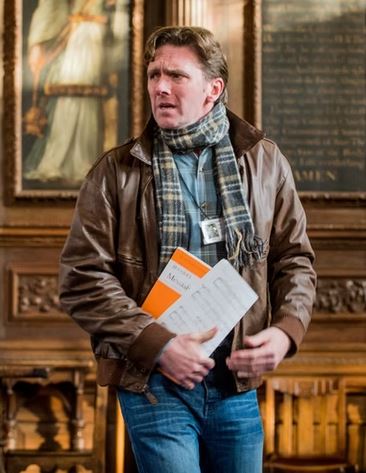
Not all of John Ramster’s production (revived by Walter Hall) completely works. In particular, things start with all the cast adopting a character with a back story including a well-dressed middle-class tearful woman dealing with trauma, a suited business type with a briefcase, a hyperactive journalist with lanyard always on his mobile phone, someone obsessively cleaning the church, an enigmatically detached woman hiding behind dark glasses, a young man in a jumper, and someone who could be destitute or an asylum seeker. Interestingly none of them was clergy.
These personae – somehow both hazy and stereotypical – can’t easily be developed or given a narrative arc, as the only words they have are the biblical quotations in Jennens’ text. So the singers have to jettison their carefully presented emotional baggage when they join in the ensembles, which makes some of their behaviour as individuals seem bafflingly inconsistent. But their characterisations (even if slightly laborious and temporary) remind us that what we are seeing is the impact of Jesus’s birth, death, and resurrection on actual people. This production vividly depicts the way that faith is about the wrestle between meaning and experience rather than a state of emotional impregnability that is free from doubt.
These singers confront us with the way we make so many assumptions about people based on their appearance, which can often be wrong or simply irrelevant. The highly emotionalised delivery is the opposite of polite, concert-style performers, who remain detached and clutch their scores to give themselves something to do with their hands. These singers, all performing from memory, knew exactly what they were doing with their hands and so many of their movements and gestures beautifully underlined what was there in the music.

A huge amount of intelligence had been applied to the production, with the whole of the Church space inventively used. Boxes are grabbed, moved, and stood on which provides variety and ensures that singers can generally be seen. This is critically important when seating in churches isn’t raked, and audiences need help with sightlines. In Part Two, with its focus on death, the cast appear in funeral attire, only to change to all white for the final resurrection section. The angels singing Glory to God in Part One made brilliant use of paper plates as improvised haloes. Then they covered them while they sang And peace on earth in suddenly hushed tones with troubled faces: you could see this as a bit of a mood killer or as giving you something to think about at time when the world has never seemed less peaceful.
I did wonder slightly whether there wasn’t a little too much activity going on. Would less have been more? But the sheer intensity of this performance, combined with Handel’s magnificently inspired music, sweeps all before it.
Patrick Shorrock, November 2025
Photography courtesy of The Merry Opera Company

 Mark Aspen