
A Christmas Carol
Fresh From the Oven
A Christmas Carol
by Charles Dickens, adapted by Beth Flintoff
ReadingRep Company at the Reading Rep Theatre until 3rdJanuary 2026
Review by Sam Martin

Reading Rep’s latest festive offering, Beth Flintoff’s re-imagining of A Christmas Carol, is a joyous reminder of why this company has become synonymous with bold, heartfelt reinventions of classic tales. Here Dickens’s familiar morality story is transplanted into the beating heart of Reading’s industrial past: Huntley and Palmer’s biscuit factory. It is a choice that proves both quaint and quietly brilliant. Local references ripple warmly through the script, doubling the audience’s sense of belonging and making the story feel as though it has risen, fresh from the oven, out of Reading’s own history.
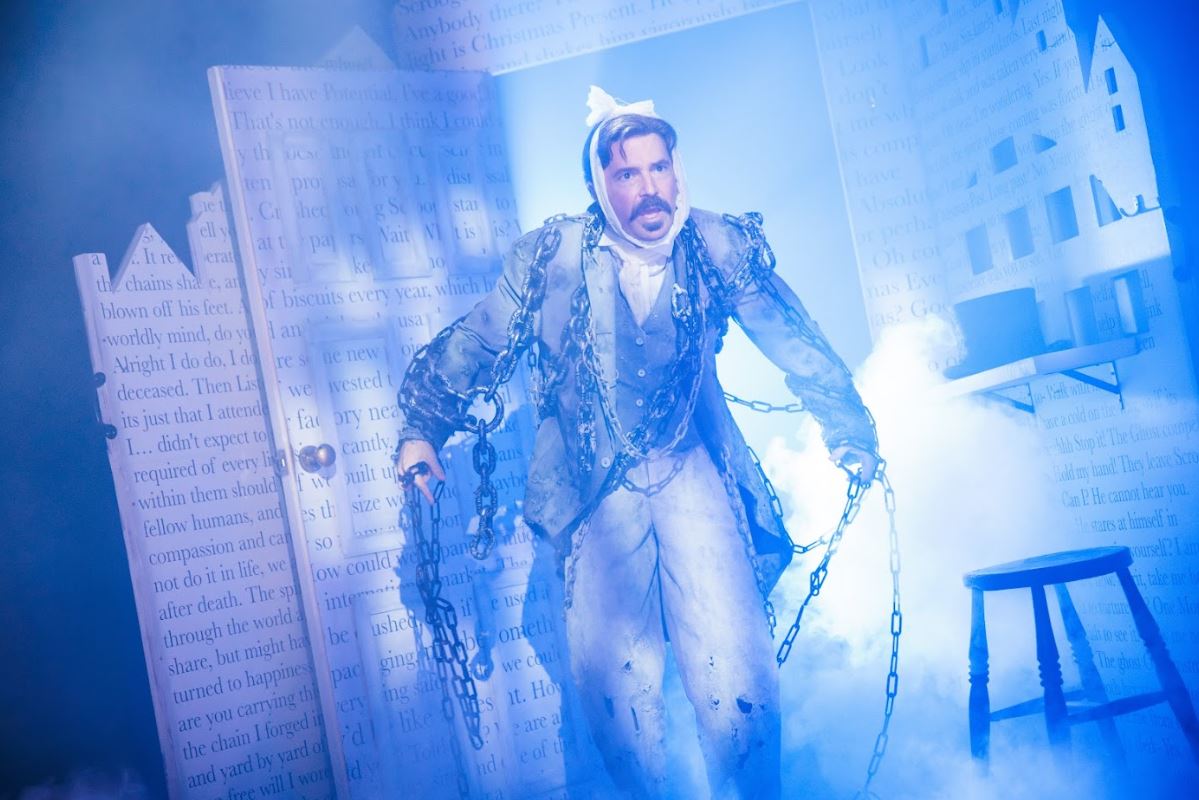
Flintoff’s narrative certainly veers from Dickens’s original in order to make this new context sing, yet the structure remains lovingly faithful. The ghosts, the memories, the revelations and regrets are all in place, threaded together with a textured understanding of why this story continues to resonate. By rooting Scrooge as the iron-fisted boss of a bustling factory, the adaptation not only makes thematic sense but also invites the audience to witness the contrast between communal festivity and corporate austerity in a way that feels strikingly contemporary.

That theme of contrast permeates the acting. Society’s excitement for the festive season, embodied by a colourful ensemble of larger-than-life characters is set against Scrooge’s deep-rooted discontent with relish. The ensemble cast are irrepressibly warm, entertaining and amusing, often stealing scenes with their exuberance and quickfire humour. Their heightened performances amplify the celebratory chaos of Christmas, and in doing so they make Scrooge’s icy stillness all the more severe. At times, Scrooge’s unrelenting sternness tips slightly too far into the resolute; his bitterness can feel unyielding. Yet when the tender moments of regret finally surface, they land with notable power precisely because of that earlier rigidity. The emotional thaw is earned, and the production takes the audience with him, step by step, through that journey.
The contrast extends into the costuming. Scrooge remains cocooned in a palette of blacks and greys throughout, a stark silhouette amidst a chorus who wear a Christmas colour palette of greens and reds. The celebratory tones of those around him emphasise the brightness of the life he has chosen to exclude himself from, and the design makes this division starkly visible.

Music, too, plays a vital role. The production opens with a beautiful build of carols, voices layering over one another until the auditorium is filled with all the familiar songs of the season. It is irresistibly inviting; the audience can’t help but lean in, many joining in the familiar refrains. Yet the score is not all warmth. As Scrooge’s internal world unfolds, the music shifts: ominous, foreboding, almost claustrophobic at times. These darker musical textures mirror his mood and foreshadow the psychological shadows he must confront. The sound design becomes a kind of emotional guide, leading the audience through each tonal shift with subtlety and precision.

Props are used with similar intelligence. The oversized ledger that dominates Scrooge’s desk is an inspired symbol – his obsession with work, his fixation on numbers, his myopic understanding of value. Its physical enormity onstage communicates everything we need to know about the weight he carries and the weight he imposes on others. As the story progresses, however, the ledger is eclipsed by a magical snow-globe, introduced as Scrooge revisits his past and peers into possible futures. The snow-globe does more than conjure Christmas sentimentality: it represents childishness lost and, ultimately, rediscovered. It marks the moment he allows himself to look beyond profit margins and into memory, emotion, and imagination.

The set is deceptively simple but strikingly evocative. The stage is bordered with Huntley and Palmer biscuit labels, grounding the production unmistakably in its Reading setting. Behind the actors, the skyline is plastered with strips of Dickens’s original text, a visual nod to the story’s origins and a clever suggestion that Scrooge’s path is, at least initially, already written. The interplay between the industrial and the literary worlds creates a frame that feels both nostalgic and inventive.
Stylistically, the production walks a careful line between realism and theatrical exaggeration. Heartfelt, grounded scenes sit comfortably alongside heightened sequences, with key moments punctuated by still images and slow motion. This is where Reading Rep’s precision shines: the shifts in pace and tone are deftly handled, allowing the audience to experience the full emotional terrain of Scrooge’s transformation without losing the playfulness that defines the adaptation.
The result is a thoroughly enjoyable, family-friendly production: festive, funny, and unexpectedly moving. It captivates across generations, as any good Christmas show should. Returning to see it for a second time, I found it just as lively and refreshing; the actors and direction continue to bring new energy and detail to the piece. Flintoff’s adaptation honours the spirit of Dickens while celebrating Reading’s own heritage, delivering a warm antidote to the winter cold and a timely reminder that redemption, generosity and community never go out of style.
Sam Martin, December 2025
Photography by Harry Elletson

 Mark Aspen