
Ballad Lines
Motherhood
Ballad Lines
by Finn Anderson and Tania Azevedo
Aria Entertainment and KT Producing at The Southwark Playhouse Elephant until 21stMarch
Review by Vince Francis
Striding along Kennington Park Road on a fresh January evening, I was feeling quite excited at the prospect of seeing a new work at Southwark Playhouse, itself a hotbed of such endeavours. However, I wasn’t going into this “blind”. As is the current practice much information is available online, including a cast recording of the show on Spotify, and various YouTube videos showing parts of the rehearsal process and interviews with the writers, Finn Anderson and Tania Azevedo, and musical director, Shonagh Murray. The intent of Anderson and Azevedo was to explore two key themes in parallel. Firstly, the migration of traditional ballads and how they survived and-or evolved in their new environments. In itself, this would possibly be a worthy topic, but the struggles of women and their agency around childbearing, often reflected in the ballads, suggested a second line of exploration on which to develop this piece.
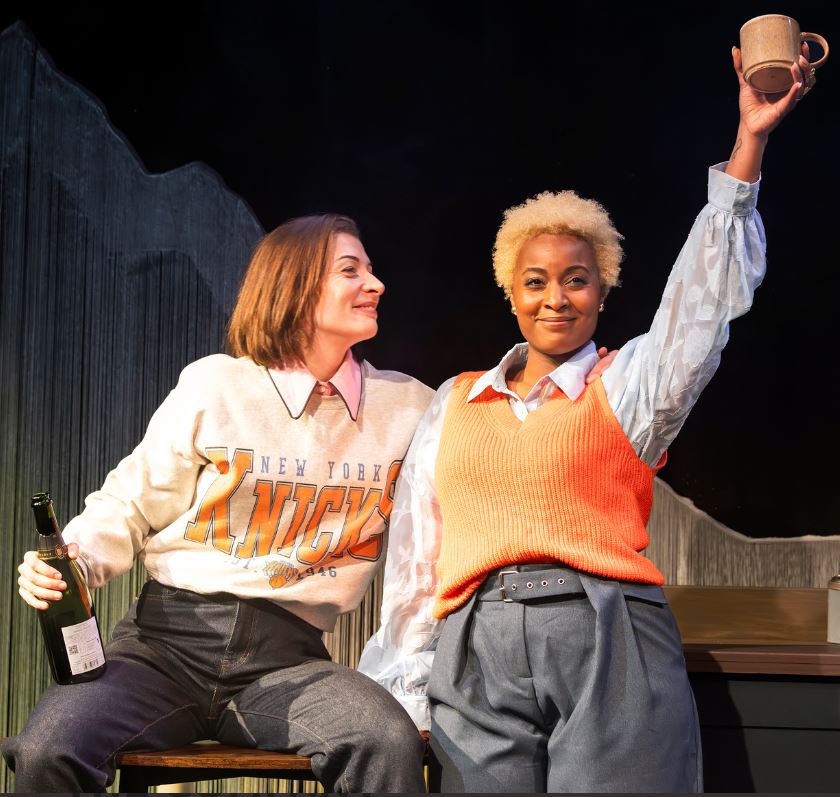
The vehicle used for these explorations is the discussion which develops between a successful New York couple, Sarah (Frances McNamee) and Alix (Sydney Sainté) as they establish themselves in their new house and start to unpack, both literally and figuratively. Sarah’s reluctance to unpack a ribbon-tied cardboard box left to her by her Aunt Betty (Rebecca Trehearn), who Sarah felt was bound up in tradition and, as such, unable to accept her as a gay woman. As might be anticipated, Sarah opens the box eventually and finds a cassette recorder-player (remember them?) and a collection of cassette recordings of Aunt Betty singing the traditional Scottish, Ulster, Appalachian ballads of her, and their, roots. Over time, the effect of hearing the stories in the ballads and the ancestors singing them, together with other family information provided by Betty, causes Sarah to re-evaluate her views on remaining childless, which causes a fault line in her relationship with Alix.
The ballads themselves reflect key experiences of womanhood and motherhood at various points in history and include what might be deemed a veiled reference to infanticide, as related in the full version of The Four Marys, which is the first of the historic ballads to appear in the show. I say ‘veiled’ as the song is curtailed by dialogue, although the short extract is beautifully presented by an ancestor, Cait (Kirsty Findlay). I’m aware that there are at least two possible interpretations of the origins of this piece, and I’m sure those with greater knowledge than mine would delight in a debate around the topic. For me, it sat appropriately in the piece as offered, although I would happily have heard more of it. Other traditional songs that are included either in whole or in part include Handsome Molly, Let No Man Steal Your Thyme, Queen Among the Heather, Early, Early in the Spring, Say Darlin’ Say, Red Red River, Love is Teasin’, and I Wish My Baby Was Born. The script covers a broad range of issues extending from unfulfilled desire for motherhood, through unwanted pregnancy, termination, arranged marriage and abuse within marriage, to the desire to have a child regardless of circumstances.
One criticism of the piece might be that these issues are well rehearsed in this information-rich society, so why are we rehashing them in a musical. Whilst that has some merit, the show demonstrates not only the enduring nature of these issues, but also, centring the discussion around a gay couple’s wrestling with the prospect of motherhood, reflects the broadening of societal norms and the adaptation of the issues with the times. The parallel with the adaptation of the ballads from traditional Scottish to Appalachian arrangements, ably demonstrated in the score, reflects that evolution.
A second criticism might adopt a “What about …” approach. For example, the piece does not address the question of the rights of a child to its natural parents, or the role of fathers. Again, perhaps there is some mileage in that discussion, but time is limited for any production, and a comprehensive inquiry might become overly weighty, or unable to do the arguments justice. If anyone is minded to explore such matters in a similar manner, the door is open for them to create their own piece and I would be happy to look at that, too.
So, does it work? Yes. In spades. I am a fan of the small ensemble format, and for me this represents some of the finest that I have had the privilege to see. The characters are people you know, the dialogue is slick, authentic and elegant. The actors move between accents with ease and confidence, maintaining character throughout. Although the themes are weighty, there is opportunity for humour and it is taken with alacrity. The eight strong cast is comprised of eight extremely strong talents, each more than capable of holding an audience individually and holding them spellbound as an ensemble.
A brisk pace is established at the outset and maintained throughout. A strong opening, which includes some excellent physical percussion by the cast, introduces us to Betty, an Appalachian balladeer, and her visceral connection to the music of her ancestors. Within the first four numbers, context, circumstance and some of the key characters have been established and an argument has been had. Keep up.
The staging is a simple change of levels, with a suggestion of a kitchen upstage left, together with a doorway. Minimal furniture is used, thus facilitating swift changes and providing maximum space for placement and movement of the characters. Talking of movement, Tinovimbanashe Sibanda’s choreography is fluid and expressive without being overly flashy. Simon Wilkinson’s lighting design provides mood and a particularly helpful clarification of who is singing or speaking in the chorus numbers, simply by spotlighting them. Of course this relies on the cast hitting their marks, but of course, this team are up to that.
Musically, the arrangements provide clear differentiation between the dialogues in the present and those in the past, which helps when more than one era is being explored at once. There are some really tasty vocal harmonies, too, which require a bravery on the part of the vocalists that they of course execute with aplomb. The songs serve to inform, expand and move the plot along with elegant efficiency. In the first half alone, the duet between Sarah and Alix, Chosen Family, feels like listening to an argument that they would have had, to music, in any event. A little later, as Sarah finds herself torn between the attraction of the traditional songs, their history and her memories of a childhood happily singing them with Aunt Betty, set against Aunt Betty’s later disapproval of her, Back in the Box provides a percussion-led piece, reminiscent perhaps of Steve Gadd’s riff in Paul Simon’s 1975 number Fifty Ways to Leave Your Lover. For me, this had the effect of the kick-drum repeatedly and insistently stating “the issue”, whilst the hi-hat and other surfaces reflected the busy tangents that minds tend to go off at when figuring out a thorny problem. All of this within what felt like a tricksy metre – is it 7/8? – “Nice”, as our jazz friends might say.
The four piece band, under the deft direction Shonagh Murray, herself on keyboards, harmonium and concertina, and with the percussionist (Isis Dunthorne) hidden, provides more than enough drive and support for the huge vocal talent that the cast clearly revels in. On the strings side, it was nice to hear an acoustic guitar (Maddy Salter) featured and some mellifluous lines on the fiddle (Sally Sampson). A nod here to Oscar Cotran and Drew Jameson on the sound desk, too, who provided an excellent mix and soundscape, ensuring all voices and instruments were heard.
The playing space is such that the cast enter and exit through the audience and, at times are acting and singing in close proximity to the front row on the same level. This is not an issue for this team, who are totally absorbed in, and committed to, their performance, drawing the audience into their world seamlessly. I left with an image in my mind of the ancestor Jean (Yna Tresvalles) arched backwards, arms outstretched and fists clenched, eyes tightly closed as she belted the anthemic line “Women of Earth, Wind and Flame” to the heavens, in the Epilogue. The gods probably heard her, too.
To summarise, this is a high-energy, fast-moving piece that does what it says on the tin and, in so doing, provides a thought-provoking, entertaining, musically belting production. I enjoyed it enormously. I’m listening to the soundtrack again as I write this, and I’m minded to give the show itself a second look. Highly recommended. Go see.
Vince Francis, January 2026
Photography by Pamela Raith

 Mark Aspen