
2:22 – A Ghost Story
Things That Go Bump
2:22 — A Ghost Story
by Danny Robins
Runaway Entertainment at Richmond Theatre, until 7thFebruary
Review by Harry Zimmerman
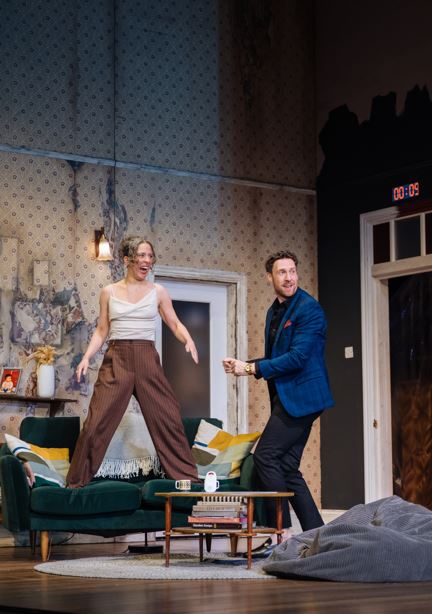
It is fair to say that 2.22 – A Ghost Story has a legitimate claim to being one of the most successful plays in British Theatre over the last five years. The statistics are impressive. Since its 2021 debut, it has played regularly across the UK and Ireland. The show has been seen by over one million people in seventeen different countries across five continents. It holds the all-time record for the most transfers in the West End and has been nominated for three Olivier awards. This particular production is its fourth extensive UK-wide tour.
Continually refreshing and resetting itself for UK tours and London residences, the play has also been instrumental in catapulting its writer, Danny Robins, to a pre-eminent position in what may be termed populist ghost broadcasting. Robins is the creator and host of the tremendously successful radio, TV and podcast show Uncanny, which investigates creepy paranormal experiences sent in by the general public. Uncanny is the ideal listening companion late at night, if you are that way inclined.
A very full house on a cold, wet Monday evening at Richmond Theatre demonstrated that a number of people are that way inclined and were very much looking forward to experiencing a few vicarious thrills from Robins’ fertile imagination.
“There’s something in our house. I hear it every night at the same time!”
2:22 — A Ghost Story unfolds over the course of a single evening and is set not in a gloomy castle or shadowy, dusty, dark old mansion, but an ordinary, mid-1930s house undergoing extensive restoration.
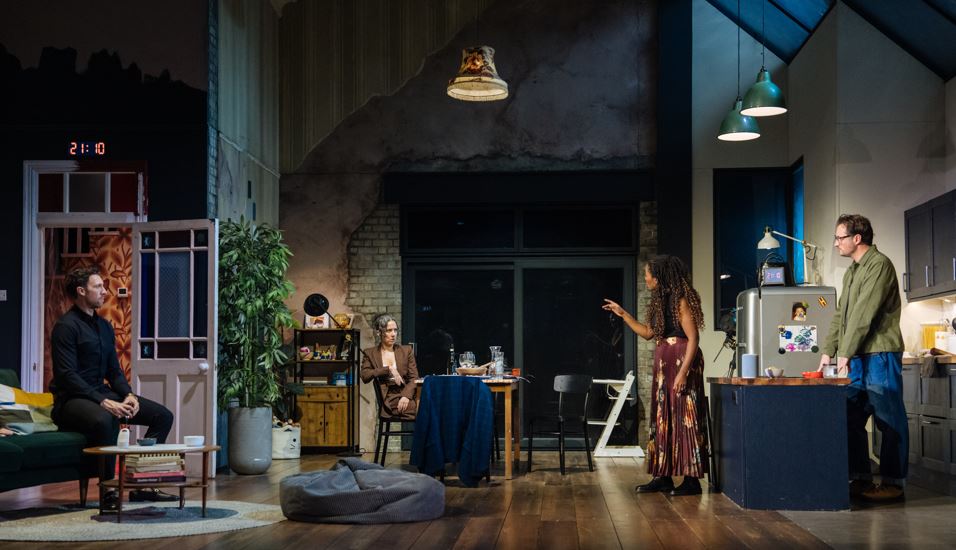
A word of praise here for Anna Fleischle’s set, which provides the perfect landscape for the chills which are to come. The kitchen – dining room layout, with half rendered and painted walls, cluttered with the detritus of a renovation work still very much in progress, and strewn with baby toys, is impressively detailed and effortlessly conveys the crowded, messy domesticity of growing family life. Glass sliding doors looking out onto a garden with bright security lights are well used throughout the play, whilst a brightly visible digital clock becomes a central and important stage device, ticking steadily through the hours of the evening and propelling the audience toward the significant moment of 2:22. It all works well in heightening anticipation and tension.
What we have here has quite rightly been termed, “the supernatural of the suburban.”
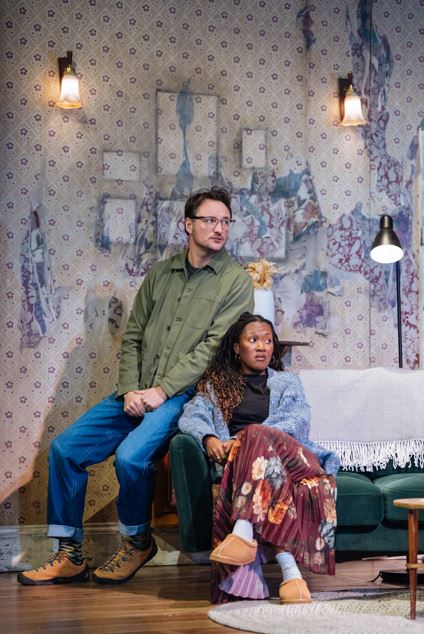
Jenny, a new mother is convinced that something eerily strange is happening in her home. She hears the same disturbing noises every night at precisely 2:22am, largely coming from their child’s bedroom. Heavy footsteps, windows opening and closing, and lights turning on and off of their own volition. Is this all happening in her own mind, a natural reaction to being overtired with the demands of a new baby and extensive house restoration? Or is there something more disturbing and sinister playing out?
This evening, Jenny (Shvorne Marks) and her husband Sam (James Bye) are hosting Sam’s old university friend Lauren (Natalie Casey), and Lauren’s new builder boyfriend Ben (Grant Kilburn), for dinner. As the evening progresses, and more wine is consumed, the general chat turns to a discussion of the paranormal and the existence of ghosts.
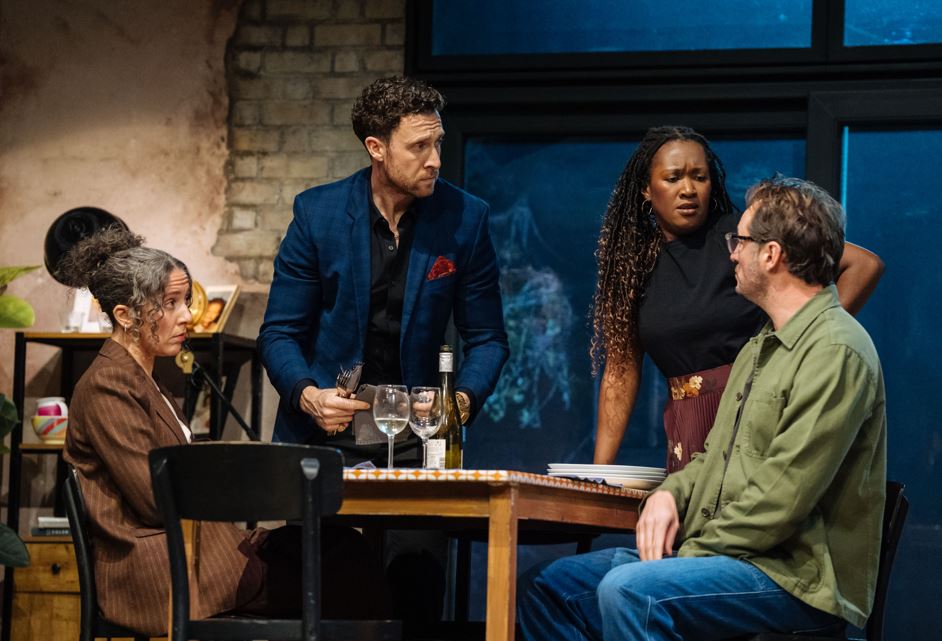
Jenny outlines her recent experiences and fears and (after more wine and, yes, spirits), persuades them all to stay awake until 2.22 to see or hear the phenomenon for themselves. What follows is an evening of tense conversation, clashing world-views, emotional revelations, and a carefully structured escalating build-up towards the moment of truth and a shattering denouement.
The play is, essentially, one long scene split across two acts, which are each very different in construction.
Act One is very plot-oriented and devotes a lot of time to establishing the characters, their belief systems, their interpersonal history, and the underlying heightening strain between them. The second act, by contrast, moves with much greater intensity and emotional momentum, building effectively to its dramatic concluding twist.
Throughout the play, tension is gradually built. Beneath the faux cheerfulness of the dinner party chat, there are intimations that something is not quite right. That a palpable tension is not just present, but being cranked up. That all is not what it seems. The simmering stresses and strains of the evening as it progresses are largely shaped by the very different attitudes of the characters to what might, or might not, be happening in the house.
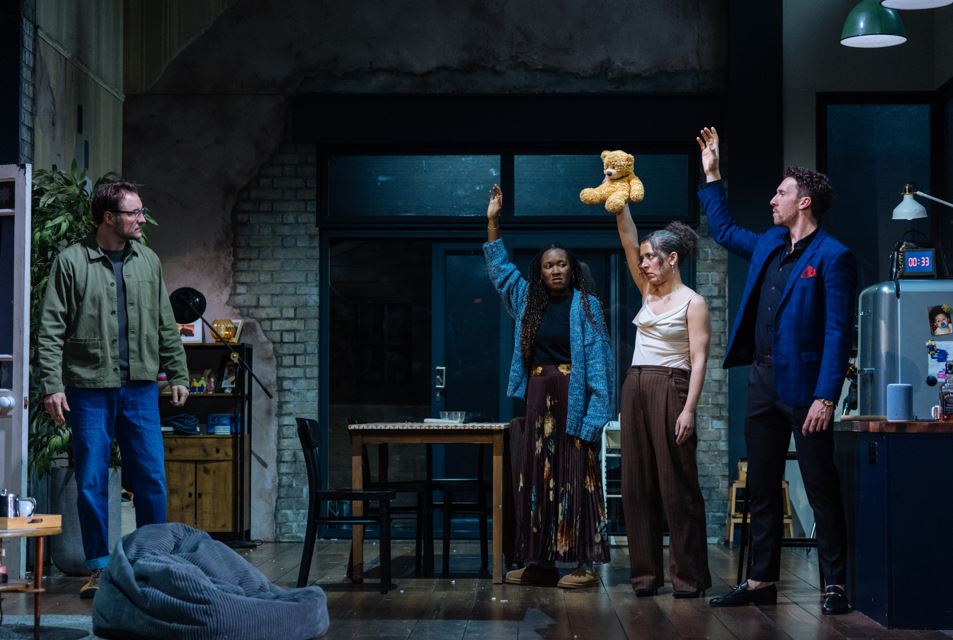
Anyone familiar with Robins’ Uncanny shows, will be aware that, in his investigations, he scrupulously considers them in the context of scepticism and belief. In microcosmic form, this is delineated very sharply within the characterisations in this play.
On “Team Believer,” we have Jenny and Ben, whose mother, we discover had the gift of second sight and could commune with the spirit world. “Team Sceptic” is firmly headed up by Sam, a scientist who is unshakeable (and scathing) in his belief that there is a rational explanation for everything, and that supposed psychic and occult phenomena are simplistic mumbo jumbo. Lauren is on the fence, but, like Ben and Jenny, has had experiences of her own that she cannot explain.
The juxtapositional positions taken in attempting to apply reason to supernatural belief, that everything can be scientifically explained, versus the firm conviction that an afterlife exists, affects us and may be all around us, come together during the evening via the various attempts at compromise between these two opposing views, and fuels the discussions and arguments which drive forward the narrative of the plot, and provide the structure for what is to come.
This is not to say that the play is a heavy discussion of metaphysical exploration. Robins had a successful career as a stand-up before his success in the paranormal genre, and his writing is funny, perceptive and direct. There are laughs to be had in this production, even though some of them become a little nervous as the narrative progresses and gets darker.
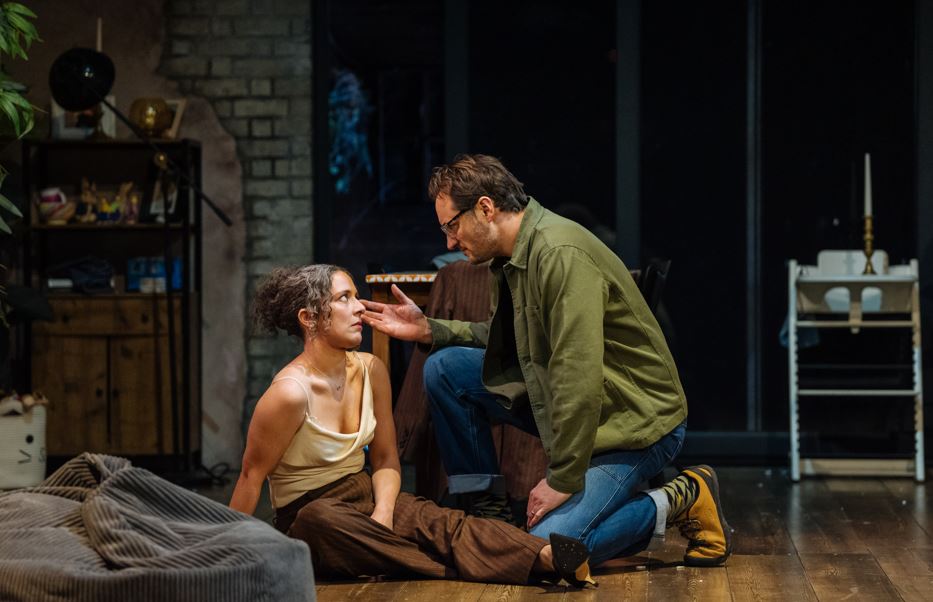
This tongue in cheek approach is also seen in the careful application of many familiar tropes of the scary film. The technical team excel themselves here. The lighting and sound design make a major contribution to the escalating sense of dread and horror of the piece. Sudden, piercing screams, (just foxes outside, right?), flickering lights (just dodgy lighting circuits yes?), and a violent thunderstorm, are all underpinned by an ominous score of discordant music and the menacing throbbing of muted drums which occasionally punctuate the action dramatically and keep the audience on edge.
Oh, and of course there is a séance later on ….
One of the factors that anchors the successful longevity of this play is the care taken with casting, ensuring that the latest team of actors are able to gel, display strong natural chemistry and provide strong ensemble playing with effective personal characterisation. This is very much the case in this production, where thoughtful and nuanced portrayals are delivered by the uniformly excellent cast.
2:22 is not solely about the creeping dread of suspense and fear leading inexorably to an apocalyptic reveal. It is also about relationships, trust, communication and love, and how difficult it can be for partners and friends to build and retain the strong emotional bonds needed to cope with life in the increasingly frantic 21st century.
So, is there life after death? Are “ghosts” a figment of our imagination, a comforting mechanism for some to use to cope with an increasingly stressful and fast-moving multimedia driven world? Or is there a dimension beyond our own, a realm where the dead can, (and in some circumstances do), come back to interact with the living, for good or ill?
What is happening in Lauren and Sam’s home?
Well, upon leaving the theatre a sign is flashed up on stage which says “Sshhh. Don’t Tell.”
So, I won’t.
Harry Zimmerman, February 2026
Photography by Helen Murray

 Mark Aspen