
The Seafarer
Deep Currents
The Seafarer
by Conor McPherson
Putney Theatre Company at the Putney Arts Theatre until 21st February
Review by Harry Zimmerman
There are currently a bewildering plethora of musicals, and one person shows, for the curious theatregoer to choose from these days.
It is, therefore, refreshing to encounter a more traditional piece, with an innovative story, combining humour and pathos, (with more than a sprinkling of the supernatural), that is well performed and holds the attention throughout its two hours.
This is what we have with Putney Arts Theatre’s resurrection of Conor McPherson’s The Seafarer. First performed at The National Theatre in 2006, the play followed McPherson’s acclaimed hit The Weir and, whilst sharing some of the constructs of its more famous predecessor, it stands up extremely well in its own right as a beautifully observed and nuanced exploration of the bonds of friendship, family, love, pain and loss. In short, a whisky-soaked allegory of the way in which long repressed guilt can creep up and threaten to overwhelm every aspect of life.
The action takes place over a single day on Christmas Eve in a Dublin suburb. James “Sharky” Harkin, with a string of brutal fistfights and failures behind him, has returned home to care for his brother Richard, blinded a few years ago following a drunken encounter with a skip.
Richard constantly barks orders at Sharky and ridicules his brother’s two-day-old resolution to swear off alcohol. He neglects personal hygiene, impulsively ignores his disability and demands endless refills from bottles stashed around the house. Sharky holds his tongue with difficulty.
The nature of the piece is established right at the start as Richard and their confused yet likeable guest, Ivan, who has stayed over following a heavy session and is engaged in an amusing and continually fruitless search for his glasses, nurse hangovers and try to remember any details of the night before.
The three old boys blunder around chaotically but happily enough until their Christmas celebrations are altered by the arrival of two guests. Nicky, a childhood friend who now, rather awkwardly, is living with Sharky’s ex-wife.
Nicky brings with him the enigmatic Mr Lockhart, an impeccably dressed, incongruously suave and extremely polite, soft spoken gentleman whose true nature is intriguingly hidden behind a deftly constructed façade of austere respectability and propriety. Unlike the others, whose characters are worn very obtrusively on their grubby, stained sleeves, it is impossible to penetrate Lockhart’s veneer of studied rectitude.
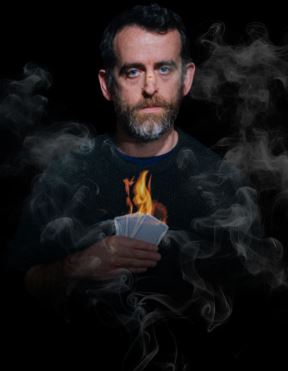
Mr Lockhart is definitely not what he appears to be. He has come into the Harkin’s home with a specific, ruthless purpose, which becomes clear in a hugely tense conversation with Sharky. The resolution of the issue will be determined by a poker game, with the cost of losing much higher and more fundamental than the mere loss of a few Euros…
What had, at first sight, appeared to be a relatively light-hearted, domestic comedy of manners, male relationship networks and drink-sodden bonhomie, suddenly becomes something very much darker, menacing and visceral.
In a production of this type, the success or failure of the play lies fairly and squarely upon the quality of the ensemble playing. Here, there are no problems. We are in very safe hands indeed. The cast is of a uniformly high quality, with believable, well observed and executed characterisations throughout.
The cast all interact superbly, delivering authentic and persuasive portrayals, whether that be the pugnacious, opinionated Richard, (Ian Cooke); the astute, but cautious Sharky devoted to his brother despite everything, (Eugene Duffy); the fretful, forgetful warm hearted peacemaker Ivan (James Turner); the spiky outwardly confident and pugnacious Nicky, (Nick Thomas), or the menacing ambiguity of Lockhart (Matthew Flexman). Not a glance, a sigh, an exclamation or intonation of voice is wasted.
Ian Higham’s direction is crisp and taut, with the dialogue crackling along, and enough time given to lighter moments of grossness, for example when Richard spills coco pops down his clothes or when Ivan, attempting to substitute coffee for whisky out of one of the innumerable bottles hidden around the basement flat, simply pours the residual dregs of coffee onto the carpet.
Such moments of high-spirited animated badinage, and well executed instances of physical comedy, serve to emphasise effectively the darker moments of almost suffocating stress, intimidation and pressure as the action takes a very different turn.
Two occasions especially stand out. The escalating, almost unbearable tension of the final poker hand, with the Faustian consequences of victory or defeat clearly delineated; and the bone-chilling, horrifying vision of hell enunciated with bleak finality and ruthlessness by Lockhart when alone with Sharky.
The Seafarer is a darkly funny, yet disturbing and haunting tale of family and friendship, loyalty and regret, the need for love, redemption and the importance of the “second chance.”
Putney Theatre Company is to be congratulated for the brio and verve that they have brought to this production.
Harry Zimmerman, February 2026
Photography courtesy of PAT

 Mark Aspen