
Chain Drive: a Deportational Road Trip
Lunatic 19’s
by Tegan McLeod
Gangway at the Finborough Theatre, Earl’s Court, until 3rd August
Review by Eleanor Lewis
Opening a review with “In the present political climate…” is probably unwise at the moment. I’m calculating the amount of readers likely to roll their eyes and move onto less exhausting things, tennis perhaps. But let’s live on the edge!
In the current political climate there is much mileage to be got from, well pretty much everything really, the deportation of undocumented immigrants in the US being just one of many controversial themes around which to weave a drama. ICE (Immigration & Customs Enforcement) raids are due this weekend in the US which makes Lunatic 19’s timely to say the least.

This two-hander at the Finborough Theatre in Earls Court tells the story of Gracie, an undocumented immigrant, and Alec from ICE who has arrived at her hospital bed to deport her forcibly back to Mexico. Gracie has lived, worked and filed her taxes in Kentucky for twenty years, she’s recovering from a car crash with significant injuries and wearing a head brace. Nonetheless, she is handcuffed and put into a van, to be driven by Alec out of the country.
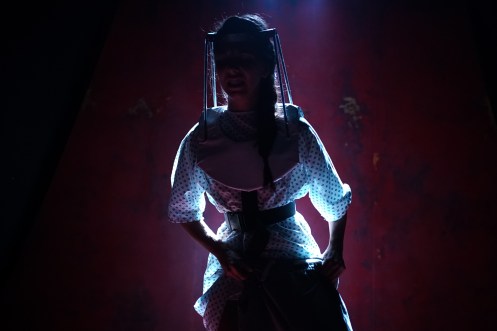
What follows, from the road trip narrative point of view, is fairly predictable. These two characters develop and interact in the way you might expect them to. It is almost The African Queen in a Van. Devon Anderson does a lovely job as Alec from ICE. Alec is a character forced by family circumstances to do a job he despises, but with enough self-respect to do it professionally. Every part of this man’s personal struggle is visible, you feel for him and you respect him despite his job.

Gabriela Garcia arguably had the bigger challenge playing the strong, stroppy, no-push-over Gracie. Strong women shouldn’t have to be endearing, nor should you need to make them endearing for the sake of a drama. That said, playwright Tegan McLeod has in fact written a witty, sarky, funny (and strong) character, and she’s funny from the start, but this I know because the programme contains the script. This is how Gracie has survived, she has entertained, she has made people like her or laugh with her and thereby got what she needed. But either by direction, or by playing, Gracie’s wit took time to show itself. She was loud and she was taking no nonsense, but the fully rounded clever, witty character Gracie is didn’t register for quite a while, which was a shame. Strong women are understandably ‘hot’ at present, but there are many types of strong, ‘loud’ is only one optional element. Once fully established however, Gracie was a warm, inspiring, spiky presence on stage.

The Finborough Theatre is an ideal space for this intense drama. The clever use of the small stage together with Kevin Treacy’s lighting and Edward Lewis’ sound created both the institutional glare of public buildings and the soothing calm of the sea, transporting the audience with Gracie and Alec along their journey.
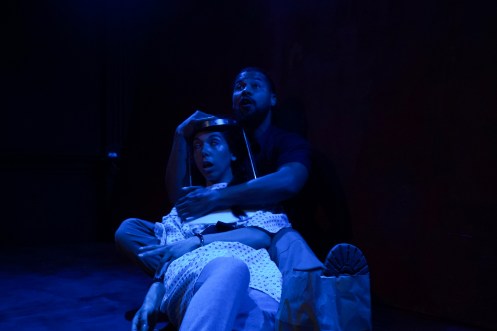
Tegan McLeod’s new play is an interesting journey through a number of themes: the state of play on immigration in the US raises questions about who belongs where, what qualifies them to belong and who decides. Alec himself is an immigrant but he has documents. Alongside this is the question of new beginnings. Gracie has difficulty with pregnancy, she has miscarried more than once but there is perhaps the promise of new life again. The significance of the title I will leave to be discovered by the next set of audience members. This is a smart play, efficiently performed and providing food for thought for a 21st century audience.
Eleanor Lewis
July 2019
Photography by Marian Medic
Regimented
Delivery
by Andy Walker
Barnes Fringe Festival, OSO Arts Centre, 11 July 2019
A review by Matthew Grierson
If many people’s experience of delivery is a long wait in for a pizza, then it’s no surprise that Delivery is such a pacey production – it clearly wants to avoid having to give us the free garlic beard.
The speed with which Andy Walker’s script cuts from one scene to the next as expectant father Joe (Alex Walton) recounts his life story is fitting given the character’s former life as a squaddie, and the production is so well drilled that you’d think Lesley Manning were more sergeant major than director. It’s doubly impressive given that only last week this was a rehearsed reading: not only dialogue but action and lightning move so swiftly and effortlessly tonight that I couldn’t help being caught up in it.
Walton remains present onstage throughout and delivers a nuanced performance that conveys Joe’s self-doubt, rage, fear and charm, slipping seamlessly between narrator and participant in his own story. The comic self-deprecation he deploys to woo wife Angela is just as effective and affecting as the rawness of his terror when deployed on active service.
Lizzie Aaryn-Stanton is likewise engaging as primary school teacher Angela. She’s a humane and compassionate counterpoint to Joe’s troubled masculinity, no more so than when her journey to assembly with her class is juxtaposed with Joe weeping over the corpse of a fallen comrade in the foreground. Yet despite this contrast there is still a genuine, touching chemistry between them, as seen in their first meeting at a football match – never has talk of the offside trap been more sexually charged.
If anything, Aaryn-Stanton is under-served by a show whose focus is very much on masculine identity. Certainly Walker’s script is interested in exploring the contradictions and frailties of masculinity that are intensified by military experience, and is justly angry about the treatment of former servicepeople. Nevertheless, these concerns are worked out of a stock of blokey tropes including football, beer and nightclubs that seem as generic as the unnamed blue and white team that Joe and Angela support, tropes that especially in the first half are played for laughs.
This makes Joe’s deployment to the Falklands a sudden and specific about-turn. The show benefits from the detail and context this gives, but nothing so far had suggested it was set in any time other than the present, or warned that it would be venturing beyond wry comedy. Even on the battlefield the jokey asides continue, making Delivery feel like a lighter piece than it should be by rights.
To earn our full engagement with Joe’s plight, the show could create more sense of jeopardy around his mental state. As it is, he kills an officer in one scene and is acquitted in the next; similarly, an implausible war crime committed by his chaplain is mentioned briefly and then not referred to again. Although the consequences of both play out later, the narrative of redemption is so far advanced by this stage that it’s clear the play is hastening towards a happy ending – handed his baby daughter, Joe quickly abandons thoughts of suicide. Taking the time to dwell on the trauma of war could have given more opportunity for legitimate discomfort and deepened our sympathy with Joe’s situation.

All the same, the momentum prevents us from lingering too long on these missed chances. In this the play is ably served not only by the energy of the two leads but also Gordon Peaston and Louis Davison, who each take on an impressive array of supporting characters. Peaston begins as a succession of stock authority figures – judge, teacher, sergeant major – enlivening them beyond sitcom stereotypes, before turning in a sensitive and insightful portrayal of the padre from whom Joe seeks support. Just as versatile, Davison offers us a posh officer and a light-fingered youth as comic turns, as well as the more sobering vision of an Argentine prisoner whose drowning drives Joe to murder.
Between them, Peaston and Davison also bring to life a veritable bestiary of hallucinatory animals, highlights being Peaston’s camp slug, Davison’s philosophic sheep and a laconic fruit fly. The switches of mood and manner in each case are total and convincing, set off by the simple addition of headgear or other costume flourishes.
That it’s possible to conceive of a show that deals with PTSD and gay gastropods and bring it to a happy ending without it coming across as silly or trite is a function of Walker’s well-crafted script. Although it focuses more than it might on maintaining momentum, it attends to the detail in dialogue that fleshes out characters as well as demonstrating an admirable command of plot. In this much, Delivery delivers.
Matthew Grierson
July 2019
Photography courtesy of OSO Arts Centre
Lasting Gift of Comic Verse
Remembering a Poet
Performance Poetry, The Adelaide, Teddington, 7th July
Review by Celia Bard
The July meeting of the Poetry Performance Group was a poignant occasion following the tragic, accidental death of co-founder, Bob Sheed. Joint co-founder, Anne Warrington, opened the evenings programme by recalling the formation of Poetry Performance and Bob’s influential impact on the group. She followed this with readings including Address Book by Maggie Butt, who reflects on the dilemma of what to do with names written in an address book once those people have died.
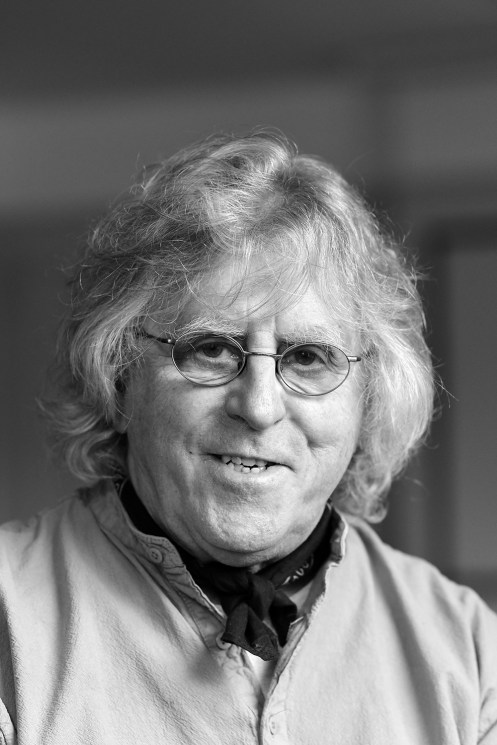
Robin Clarke presented his own moving poetic tribute to Bob, providing a moving brief biographical account of many aspects of his life. On a lighter note was the reading of I’m a Little Teapot, taken from Bob’s collection of poems, It’s Not What You Think, a tongue in the cheek reflection on changing social habits and etiquette. Graham Harmes then performed another of Bob’s numerous humorous poems The Lawyer, a poem that beautifully demonstrates Bob’s talents as a wordsmith, and how highly articulate people can use words to manipulate and outmanoeuvre people.
In contrast Judith Blakemore Lawton delivered Bob’s parody poem Unstoppable, a new twist on the Dutch story of the boy who plugged the hole in the dyke with his finger. In this version his efforts are rewarded with a good walloping from his father. The first half of the evening concluded with Keat’s Ode to a Nightingale, splendidly read by Ann Vaughan Williams, bringing the group back to the reality of contemplating Bob’s sad death.
Heather Montford, our MC for the evening, opened the second half with her poem No Golden Glory, the last line resonating with Bob’s work that like the chestnut tree, it will survive. Breaking the mood was Tony Josolyne’s delivery of his poem The Casting Couch, a humorous warning to those auditioning for theatrical, TV or film roles. The next performers were Vicki and Chris Naylor. Vicki gave us her shortlisted poem Another Time from the Roger McGough competition and printed in the Arts Richmond About Time anthology, a poem alive with fiery images, whilst Chris amused us with his rendition of Bob Sheed’s Gender Balance in which Golom, the hermaphrodite, thinks he had the right to use both the Ladies and the Gents toilets. Stephen Harman then gave us his historical I See No Ships, a reflection of Nelson’s last battle, cleverly written in rhyming verse. Following this was Barbara Lees self-reflective poem: I See Myself – What Do I See, a refrain that was echoed throughout each of the stanzas.
Steve White read two poems written by his late wife, Frances: Pink Fluff and Red Hat Band. These two poems seemed so appropriate to the occasion – particularly poignant as Frances only died a few months ago and regularly attended Poetry Performance sessions. In the same vein Carol Wain presented The Planting of Trees in Southern Scotland, a poem from her poetry collection More Poems for Alice, inspired by the loss of her much loved, gifted daughter who was killed in 2000. Heather Montford concluded this somewhat reflective session with Fallen Leaf.
Although the subject matter of the evening was greatly influenced by memories of Bob Sheed and others who have departed this life, the prevailing mood was uplifting, brought about by the humour in many of Bob’s poems. Members of Poetry Performance were as much celebrating his gift of comic verse and laughter as his sad loss.
Celia Bard
July 2019
Photography courtesy of the Bob Sheed estate
Pacing, Pursuing and Passion
Summertime Soirée
with Amy Gould and David Harrod
Garrick’s Temple to Shakespeare, Hampton 6th July
a review by Ian Nethersell
A musical journey through time and style, past and present with some familiar favourites and some new discoveries …
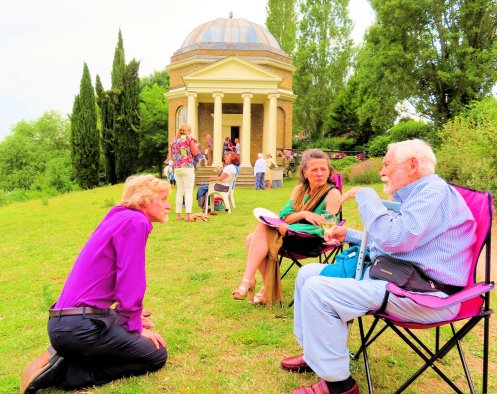
On a balmy summer’s evening on the banks of Old Father Thames we found ourselves lounging alongside a Grade 1 listed folly in Hampton. The Garrick Temple was built in 1756 as a tribute to a certain Mr William Shakespeare by the actor David Garrick, who made his name and success performing the works of the previously mentioned playwright in this, the perfect setting for some magical mid-summer happenings – and what a magical evening it was.
The history of chamber music stretches back to medieval times and as our talented duo opened with the melodic B aroque sounds of Bach, in this setting it was very easy to imagine and experience how it might have been in the Georgian era, sitting in the parlour of a fine house listening to music being performed by a small number of musicians. I was transported by the smooth and flowing bowing of a cello whilst enjoying the authentic sounding representation of a harpsichord from David’s modern keyboard. Amy beautifully demonstrated the emotional range of her cello and Bach, journeying from a smooth, flowing legato into a bright skipping pace building to a strong allegro and ending with a restrained, almost tortured emotion straining to burst forth which I felt viscerally. And I always thought Bach was boring!
Following on with a theme of discovery, I was introduced to the work of Astor Piazzolla and his very appropriate piece A Midsummer Night’s Dream. The jazzy, almost Scott Joplin-esque style engendering the passion and fire in the Latin American people, and closing my eyes, images of people dancing the tango through the streets at Mardi Gras flooded my mind and filled my body as I felt myself swaying in my seat, struggling to restrain my fire. This fusion of jazz and classical styles was echoed in the conversation between the keyboard and cello as they performed their own dance, a connectedness and yet a separation which culminated in a pacing, a pursuing, a passion which may devour, fear yet excitement.
Continuing our journey towards the interval, Amy took us Sailing down the River in an effortless display of dexterity and technique, encompassing the multi-note, multi-style and multi-tonal playing required in Aaron Minsky’s Journey through America represented in etudes by the styles and themes of music evocative of an area.

The second part of our evening opened again with Bach, his Sonata in G Minor. Amy seemed to take a while to get her fingers in flow but once there she was able to again demonstrate her dexterity and ability to create images. The first movement, flitted like two bees independently buzzing about on their own business, never resting, until the second movement where smooth legato engendered some rest and an almost internalised place. This was felt not only by Amy’s flowing technique but by a complete embodiment. It was a joy to be able to witness a musician so completely at one with a piece. In the third and final movement the pace quickened again and with it a form of conflict but without aggression, a conversation between light and dark, love and hate, joy and sadness. As the opposites drifted apart in the final moments there was tenderness, a coming together, a unity, an acceptance.
 David then played a small interlude, Le Cahier Romand #3 by Arthur Honegger, another discovery for me which I have since become acquainted with. David played for himself, not for performance, not for ego, but for pleasure, and then it struck me, something I had always known but never realised; it is impossible to play music without emotion.
Throughout the remainder of the evening Amy and David continued to conjure pictures and feelings. The audience felt wonderment at the skill displayed in the incredibly difficult Fantasy by Anton Hegner which requires contrasting bowing and picking, through the evocative Harlem Nocturne by Hagen and Dick Rogers with images of a laid-back 40s strolling through Central Park. Molly on the Shore by Percy Grainger, a favourite of mine, had great energy and invoked images of a maiden dancing freely over the fields and glens echoing the unrestrained freedom of the wind and spirit as it dances through the trees and across streams.


The final piece of the evening was a deeply rich and full embodiment of Summertime, the enduring standard from the versatile genius that was George Gershwin, our musicians managing to capture and convey the richness and emotion.
Rather than leaving on a dour note though we were given yet another Gershwin to see us home. I Got Rhythm, full of life and vitality, giving us the boost to skip home! On this enjoyable evening our duo definitely did have rhythm, and skill, and passion, a passion that was also shared and conveyed by the welcome and care of the custodians and volunteers of Garrick’s Temple.
Ian Nethersell
July 2019
Photography by Alison Gibson and Lewis Lloyd
Tough Journey of Self-Discovery
Blood, Sweat and Vaginas
by Paula David
Barnes Fringe Festival at OSO Arts Centre, Barnes until 9th July
A Review by Celia Bard
The Barnes Fringe Festival is now in its fourth year. An integral element of the Festival is its support in the development of two brand new plays. The play, Blood, Sweat and Vaginas, written and performed by Paula David is one of the two winning entries selected to be developed, refined, and performed over the course of the Festival. Performers are given the opportunity to perform their show twice, once a sneak view into a work-in-progress of the production using audience response to help in refining performance, and again as a fully, developed, and workshopped show.
One of many distinguishing features in Blood, Sweat and Vaginas is the sparse use of props. In fact, Paula David as Carolann doesn’t use them. She relies entirely on voice, physical movement, mime, song and one isolated chair, which is moved just once throughout the production. Carolann doesn’t direct any conversation to the chair, it is just there. The audience is left to interpret its symbolism, though at the end of the play its symbolism becomes clearer. To provide an interpretation in this review risks the danger of spoiling the end of the play, so this reviewer will refrain from doing so.

Blood, Sweat and Vaginas, a monologue play, runs for about an hour. Paula David is just superb as Carolann, the main character, who invites the audience to follow her on her path of self-discovery. With her we learn who she is, meet some of the main characters in her life, share her pain and discomfort, laugh at her jokes, respect her honesty, and admire her ability to burst into song whenever her feelings threaten to overwhelm her.
Carolann is an intriguing and fascinating character, shrouded in self-doubt, but with an air of mystery about her. She oscillates between loud, outrageous, shocking behaviour to moments of intense introspection about her relationships with men, her daughter Tanya, and her inability to make love without feeling intense vaginal discomfort. Suffering from atrophic vaginitis she only slowly realises the nature of this condition, which makes the act of love such a painful one. She states that she she is not frustrated, only puzzled, and it certainly does not stop her from being sexually aroused.
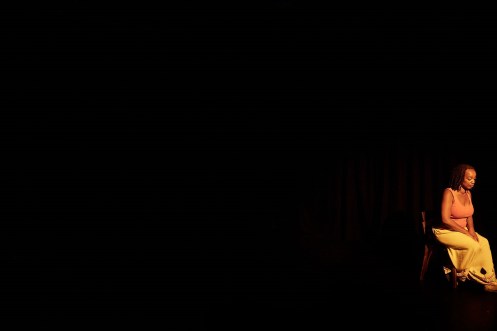
Her journey of discovery begins at the age of sixteen, her GCSE year. The dialogue here is characterised by a mixture of nervousness and humour. We follow her through the complexities of her life. Her first attempts at singing are hesitant although Paula David does just enough for the audience to realise that she is a performer with a rich, punchy but melodious voice. Continuing this journey of self-discovery, we learn about Carolann’s insensitive husband and marriage, motherhood, divorce, boyfriends, the lonely years, the painfulness of her condition, and eventually reconciliation and resolution.
During the play Carolann often refers to a character called Shelly. Who Shelly is doesn’t become clear until the end of the play, but she is certainly somebody Carolann knows extremely well and feels very close to. Shelly’s name and the snippets of sung music lines throughout the play act similarly to motifs, repeated word and musical phrases that contribute to Carolann’s moods. For example, the sung lines, “finding yourself,” “I don’t know why,” “being put down,” are delivered when we learn from Carolann that her husband has had an affair with another woman, Tracy. “Don’t know me,” and “sexy bitch,” are other phrases that are heard again.

This play demands a great deal of an actress in terms of physicality, mime and vocal range, and Paula David doesn’t disappoint. Her miming of intercourse with Jacob is strongly physical but is not obscene. At other times she throws herself on the floor with complete abandonment as when she trips on the dance floor and lands on a male figure, very much enjoying the proximity of his maleness. We meet a number of different characters on Carolann’s journey and Paula David succeeds in making them very real.
Against this backdrop of sex, song, laughter, physical action, there are quieter moment, times when Carolann is more reflective and when we learn more of her inner thoughts. Here she breaks the fourth wall and directs her observations to the audience. She manages to do this in a way that is conspiratorial, there is no sharp break between her engagements with other characters and chats with the audience. During these moments the audience get insights into her vulnerability.
The final encounter in this monologue is Carolann’s exchange with her daughter Tanya, whom she thinks may be gay. She thinks this because of their inability to easily communicate with each other. Realisation occurs when Tanya hands Carolann a bunch of flowers. The audience learn that Tanya is very supportive of her mother during anniversaries of a very sad event in Carolann’s life. Tanya is not gay; she has a boyfriend but can never find an occasion to tell her mother about him. The play ends on a strong note of hope and this is symbolised by Carolann and Tanya making pancakes together.
I wish Paula David the very best of luck with Blood, Sweat and Vaginas. It is a beautifully, constructed play, works on many different levels and is performed by a multi-talented actor. It deserves a good audience.
Celia Bard
July 2019
Photography by Arnhel de Serra; image by Mark Taylor
Human Interactions, Expressed With Flair
Dance@TheGrange
Company Wayne McGregor and Ballet Black
The Grange Festival, at The Grange, Northington until 26th June
A review by Mark Aspen
Our humanity is the one thing which we all share. This was the sentiment of the brief curtain speech by Michael Chance, the Artistic Director of The Grange Festival on the opening night of Dance@TheGrange, reflecting the enthusiasm of the audience for the inspired harmonisation of dance into the Grange’s opera season for a second year. His words, “We all love dance; we all love to sing; we all are human”, encapsulated the ethos of his collaboration with the renowned choreographer, Wayne McGregor.
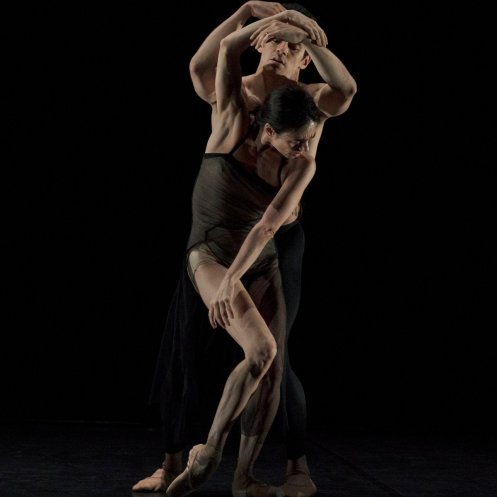
The common themes that emerge from the five dance pieces are twofold: how we interact with other human beings; and how we interact within ourselves, our bodies with our minds and our minds with our spirit. We could interchange the word interact with the word react, as the two themes interconnect.

The programme comprises five dance pieces, three by Company Wayne McGregor and two by Ballet Black. One piece by each company had its premiere on the opening night. Wayne McGregor is the doyen of the modern dance world, having successfully managed to fuse a spectrum of dance styles, the classical ballet of The Royal Ballet, the innovation of Sadler’s Wells and the cutting edge contemporary dance of The Place, having been choreographer in residence with all three companies.
Outlier, the first work of the programme, is by Company Wayne McGregor, a remounting of McGregor’s own neo-classical ballet, initially produced for the New York City Ballet, as part of its 2010 Architecture of Dance series. Although McGregor describes this as a mini malist work, in many ways it is anything but. It is a high-tempo piece that is complex both visually and musically, being set to Thomas Adès’ labyrinthine Op 24 violin concerto Concentric Paths. Its three movements are entitled Rings, Paths and Rounds, which contextualises it within the architecture theme. The architectural inspiration is Bauhaus, and here is where the minimalism is apparent in the clean cut lines of Bauhaus reflected in the precise placings and movements of the dancers. The abstract presentation hints nevertheless at the human interaction within and its reaction to the built environment. Rings is a boldly sinuous section, where the interactions are between pairs dissolving from duets into investigative groupings. It is set at first against scarlet
  ring of light, an understated but effective design by Lucy Carter, who opens Rounds by bold placing the whole company in silhouette. This short passage includes some remarkable interpretations of flute set against a pizzicato violin, which is danced with staccato steps, humanity confined. These two movements parenthesise the longer middle movement, Paths, which features the guest artist, Alessandra Ferri, prima ballerina assoluta at La Scala Ballet and a former Principal of The Royal Ballet. This is a more lyrical and introspective movement with the intensity of the solo violin set against the caprice of the other instruments, giving ample opportunity show Ferri’s virtuosity, much en pointe, supported by the fugitive background of the corps. (It is difficult to find an image of Alessandra Ferri not en pointe.)
Washa, the first of the works with its premiere at The Grange, is a gorgeously vivid contrast. Produced by Cassa Pancho’s Ballet Black it is especially commissioned for the Grange Festival from the talented emerging choreographer, Mthuthuzeli November. Contemplating the origin of music, November asks in this piece “Exactly why do we dance to music?” and he answers his own question with this very affirming celebration of the human body and spirit interacting thorough music. Washa translates from Xhosa as “burn from the inside” and November is fascinated by the clicks and trills used in that language. The opening of the dance is inspired by the rhythms created by San Bushmen singing around the fire. Fire forms an all-encompassing image in this integrated ensemble piece from the full sextet of the company’s dancers. Opening with the sounds generated by a dancer kindling a fire from a fire-stick and driven by Peter Johnson’s percussive score, the image of fire is impressively pervasive, highlighted by the free-flowing fire-red flaming skirts of the dancers. The piece is a triumphant fusion of classical and modern dance into the millennia-old African culture, which realises November’s aim to cause the inner fire of the dancers to suffuse through their audience.
The emotionally penetrating duet, Clay, by the acclaimed Australian choreographer Alice Topp, is presented by Company Wayne McGregor as the second of the world premieres. Human beings can mould and shape each other like clay, but separation, grief and pain can intensify mutual feelings. Clay studies the sensitivities underlying the interactions between a couple where one is suffering under the burden of pain. How much can the burden be shared to the other, the clay stretched before it shears? The subtle lighting of erstwhile dancer Geneviève Giron provides a claustrophobic atmosphere. The ostinato score, Whirling Winds, by the Italian laureate composer, Ludovico Einaudi is the perfect vehicle for the two artists, Rebecca Basset-Graham and Izzac Carroll. The opening is lyrical and the dancing shows mutual sympathy, but as the music takes on an urgency and sense of aggravation, tensions become apparent. Carroll and Basset-Graham’s expressive dancing portrays the compassion and the tribulations of the relationship, its actions shift from gentle and sensitive to troubled and grudging. The pair cut some dramatic figures, difficult dynamic lifts are executed effortlessly, and the increasing weight of the piece is thoroughly acted out. As Clay is said to be a sketch for a larger dance-piece, we should be looking out with impatience to see the final work.
The versatility of Alice Topp’s choreography is exhibited in the style of Company Wayne McGregor’s Little Atlas, where it owes much to classical ballet. It premiered in 2016 at the Sydney Opera House, but transfers well to the Grange stage, where Jon Buswell’s adapted lighting plot enhances the sense of confinement crucial to the piece. This too is set to a score by Ludovico Einaudi, taken from two of his works, Fly and Pieces. Little Atlas is a piece of considerable crystalline beauty that explores the nature of memory. A solo dancer, Camille Bracher, is discovered held within a cone of brilliant light, the confines of her past experiences, her memories. She is joined by two male dancers, Jacob O’Connell and Jordan James Bridge, positive and negative reminiscences of her past. There are some beautifully executed classical movements, the ballerina held en attitude Balanchine. As forgetfulness intervenes, the top lit cone becomes more stable. Finally we are left with the solo dancer again, in a close top spotlight, a moment of sublime pathos.

The final work in the programme, The Suit, firmly picks up the theme of human interaction. It is a longer piece, with a sharply defined narrative. The plot is based on a short story by South African writer Can Themba about a married couple Matilda and Philemon, who live in a suburb of Johannesburg. The story moves from light-hearted observations of day-to-day life to a dark and tragic denouement, and requires a difficult emotional journey from the principals. American dancer Cira Robinson and Brazilian born José Alves, both Senior Artists with Ballet Black, are well up to this task and their characterisations are impeccable. The Suit won two Critics’ Circle National Dance Awards last year for Ballet Black, and choreographer Cathy Marston’s revival at The Grange remains fresh and energetic. The adage, less is more, works wonders in Jane Heather’s inspired set and David Plater’s lighting which give a sense of place as scenes move convincingly from bedroom to bathroom, to the road and bus-stop outside, to a park and on to a dance hall. All is done with two simple frames, albeit greatly augmented by the company ensemble who mime everything else from an alarm clock to a bathroom tap.  Alves, as Philemon, extracts much humour from the husband’s daily routine, taking scrupulous care of his ablutions. Then into the streets where he has a cheery hello for everyone, helps little-ol’-ladies across the road, and generally excels as a good egg. But things are about to change for Philemon. Back home Matilda has shown in her lover, Simon, and her morning is about to hot-up. Their amorous encounter rapidly develops in intensity. Robinson’s sensual dancing is matched by the erotically charged interpretation of Mthuthuzeli November, now as a dancer, as they come to “the awful daring of a moment’s surrender”. Unfortunately, Philemon has forgotten his briefcase, and discovers his wife in flagrante delicto. Alves’s depiction of Philemon’s revulsion is palpable. In true farce style, Simon disappears déshabillé, though the window, but not in Brian Rix style, since he leaves his trousers, and the rest of his clothes, behind. The score is written by Phillip Feeney, as arrangements of eight diverse composers’ music, and this works well to delineate the changing emotional circumstances of the protagonists. You see, Simon’s abandoned suit becomes a symbol, of shame for Matilda and of humiliation for the cuckolded Philemon. The vacant suit, cleverly becoming one of the ensemble on its coat-hanger, is constantly with the couple. It sits with them at dinner and goes with them on a walk to the park. Philemon’s personality has changed and he now only wants to humiliate his wife. He even forces her to come to a dance with their friends and makes her dance publicly with the suit. All the company, and the suit, dance a beautifully choreographed paso-doble, , but clearly its binary rhythm (and its title) is a sardonic musical pun. There is a point in the dance where it seems that Philemon is going to forgive her, a great moment of dramatic tension and you could almost feel the audience willing it to happen, but he cannot bring himself to do so. This is a moment he will regret for ever. Supported by a versatile ensemble, the expressive acting conveyed by skilfully interpretive dancing by the three principals, made this a memorable piece of story-telling.

A wide range of human interactions, bodies, minds and spirits, is packaged in the 2019 Dance@TheGrange programme, and is presented with the flair that we have come to expect of The Grange Festival, a successful pairing of opera and dance: what a wonderful way to express our humanity.
Mark Aspen
June 2019
Photography by Bill Cooper, ASH, and Paul Kolnik
Laugh Your Head Off !
Wolf Hall and Bring up the Bodies
by Mike Poulton, adapted from the novels of Hilary Mantel
Teddington Theatre Club at the Hampton Hill Theatre until 28th June
A review by Viola Selby
Who fancies a good gossip about so called friends, adultery, incest, divorce and beheading? Well then Sally Halsey’s production of Mike Poulton’s adaptation of Hilary Mantel’s Wolf Hall and Bring up the Bodies is just up your alley! This six-hour long production, including intervals, but not dinner breaks, is a royally rumbustious affair that will have you both laughing your head off (pun intended) whilst sitting on the edge of your seat. Taken along by Sally Halsey’s great direction, the audience is transported back to various famous locations of Tudor England by Junis Olmscheid’s exquisite and highly detailed set designs, including hidden gems like the Tudor Rose on one of the corridor walls, clever lighting and sound by Gary Stevenson and Harry Jacobs and costumes that would make a queen green with envy, creatively crafted by the wardrobe team.
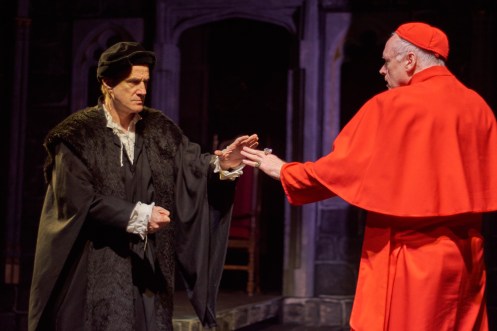
Each performance is strong and carefully planned out, with all actors having a clear understanding of their character and motives. For example, Dave O’Roarty plays Cardinal Wolsey, not just as a greedy right hand of the king, but as a man whose beliefs and desires are often in conflict with his need to survive and to serve his king. Whilst Tom Wright’s Thomas More is not some gentle religious man as often More is made out to be, but an annoying pious creep.
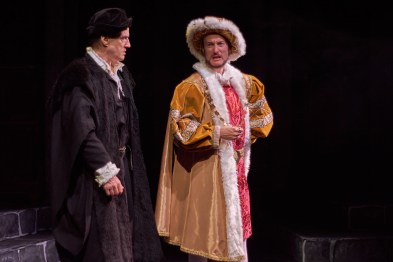 But it is Dave Brickwood, who is the star of the show as Thomas Cromwell, managing to portray a man with many layers, in an intense yet seemingly effortless performance. Instead of portraying him as a man completely devoted to Wolsey, as Mantel would have us believe, or the Tudor Alistair Campbell with an axe, as David Starkey argues, Brickwood has the audience’s mind in a real muddle as they try to work out Cromwell’s true intention. As Cromwell says, “I have never known what is in your heart. Do not presume to know what is in mine.” And this is something that in this play we can never do!
Unlike many other plays adapted from books, this is not a play about which the audience needs to have read and remembered Mantel’s books word for word, nor do you feel the need to remember everything from your GCSE History lessons. It holds well on its own. However a light understanding of the characters and places would help, as there are so many plot twists and place names it is almost like watching a Game of Thrones episode! It would also help in understanding the comedy behind lines such as when Jane Seymour, brilliantly played by Hannah Lobley, introduces herself as, “Oh, I’m nobody. I’m only Jane Seymour.”
A gripping and hilarious royal romp filled with backstabbing, plotting and intrigue, Wolf Hall and Bring up the Bodies is a six-hour production that will have you both sitting on the edge of your thrones and laughing your breeches off!
Viola Selby
June 2019
Photography by Joe Stockwell
Riotous Spectacle, Gloriously Sung
The Magic Flute
by Wolfgang Amadeus Mozart, libretto by Emanuel Schikaneder
Scottish Opera at the Hackney Empire until 22nd June
A review by Genni Trickett
As a steampunk enthusiast, I have learned to be wary of mainstream events and productions that claim to be steampunk. Often, it signals a half-hearted attempt to leap on the popular bandwagon by bunging a few cogs into the design and making the ladies wear their corsets over their dresses.
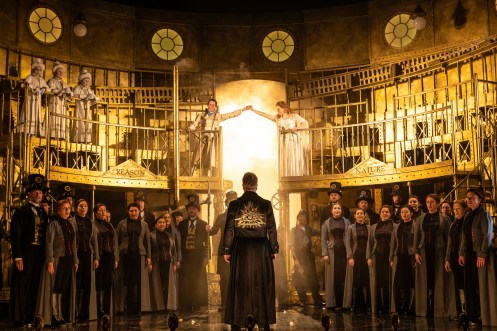
Not so in this production of The Magic Flute, however; Scottish Opera have really gone for it. Simon Higlett’s lavish set gleams with brass, there are top hats and goggles everywhere, a delightful mechanical automaton almost steals the show, and a gloriously voluptuous, rather kinky chaise makes an appearance – maybe a sly nod to the rumour that Victorians considered furniture legs obscene. Oh, and there is also a rather fabulous monster, all gleaming metal and glowing eyes.

Papageno first appears as a flamboyant Victorian showman, drawing Tamino into the house of wonders, where a sparkly Queen of the Night and a sinister, black-clad Sarastro await him. The Masonic symbols are all present and correct, of course, but they fit rather well into the lavish spectacle. Mark Jonathan’s lighting is marvellously atmospheric, giving us gloomy shadows, bright sunshine and sinister flashes of lightning as required.
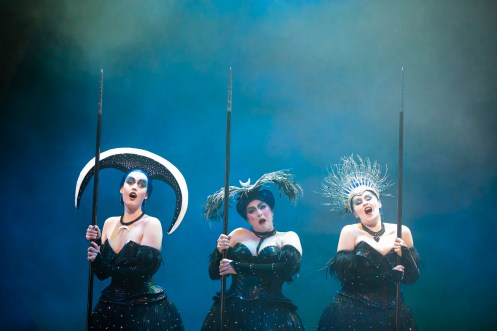
All in all, a visual feast. And thankfully, the production itself lived up to the aesthetic. Movement is kept largely minimal, especially during the singing, but what little there is works well. Sarastro’s henchmen lurk unsettlingly in the shadows on scaffolding, the Queen’s naughty handmaidens glide about, full of devilment, and three small boys dangle bravely from the rafters.
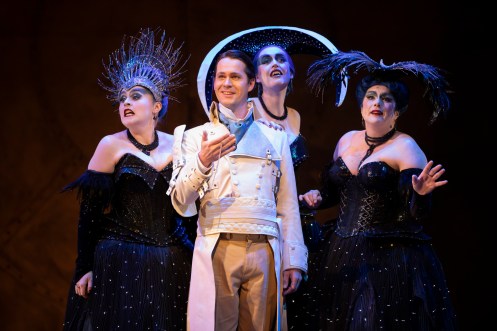
Peter Gijsbertsen is a noble, bewildered Tamino, and Gemma Summerfield brings some welcome melodrama to his long-suffering love, Pamina. Adrian Thompson is perfectly revolting as the cartoon villain, Monostatos, and Dingle Yandell gives an unnerving stillness to the ineffable Sarastro. Julia Sitkovetsky, as the Queen of the Night, gave a bravura performance while singing, perfectly nailing the legendarily difficult Der Hölle Rache. However, her character lacked power, particularly when compared to her handmaidens, played by Jeni Bern, Bethan Langford and Sioned Gwen Davies.
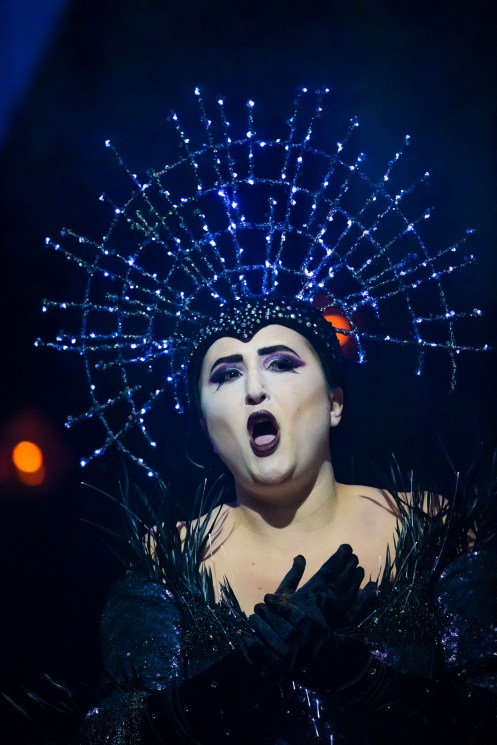
Full marks for James Cleverton, standing in for Richard Burkhard as Papegeno; his is surely the most difficult and complicated role, but he really pulls it off. His clowning and theatrics give a much-needed lift to the meandering story line, and in this he was greatly aided by Sofia Troncoso’s ridiculously entertaining Papagena.

The orchestra, doubtless sweating away in their pit on such a hot night, were simply wonderful, and the sound levels were spot on.
It is impossible to review The Magic Flute without touching on the thorny issue of its innate sexism and misogyny. In this production its troublesome presence was greatly alleviated by Kit Hesketh-Harvey’s witty, slightly modernised English libretto and Sir Thomas Allen’s light, comic direction. Together they emphasised the fact that almost everything and everyone in this opera is ridiculous, and should not be taken seriously. It is a sumptuous, riotous spectacle, gloriously sung and marvellous fun. That is all.
Genni Trickett
June 2019
Photography by James Glossop
Power, Piety and Pity Flow from Sybaritic Sensuality
Belshazzar
by Georg Frideric Handel, libretto by Charles Jennens
The Grange Festival, at The Grange, Northington until 6th July
A review by Mark Aspen
If you want a good rip-roaring story, there is probably no better place to go than the Old Testament. There are tales on an epic scale, as armies besiege cities, Jericho … or Babylon. There are cities of debauchery, Sodom and Gomorrah, … or Babylon. Or Babylon … here you have the best of the worst worlds, an army besieges while the city debauches. Hence, the fall of Babylon at the end of the reign of Belshazzar is a gift for an opera, and particularly if large scale choral singing is your forte (in both senses of the word).
Large scale choral works, oratorios and opera, were unquestionably a forte of Georg Frideric Handel, but to the devout Handel and his pious and staid librettist Charles Jennens, Belshazzar had a strong moral and religious message (and possibly hints of a political one).
The excesses of the eponymous Belshazzar, King (or strictly speaking co-regent) of Babylon, as the conquering Persians attack his city, are certainly strong meat; and Daniel Slater, the director of The Grange Festival’s powerful production of Belshazzar, takes every opportunity to squeeze out every delicious drop of juice from that meat.

Handel conceived Belshazzar as an oratorio and it is indeed rare for it to be presented as a fully staged opera. Michael Chance, The Grange Festival’s ebullient Artistic Director, tells us that this is the first UK production* of Belshazzar as an opera in “living memory”. The dedicated and knowledgeable Chance knows how to pick his season, and this opera is more than a dramatised oratorio, it is a triumph!

Slatter’s setting reeks of voluptuousness, think Peter Greenaway meets Sir Lawrence Alma-Tadema. The setting has a tripartite artistic concept, design, lighting and movement. Robert Innes Hopkins set design is an inspired by the iconic image of Breughel’s Tower of Babel. We feel we have to let pass the anachronism of a couple of millennia between Genesis and Daniel, but then again this tower is truncated and no longer has the conceit to reach heaven. It is still a structure of some substance set with precarious footholds for the cast to clamber on. The tower is mounted on a revolve and turns to reveal the sumptuous golden walled palace of Belshazzar. Then Peter Mumford’s lighting design follows the various moods of the plot, colour-coding emotions and emphasizing place. We can be with the licentious Babylonians inside the massive city walls, or outside with the haughty Persians. The third impressive element is the movement, individuals become masses: crowds whose every move underlines the action, sometime disciplined armies, sometime mobs, sometime orgiastic writhing heaps of sensuality. Movement director Tim Claydon’s choreography is a well-studied and accurately observed replication of the collective instincts of the crowd. It delivers just as much impact as the large scale operatic or dramatic blockbusters mounted on the London stages by directors such as Deborah Warner.

Claydon’s palette is the augmented festival chorus comprising The Sixteen Choir and The Grange Festival Chorus. It is unusual in a review to mention the chorus before the principals, but in this production the chorus makes such a magnificent visual and vocal foil to set off the talents of the individual performers. Handel gives the chorus much to do, and they are certainly kept busy repeatedly changing costumes to become Babylonians, Jews, Medes or Persians. But Handel gives them music of grandeur and magnificence, and the augmented chorus of some 27 singers bring this out with musical vibrancy and unimpeachable coordination. Each of the peoples has its own character. The Babylonians, gaudy and brash, mock the besiegers from atop the walls, “Hark, Cyrus! A tedious time! To make it short, thy wise attempt will find us sport”. The Jews, dressed in black are pious and are submissive, until Belshazzar profanes their sacred chalice, “Recall, O king, thy rash command”. The Persians, determined and confident, hold the moral high ground, “Of things on earth, proud man must own, falsehood is found in man alone.” The chorus differentiate between each with well-polished skill.
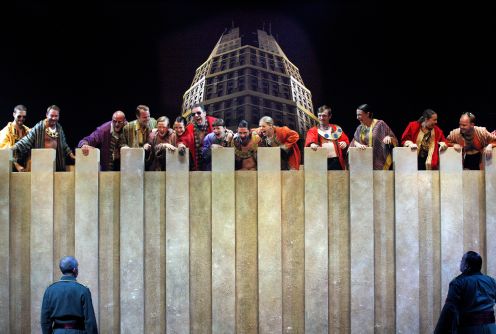
The visual impact of the chorus, increased to thirty by the presence of three skilled acrobats (Haylee Ann, Craig Dagostio and Felipe Reyes), comes from the fluent and expressive choreographed movement that almost articulates the collective consciousness of the group, as cowed prisoners, marching disciplined armies, or decadent courtiers. The depraved licentiousness of the Babylonian court reaches its depths in the Feast of Sesach, an unbridled drunken orgy of sex in all its versions and perversions, which continues even as the Persians besiege the city.
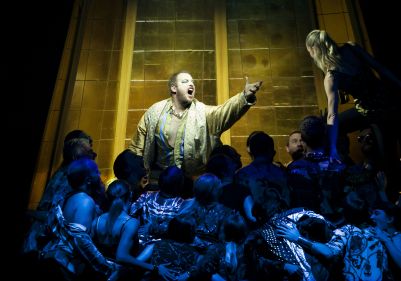 And from the innermost core of the depravity there bursts like an erupting volcano the lip-smacking figure of the bisexual tyrant, Belshazzar. Robert Murray makes a remarkable Belshazzar, his muscular tenor negotiating the intricacies of the score with aplomb, and obviously relishing acting the reckless despot. The sybaritic sensuality of his court is played out in Haylee Ann’s aerial ballet, on a stream of golden silk, dangled before Belshazzar’s popping eyes. She climbs the silk to retrieve the Jewish chalice … Belshazzar drinks from it! Then a sudden staccato violin chord as he faints in fear! At first it is only he who sees the Writing on the Wall.
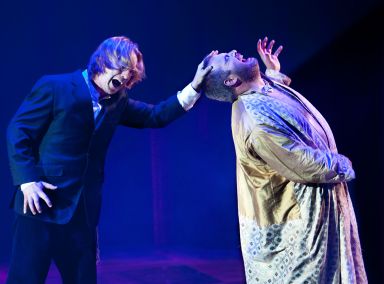 Daniel, the charismatic prophet of royal Jewish descent, is brought forth, as only he can decipher The Writing. James Laing, as a long haired, bespectacled and somewhat studious Daniel, conveys calm and dignified piety. Laing (soon to revive his “sleazy” Terry in Nico Muhly’s Marnie at ENO) has a finely pointed countertenor voice, which emanates authority “Thou hast not glorified, but hast blasphem’d.” As he interprets the portentous message, he places a healing and exorcising hand on Belshazzar, who is spiritually slain.
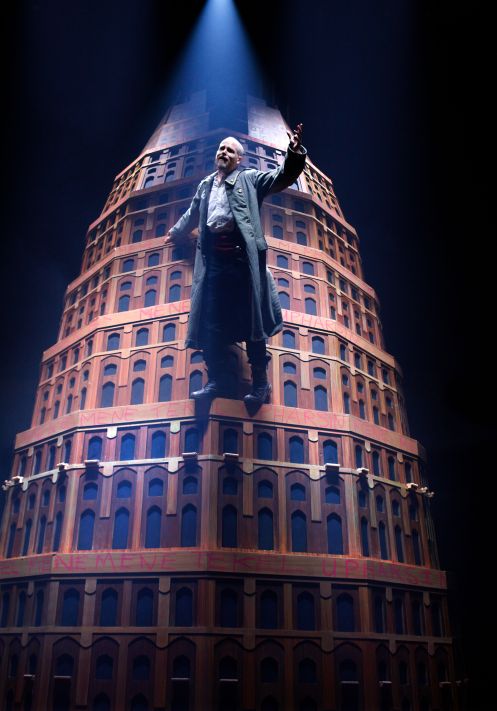
The countertenor is a stock in modern interpretations of Baroque opera, and The Grange Festival has built a strong reputation in the Baroque with its yearly production of early opera. (Michael Chance himself is of course a renowned countertenor.) It is interesting to hear the subtleties of timbre and approach that exist within the countertenor range. Christopher Ainslie, who played Ottone in The Grange Festival’s Agrippina last year (and Oberon in A Midsummers’ Night’s Dream at ENO) is now Cyrus in this production, Cyrus the Great, the Persian Emperor. He portrays the patient confident Cyrus with an assertive countertenor, slightly more coloured than Laing’s defined approach, imbuing the character with considered audacity.

Cyrus’s audacity is at its most evident in his bold tactic of diverting the Euphrates river which encircles the city, an historic detail that Jennens gleaned from Herodotus rather than the Old Testament, but which embodies the out-of-the-box daring-do of the character. This trait is highlighted by the juxtaposition of Cyrus’s more conventional military man, his general Gobrias, scored as a bass. The men are depicted as mutually supportive. Gobrias is “oppress’d with never-ceasing grief” over the murder of his son by Belshazzar, but Cyrus urges him to revenge. Henry Waddington portrays Gobrias as a tragic figure for whom “no hope, but in revenge, is left”. He relishes in his delivery of his observation of Belshazzar, “Behold the monstrous human beast, wallowing in excessive feast” and the drama of the descending scales paints a vivid picture. It is Gobrias who kills Belshazzar with his own hand, and in a dramatic coda we feel his revulsion as he hands over the bloodied sword to Cyrus.
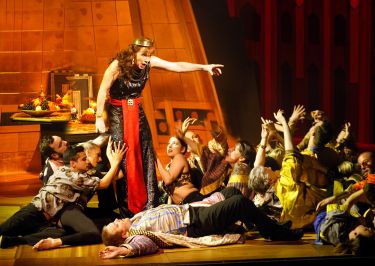 In spite of all the swashbuckling, there are profound depths to Belshazzar. It is a three-way struggle between reason, immorality and spirituality, embodied in each of the three peoples, the good, the bad and the pious. Nitocris, Belshazzar’s mother, is a well-developed character who is torn by the heart-rending dilemma between condemning Belshazzar’s sins and protecting him as the son she loves, whilst filled with foreboding about his fate. Slater places Nitocris as the parentheses around the opera. During the overture we see the veiled Nitocris mourning alongside the coffin of her late husband, one of the four Babylonian kings assassinated during the bloody six years following the death of Nebuchadnezzar. Finally, as a visual epilogue to the opera, we see the veiled Nitocris mourning alongside the coffin of her late son. Claire Booth’s Nitocris sincere characterisation and expressive soprano vocal colour exudes the emotional language at the heart of the opera’s message.
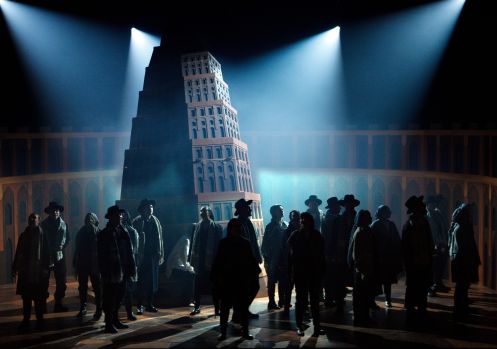
Slater’s Belshazzar drips with symbolism. Some is obvious, witness the lascivious things the Babylonians do with luscious bowls of fruit, some less so. Why does Daniel end up locked in erotic embraces with Nitocris after Belshazzar’s death? There is nothing in the libretto or score to suggest this. Maybe it contrasts with Cyrus, for whom the libretto has him declaring to Nitocris, “Be still a queen, a mother still, a son in Cyrus you shall find”. A bit Freudian-Oedipal it seems, so perhaps the implication is that Daniel will become a spiritual step-father to Cyrus. Are we meant to read that much in?
The Orchestra of The Sixteen, under the baton of its director Harry Christophers, is at one with the piece. Christophers moves the opera along at just the right pace, and the orchestra and the augmented Sixteen Choir are in perfect balance. Indeed, they have had a long time working together as this year marks the fortieth anniversary of The Sixteen, which Christophers founded in the summer of 1979.
With all the flair that The Grange Festival has for the baroque, its Belshazzar is a tour de force, a parable of power, piety and pity told with epic spectacle and artistic finesse. Yet another must see for The Grange.
Mark Aspen
June 2019

 Mark Aspen