
Ghost of a Chance
The Woman in Black
by Stephen Mallatratt, adapted from the novel by Susan Hill
PW Productions at Richmond Theatre until 18th November, then on tour until 1st June 2024
Review by Heather Moulson
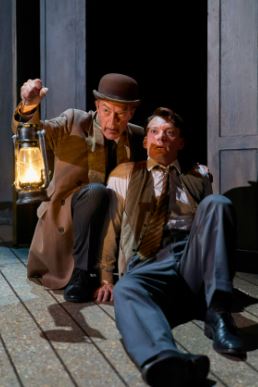
Back in 1989, The Woman in Black opened in the in the West End and over 13,000 performances have followed. But the current production is still a fresh fest of Gothic horror.
A great entrance from the auditorium by the excellent Mark Hawkins playing The Actor forms the surprise opening. This humorous first encounter lets us forgive the distracting house lights staying on in the opening minutes. However, once they dim, we long for them to return, as terror and apprehension envelope us.
Read more…Debauchery with a Health Warning
Don Giovanni
by Wolfgang Amadeus Mozart, libretto by Lorenzo Da Ponte
Glyndebourne Productions at Glyndebourne Festival Theatre until 2nd December.
Review by Mark Aspen
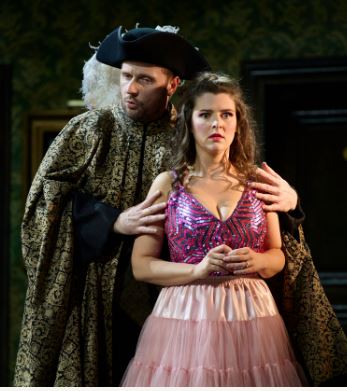
Mozart and his librettist, the worldly-aware Da Ponte, knew what pulled in the crowds: sex and violence, especially if it comes with a strong whiff of society gossip. La plus ça change!
Don Giovanni, widely regarded as one of his finest operas musically (although some may prefer Le Nozze di Figaro), certainly has all these crowd-pullers. And perhaps therein lies its difficulty. Is it a tragedy or a comedy? Mozart described it as a dramma giocoso, but attempted rape and murder are far, far from joyous. Some productions truncate the final scene of the happy(ish) ending and finish on the stern moral lesson of the unrepentant reprobate of the title being dragged to hell by the ghost of his murder victim (the so-called Prague versus Vienna endings, after the locations of the premières). Glyndebourne’s production retains the (Prague) upbeat ending and skilfully manages to keep the delicate balance between the parallel streams of humour and horror that run throughout.
Read more…Schubert Makes Everything Better
Schubertiade
Music by Franz Schubert words by various including Wilhelm Müller and Wolfgang von Goethe
Rose Opera at Leighton House, Kensington, 10th November
Review by Patrick Shorrock
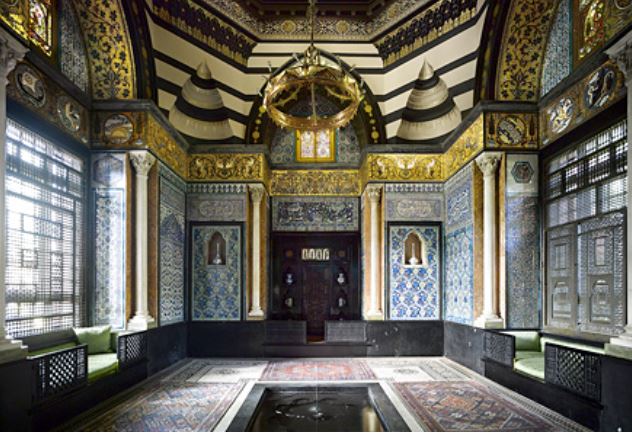
This was a delightful evening, with some of Schubert’s best-known songs performed by some talented singers in the glorious setting of Leighton House.
Pedants might say that this high camp Victorian setting isn’t a perfect fit for Schubert who is from a rather earlier period. But Leighton House is well worth a visit in its own right, both for the sensational Arab Hall, with its indoor fountain and glorious blue tiles, and also for the many drawings, paintings, and sculptures by the cosmopolitan Lord Leighton, who had this house built for him as both studio and residence.
Read more…By Gosh!
Mates in Chelsea
by Rory Mullarkey
The Royal Court Theatre, Chelsea until 16th December
Review by Polly Davies

Rory Mullarkey’s Mates in Chelsea is a joy. The script is clever, witty, and very funny and the cast romp through it, keeping the audience engaged throughout. In the process it quietly takes a hammer to both the established social order and the socialist dream. But this nihilistic message is best considered quietly at home later. The play is far too fast paced and entertaining to miss a moment.
Laurie Kynaston’s s foppish Theodore (Tug) Bungay’s life as an entitled carefree bachelor is about to come to an end. His modern- day Jeeves, Mrs Hanratty, convincingly played by Amy Booth-Steel is a card-carrying ex-member of the Baader Meinhof with a penchant for baking, and an inexplicable affection for him. His socialite fiancée Finty Crossbell is becoming weary of an overlong engagement, and his ancestral home is about to be sold to a Russian Oligarch. As the play develops, the audience are variously giggling at the topical references and innuendos, belly laughing at the delightful farce scene in the middle of the play, gasping at the incredible stage effects, or quietly watching and listening intently as the denouement unfolds.
Read more…Reflections of Shadowing
Creative Voices II
An Evening with Lisa Jewell
Arts Richmond at the Exchange Theatre, Twickenham, 8th November
Review by Heather Moulson

Seated before us was the very prolific writer, Lisa Jewell. With a backdrop of her latest book None of This Is True, the interviewer, York Membery introduced us to Jewell, who in turn presented this her latest novel. Part of Arts Richmond’s Creative Voices, this was the second talk with an established author at The Exchange.
We were eager to learn the secret of her engaging and gripping plots, and Jewell was happy to share the notion of how she would be obsessed with a particular idea, as in this case, being shadowed by someone from the outside. For instance, for his book A Year with Lisa Jewell,Will Brooker did indeed shadow Jewell for that amount of time, parting company, leaving the writer to surmise what if it was the wrong one you let into your life? The product of which emerged in July 2023 and lit up on the backdrop.
Read more…Flowers by the Docks
A Midsummer Night’s Dream
by William Shakespeare
YAT at Hampton Hill Theatre, until 11th November
Review by Celia Bard
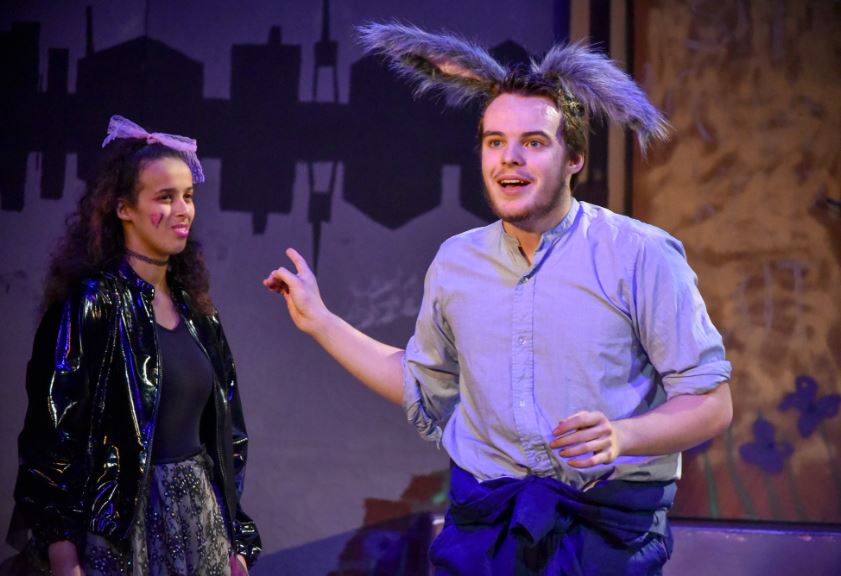
The play, A Midsummer Night’s Dream by William Shakespeare, is an interesting one as it takes the audience into fairyland, something that you don’t expect to see in his plays, apart from The Tempest. The majority of his plays focus on comedies, histories and tragedies with themes that reflect events taking place during his time period. So, it was interesting to see how YAT and the director of this production, Joseph Evans, interpreted the complexities of a ‘real’ world and its ‘realistic’ characters with a magical world containing fanciful characters pursuing their own ambitions and playful plots.
Read more…Bittersweet Memoirs
Love Letters
by A J Gurney
OHADS at the Coward Studio, Hampton Hill Theatre until 4th November
Review by Steve Mackrell

Love Letters is a play in which two seated characters read out a lifetime’s correspondence which, on the face of it, requires little in the way of set design or costumes and, arguably, not even much rehearsal. Nonetheless, the play has recently become something of a celebrity vehicle with the latest notable outing being a production by the late Bill Kenwright, with Martin Shaw and Jenny Seagrove, at the Theatre Royal, Haymarket. This was the first post-lockdown play to open in the West End following the Covid pandemic, a choice presumably made easier due to meeting the required social distancing between the two actors.
LoveLetters is an American play by A.R. Gurney that first opened in New York in 1988 and was a finalist for the Pulitzer Prize for Drama. The play centres on two characters, Melissa Gardner and Andrew Makepeace Ladd III who sit side by side at a table and read out aloud the story of their lives through correspondence with each other over a period of some fifty years. We follow their lives – their hopes and ambitions, their dreams and disappointments, over a lifetime of (mostly) separate lives.
Read more…Branagh Lithic
King Lear
by William Shakespeare
Fiery Angel and Kenneth Branagh Theatre Company, at Wyndham’s Theatre, West End until 9th December
Review by Mark Aspen
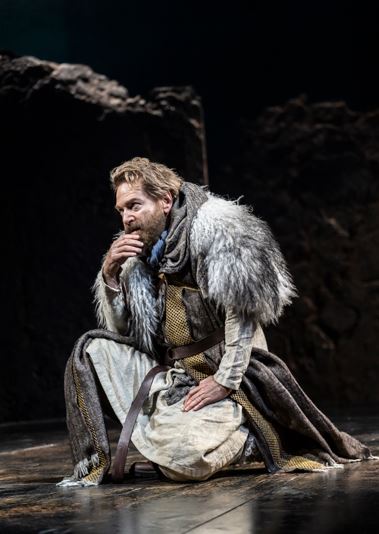
Welcome to the Stone Age. A circle of standing stones rings Wyndham’s stage, like a semi-dilapidated Stonehenge; and a fluid one, for we do not always see the same henge. Above hangs a massive glossy toroidal installation, its curved surfaces receiving the changing pictures of the projection and lighting designs of Ninna Dunn and Paul Keogan. It would not be out of place gracing the ceiling of a grand five-star hotel or an ocean liner. Designer Jon Bausor’s impressive setting is quite a spectacle.
The giant torus, though, often resembles the iris of a titanic eyeball, the pitch-black pupil in its central void an all-seeing organ of a Neolithic god, an atavistic deity. Such fatalistic influences impel the plot of King Lear, although Shakespeare does not place it in a clearly defined era. One can therefore forgive Shakespeare his anachronisms. The concept of political and military rivalries between England and France is clearly a preoccupation of the late medieval mind. And there are the repeated references to swords: the swordsmith first put in an appearance in the Bronze Age. This production sidesteps this by having almost everyone armed with a willow stave. A lot of time is spent by everyone thwacking everyone else with sticks.
Read more…Suspension Bridge
A View from the Bridge
by Arthur Miller
Headlong at the Rose Theatre Kingston until 11th November
Review by Heather Moulson
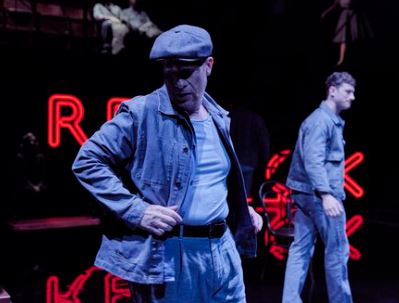
A girl sits on a swing with her back to the audience, against neon lighting, and a subtly tense soundtrack. A shiny floor resembles a river, surrounded by a stark black setting, with stairs leading up to a courtroom-like area. The overall design sacrifices the tawdriness of 1950s Brooklyn for a dark atmosphere that exudes an air of downbeat glamour.
Read more…Spectacle of Storms and Sherry
And Then There Were None
by Agatha Christie
Fiery Angel, Royal & Derngate, Northampton and ROYO at Richmond Theatre, until 4th November, then on tour until 13th April 2024
Review by Eleanor Lewis

For the British there are few places more appropriate to be transported away to on a rainy Hallowe’en night than a small, difficult-to-get-to island off the coast of Britain where ten strangers are about to meet their untimely deaths in very mysterious circumstances, which means of course an Agatha Christie.
Read more…
 Mark Aspen