
Masks Slipping
God of Carnage
by Yasmina Reza
The Questors, at the Judi Dench Playhouse, Ealing until 14th August
Review by Eleanor Lewis
Fights in the playground aren’t always between the children and there is the distinct possibility that sometimes those parental altercations caught on CCTV are watched back in the school office at the end of the day. There is evidently an audience for parents behaving badly, especially amongst those parents who would never let themselves go like that …
Yasmina Reza’s God of Carnage at Questors’ Theatre is about that subject and a great deal more: are we really superior in the West? Is society in its current incarnation actually working? Is marriage a good thing? Why do people have children without any idea of what it will actually involve? But the pivot on which all of that turns (or spins wildly) is the meeting between two sets of parents to discuss the fact that one of their children has whacked the other couple’s child and knocked out two of his teeth.

Double or Quips?
The Comedy of Errors
by William Shakespeare
Richmond Shakespeare Society, Fountain Gardens, York House, Twickenham until 14th August
Review by Mark Aspen
Yee-Hah! In the Wild West of Ephesus folks are likely to be seeing double. Could be the local hooch or moonshine hereabouts, or m’be it’s more than that? So I moseyed down to the Naked Ladies’ tavern in Twickenham to take me a look.
The Richmond Shakespeare Society is back in town, or rather out of its theatre and it’s the Fountain Gardens for its traditional annual open-air show, which has been almost its raison d’être since 1934, thankfully re-established in all its glory after the worse ravages of the pandemic.
With its errors resulting from the mistaken identities of identical twin brothers, the plot of Shakespeare’s The Comedy of Errors has travelled far, from its original Latin farce, the Menæchmi, penned by Plautus around 200 B.C; all the way to Rodgers and Hart’s 1938 Broadway musical The Boys from Syracuse, this with various subsequent film versions. So it’s got (gotten?) to America, but possibly never to the Wild West.
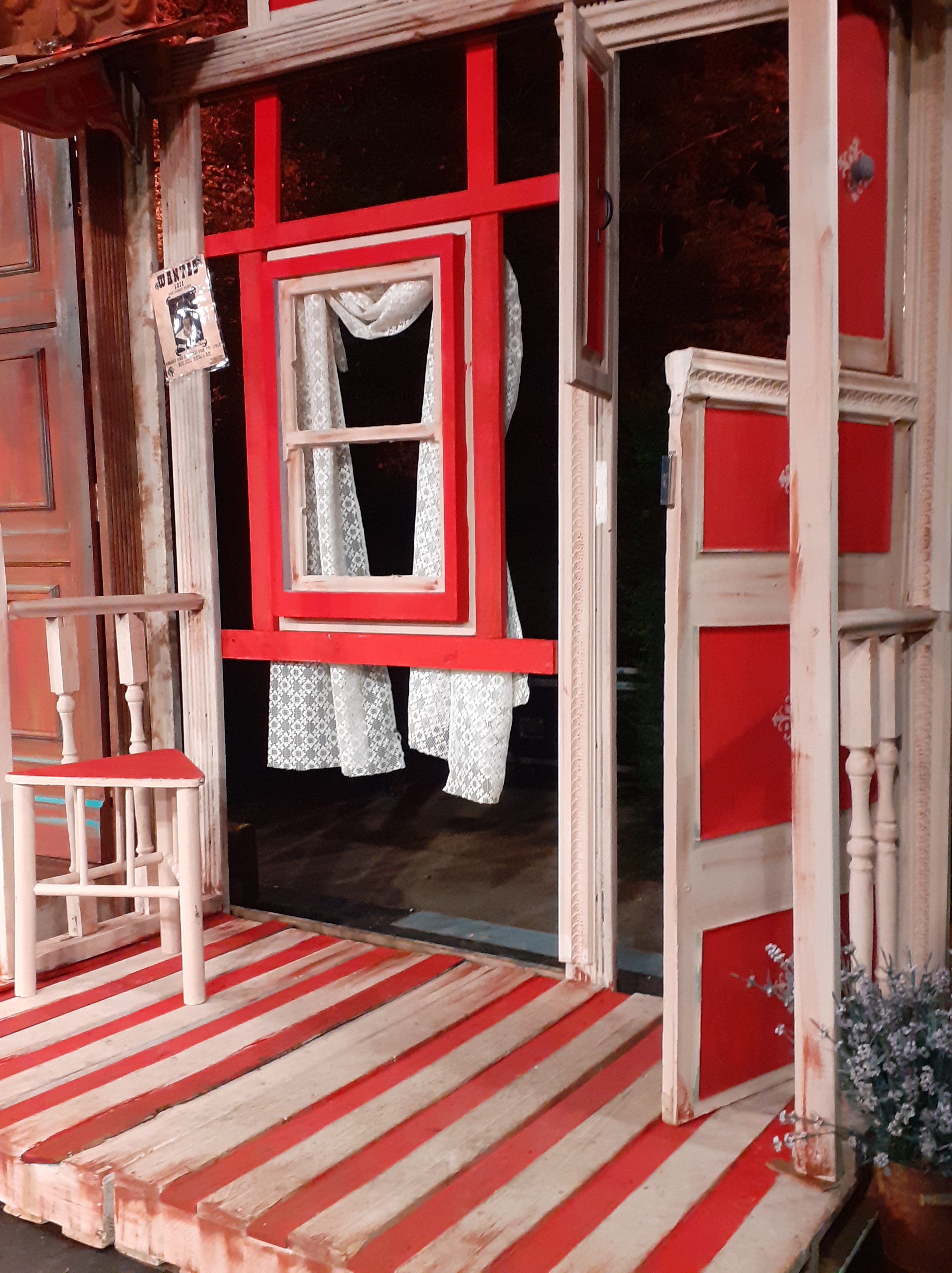
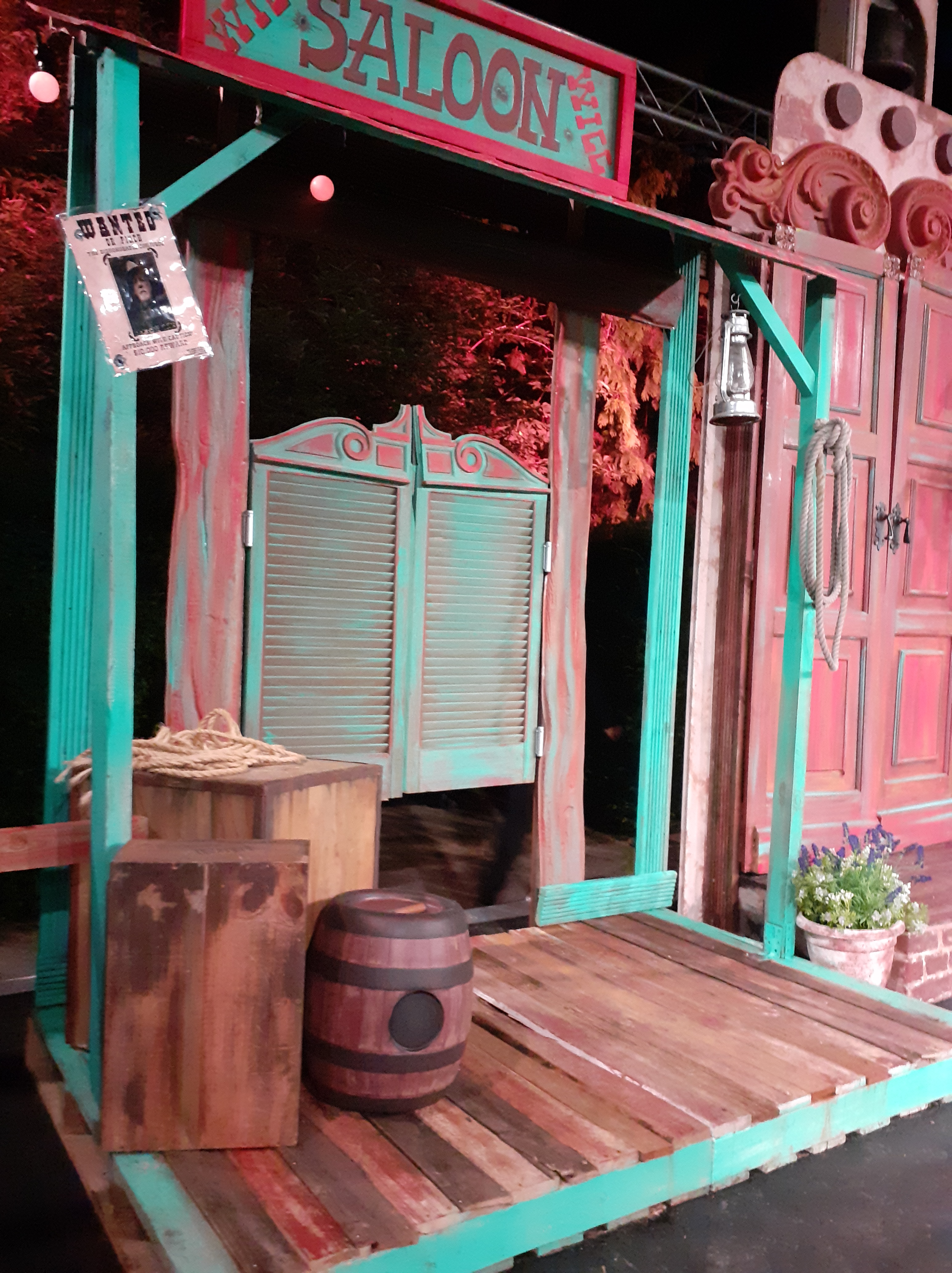
Appropriately listening to country and western music whilst enjoying our pre-show picnic, the audience had plenty of opportunity to admire Junis Olmscheid’s colourful picture book set. It is straight from Hollywood, to which she is no stranger. The saloon has swinging half-doors, the Hotel Phoenix is shuttered and panelled, and they are connected via a wooden sidewalk. This is the town of Ephesus (The USA probably has one somewhere way out west.) It’s mean and dusty, where men are ma-en and women are wimmen.
Read more…Dismantling Folklore in the Pheasantry
Robin Hood: The Legend of Bushy Park
by Josh Clarke
YAT, The Woodland Gardens, Teddington until 8th August.
Review by Heather Moulson
Dressed up all in Green Yo, Ho! … well, in a mac actually, just in case, I went in search of the legendary Robin Hood in his Bushy Park hideaway.

Arriving at the verdant Pheasantry grounds, I didn’t know quite what to expect. A natural grass stage before the audience, with an abundance of foliage to the right, making up the only stage entrance: I was intrigued and slightly worried by these elements … and by the looming precipitation.
Read more…Power of The Camden Fringe
Marie Lloyd Stole My Life

by J.J. Leppink
Blue Fire Theatre Company at Water Rats, Camden Fringe then at Museum of Comedy until 21st August.
Review by David Stephens

“I’m reviewing a play about a Victorian Music Hall singer.”
“Oh, is it Marie Lloyd?”
“No… but funny you should say that…”.
The above is an excerpt from a conversation with a family member prior to my attending last night’s performance of Marie Lloyd Stole My Life, at this year’s Camden Fringe Festival, and, by the end of this short exchange, the author’s apparent need to tell this relatively unknown story immediately dawned on me. Most people, even with only a vague knowledge of theatrical history, will recognise the name of the ‘queen’ of British music hall, ‘Marie Lloyd’, but how many will have heard of ‘Nelly Power’, one of the early stars of this theatrical genre, whose sparkle was dulled significantly when the former burst onto the scene, stealing more than just her limelight? This brilliantly written monologue leaves us in no doubt about who, according to Power at least, the true star of ‘music hall’ really was.
Staged in the perfectly-suited theatre at the rear of the iconic Water Rats Theatre Bar in London’s Kings Cross, quite literally a stone’s throw from St. Pancras, the birthplace of Nelly Power, it was in the saloon bars of public houses such as this, that the music hall genre was originally born, allowing raucous audiences to eat, drink, smoke, cheer and sing-along to their favourite acts in affordable surroundings. Indeed, this venue was itself a vibrant music hall, still hosting ‘Variety’ until as recently as the 1980’s. It was, therefore, almost like stepping back in time when, walking into the ex-Saloon Bar of this pub, we were immediately greeted by the tinkling ivories of the “old Joanna”, under orange-tinged lighting, perfectly replicating the dimly-lit venues of bygone times.
Down-Under Goes Up and Over
A Midsummer Night’s Dream
by William Shakespeare, re-imagined by Glenn Elston
Australian Shakespeare Company, Theatre on Kew at Kew Gardens until 29th August
Review by Mark Aspen
I know a bank where the (wild) thyme blows, where oxlips and the nodding violet grows, and luscious woodbine, sweet musk-roses and eglantine; plus of course cowslips and love-in-idleness. Of course, I know … in Kew Gardens; where else? Oberon might have been lost with eucalyptus, mimosa, bottlebrush, or anigozanthos, known as kangaroo paws; but I’m sure they’re there in Kew Gardens too.
These Australian plants might offer a welcome to Theatre on Kew, a touring group from the Australian Shakespeare Company, who are adding some down-under colour to open-air theatre throughout August. Its rip-roaring A Midsummer Night’s Dream is must for this season, especially if you can bring along a child or a teenager or two. This is a great fun introduction to Shakespeare. A tiny tot near the front of the audience was laughing her little-self hoarse throughout all the (many) comic enhancements.
Glenn Elston, the ASC’s Artistic Director, has taken a lot of liberties with the Bard in his re-imagining of A Midsummer Night’s Dream. Shakespeare’s text is pared back a bit to make room for a lot of Aussie humour, which clearly chimes with the humour of the environs of Kew. “Aussies are experts in not taking things too seriously”, we were reminded by Peter Amesbury, the show’s Production Manager. The contemporary language additions often slip in seamlessly, are sometimes deliberately in contrast and occasionally are impertinent to the late-Tudor metre. The late-Tudors would probably have loved its bawdiness and its sheer energy.
Almost all the cast double (and even triple) in their roles. This can make some scenes sparse on characters as a choice has to be made. Some minor parts disappear; there is no Robin Starveling the tailor, for instance. There are, though, clear differentiations between the parts, a credit to the cast and also to the electric and varied costumes of Sydonie Paterson, the multi-tasking Costume Designer, who I suspect is also the dresser who helps to speed along those many quick changes.

Images of the Superfluous Man
Eugene Onegin
by Pyotr Ilych Tchaikovsky, based on a story by Alexander Pushkin
West Green House Opera, Theatre on the Lake, Hartley Wintney until 1st August
Review by Mark Aspen
O tempora, o mores ! Cicero’s disgust could easy be directed at the many modern theatre directors who insist on pushing an opera out of the time or place that the composer or his librettist had set. How refreshing then that for West Green House Opera’s Eugene Onegin director John Ramster has decided to set it “in its ‘proper’ period of Pushkin’s own making”, but it seems a shame, O tempora, o mores, that he feels the need to apologise for his “radical and unexpected decision”. It could be seen as difficult to set it differently, as so much depends on the social structures of the Russia of the early Nineteenth Century, with its finely delineated hierarchy from serfs to aristocrats.

Onegin himself is a child of these times and manners. He is the archetypical “superfluous man” of Russian literature, a younger son of noble birth, but with no practical place, a man by nature inclined to be indifferently unsympathetic. Turgenev, who coined the term, described such a man as incapable of understanding himself or others. However, the opera is much more focussed on Tatyana Larina, whom we initially see as a reserved, romantic and remiss girl and who becomes a dignified, determined and dedicated lady in the course of the opera, than it is with the self-centred Eugene Onegin. Certainly Tchaikovsky himself declared that he felt more for Tatyana than he did for Onegin. He also insisted that his work was not so much an opera as a series of lyric scenes. Indeed Pushkin’s original verse novella is written as a series of stanzas in sonnet-like format.
Ramster not only succeeds in being true to both Tchaikovsky and Pushkin’s intentions, but excels in recreating the feel and place of the countryside around St Petersburg in the 1820’s. West Green House Opera’s new delightful Theatre on the Lake serves his purpose well. There could not be a more evocative setting. Sitting at tables in café-théâtre mode, fairy-lit within wide waterside pavilions, we look across to where, poised on the edge of an island, the stage levitates above the lake. Perfumes of flowers from West Green’s magnificent gardens drift on the breeze. Designer Richard Studer has assimilated the Regency chinoiserie bridge within the set so that the whole island becomes Madame Larina’s estate during the whole of the first half. Period accurate costumes (empire line dresses, barn-door breeches, properly tied stocks) complete the picture, thanks to Adrian Linford and his team.
Read more…Jelly through Sticky Fingers
How to Spot an Alien
by Georgia Christou
The Questors, at the Judy Dench Playhouse, Ealing until 31st July
Review by Emma Byrne

Something awfully strange is happening in Ealing. The theatres are coming back to life? Well, yes, there’s that, but no, I mean something really scary! Your reviewer thought she had better check it out.

So I took along my daughter who, at five, is a little younger than the recommended audience of 7+ and – bless her timid little heart – hates even mild peril on screen. I wasn’t sure if she’d make it through, especially when our protagonists, Jonjo and Jelly – played with charm and enthusiasm by Sara Page and Emily Sanctuary – warned that there was no guarantee of a happy ending.

Despite a few “watching through her fingers” moments, my daughter was entranced enough by the show, and the very reasonably priced Smarties stocked behind the Questors Theatre bar, to stay for the full fifty minutes without an interval that the show runs.
Read more…Romantic Demons
La Rondine
by Giacomo Puccini, libretto by Giuseppe Adami
West Green House Opera, Theatre on the Lake, Hartley Wintney until 25th July
Review by Mark Aspen
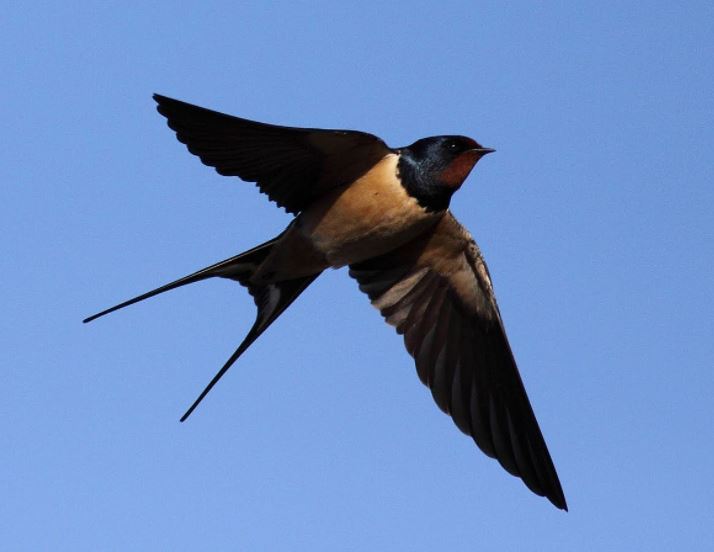
“Every soul contains a romantic demon”. The whimsical words of Prunier, the romantic poet, “fondo d’ogni anima c’è un diavolo romantico”, casually tossed into the playful chatter at a Parisian society rendezvous, prove their prescience in the life of Magda de Civry, the party’s glamourous hostess. Within her heart, there are four personalities, Magda, the self-assured courtesan; Doretta, the fictitious subject of poem that points to her heart’s desire; Paulette, her escapist alto ego; and La Rondine, the eponymous swallow that flies away but must always return.
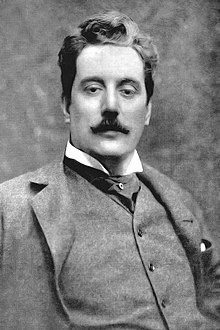
La Rondine is an opera that is unmistakably romantic. After all, as Tony (Sir Antonio) Pappano says “Puccini does love like no other composer”. And, I might add, Puccini does tear-jerking like no other composer. Cio-Cio-San’s heartbreaking aria in Madama Butterfly, Un bel dì vedremo, as she waits in vain expecting to see the husband who has deserted her, or Mimì’s Sono andati in La Bohème, as she tells Rodolfo their love is her whole life, just as she dies of consumption, will have anyone in tears (even wizened old opera critics). But in both these tragic operas the heroine dies. In La Rondine no-one dies. The final tragedy is an emotional tragedy.
Read more…Eclectic Magnificence
Invictus: a Passion
by Howard Goodall
West Green House Opera, Theatre on the Lake, Hartley Wintney until 23rd July
Review by Mark Aspen
What has Mr Bean and Blackadder to do with The King James Bible or Requiem Æternam (the everlasting peace at the end of the world)? Answer: they are pieces of music by the English composer, Howard Goodall, a prolific and wide-ranging creator of music, who fills a mixed bag of genres, film and TV scores, stage musicals and secular and sacred choral works, picking up EMMY, BRIT and BAFTA awards along the way.
Invictus: A Passion is Goodall’s latest work, which premiered in Texas, followed by its European premiere in St John’s Smith Square, London. Now West Green House Opera has opened its 2021 season with the first major production of Invictus in oratorio form (Goodall calls it a choral-orchestral work), with a chamber orchestra (The Lanyer Ensemble), soloists from The Sixteen and almost forty voices including Aurum Vocale and The Quiristers from the Chapel Choir of Winchester College.
So far, so good, but one would normally expect a Passion to find its inspiration in the Gospels. However, Goodall has stated that he wants the piece to “find relevance” and be “approachable” to audiences of the 21st Century. He has included “a feminist critique of the events” and references to slavery, the holocaust and atheism. With all these buzz-words would the piece lose the intention and message of a Passion, and be trampled by the zeitgeist, one could be forgiven for wondering? Nevertheless, Goodall says that although the resurrection of Christ is an event “uniquely adhered to by believing Christians, much of the Passion– persecution of the innocent, malevolent authority exerting itself against ideas that threaten and challenge, the power of a peaceful, loving humility in the face of tyranny, the facing-down of fear – holds profound universal resonance for people of many faiths and those of none.”
Read more…English as another language
Quartermaine’s Terms
by Simon Gray
Richmond Shakespeare Society, Mary Wallace Theatre, until 24 July
Review by Matthew Grierson
As St John Quartermaine (Luke Daxon) enters the common room of Cull–Loomis Academy, Cambridge, he touches various props and pieces of furniture as though to affirm their reality. Were I allowed, I may have done likewise, given that it’s so long since I’ve been in an actual theatre and I wanted to be sure what I was seeing was directly in front of me and not just a digital projection.
But the silent conceit sets up effectively the play’s contrast between words and world, later touched on when one of Quartermaine’s fellow English language teachers refers to the dispute between nominalists and realists in Medieval philosophy. The premise allows director Rodney Figaro and his cast to mine a rich seam of misunderstanding in what proves to be a farce of the mind – or perhaps the mouth, given that it is not bodies but words that are forever missing their mark.
The production does, admittedly, take a little while to get going, with the opening exchange between Quartermaine and Anita Manchip (Charlotte Horobin) for instance seeming a little stilted and wordy, as though they, like us, are only just getting used to small talk once again. Quartermaine’s general cluelessness means his colleagues tend to info-dump their private lives on him, which brings us up to speed without making them seem particularly real, at least at first. This is coupled with characterisations that are, initially, a little broad, be they absent-minded professor or wronged wife, and subsequently a depressive writer, angry northerner and bluff windbag, among others. They are the English equivalents of the very stereotypes the faculty harbours about their international students.
Read more…
 Mark Aspen