
The Bartered Bride
Again Last Summer
The Bartered Bride
by Bedřich Smetana , libretto by Karel Sabina
Garsington Opera, at Wormsley, Stokenchurch until 23rd July
Review by Mark Aspen
Would you trust the leader of your local council as a marriage broker? It is a risk worth taking for Garsington Opera, and one that succeeds magnificently. Smetana’s best-known opera is moved from its setting in 1860’s rural Bohemia and transposed to the English countryside in the end of the 1950s. The swinging sixties had not yet got underway, but local marriage brokers are still hard to find. In its revival of Paul Curran’s pre-pandemic production of The Bartered Bride, making the mayor the marriage broker is one of many twists, for of course the mayor has ulterior motives.
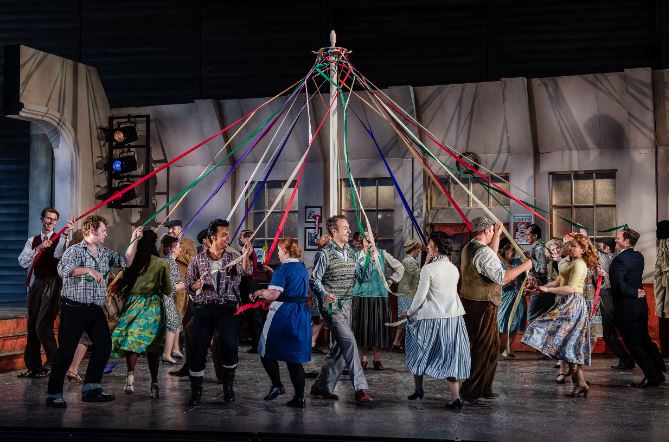
However, there are twists galore. The famous Act One polka in takes on the dance craze of 1959 to dissolve into The Twist (and works well to the polka’s half-tempo) … and was that an Elvis lookalike we spotted? More traditionally, the chorus get their ribbons in a twist with a maypole dance on the village green, and the merry-go-round music in the circus is twisting away. Then of course, there is the plot, which has a nice twist at the end, even if it is somewhat predictable. (Tales of Shakespeare and of Gilbert and Sullivan come to mind.)
The plot is indeed fairly simple. Boy and girl are in love. The girl Mařenka, the bride of the opera’s title, has been promised in marriage by her father, to the son of his creditor, a wealthy landowner, in exchange for the cancelling of his large debt. The married is arranged by the local mayor. But all the facts are not widely known and, by means of various subterfuges, all works out well in the end.
This production is a wonderful, joyous and busy-busy spectacle. The Bartered Bride is a comic opera at heart, but with a rich, full through-composed operatic score. Garsington though gives much more. There are large scale folk dances, a wealth of individual background micro-sketches, and a real life circus show.
However, it is not merely a lightweight froth of light-hearted comedy. Far from it. In the hands of revival director, Rosie Purdie, it creates three dimensional characters, and explores the emotional undercurrents of the work. There is a sense of yearning for freedom in the piece. Mařenka has often been seen as a metaphor for the Bohemian kingdom, subjugated in Smetana’s time under Hapsburg rule. The Bartered Bride is regarded as a preeminent exemplar of Czech music and culture. In its celebration of national pride it is very much a nationalist piece. So, its transfer to the England of the end of the 1950s reflects the freedom and nationalism of the post-war era. Purdie says that this setting brings a more immediate sense to Mařenka’s rebellion against her arranged marriage, as this was an age on the brink of a sexual revolution. (The contraceptive pill became available in Britain in 1962.) Another metaphor for freedom, and a well-established one, is the circus. All these allegories for freedom are depicted in this production with equal delight.
One of the remarkable features of this production, and there are quite a few, is the comprehensive involvement of the two dozen strong Garsington Opera Chorus. Smetana has already given the chorus much to do with wonderful folksy ensemble pieces, all of which are tackled with gusto. Additionally, the composition includes lively traditional Czech dances, the polka, furiant, and skočná. Choreographer Darren Royston’s dynamic dance formations and progressions weave in jiving, bopping and the aforementioned twist, to spotlight the period. The chorus give a glittering display of dance, which they are obviously enjoying.
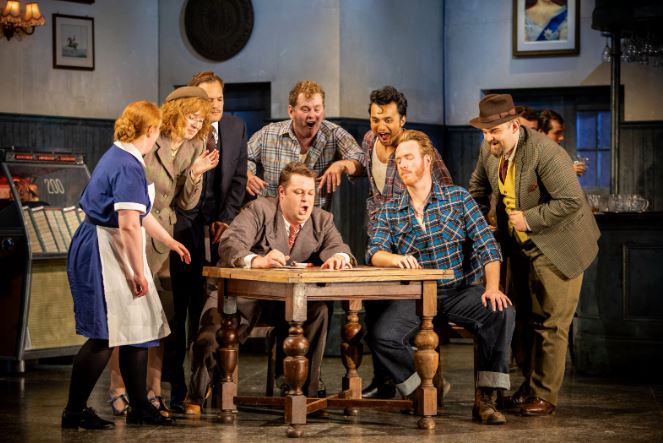
Apart from singing and dancing, the chorus are also involved in scene shifting in an equally well choreographed movement that transforms the village hall to the to the village pub, as the set slickly and seamlessly elides between the first two acts. Designer Kevin Knight has created three separate yet complementary period-perfect sets for each of the acts, all of which are authentic, well-observed and witty in their meticulous detail. So the village hall with its side kitchen transforms to the convivial hive of social activity that is the village pub. In the second half the action moves outdoors to the village green dominated by the circus with its fairground proscenium-arch stage, a real working circus. Lighting designer Howard Hudson skilfully incorporates the natural light that floods the Garsington stage through the theatre’s glass walls, with stage lighting that gives a balanced authenticity to each scene.
The most memorable contribution from the chorus must be the creation of a subtly faceted human background. This is not an homogenous crowd, but a coherent group of individual interesting characters. Each chorus member acts out their own person with their own backstory. There’s the district nurse, the pungent pig-farmer, the pregnant mum besotted with her own baby-to-be, the postmistress, the pair of lairy Teds. They chat, they flirt, they squabble, they joke. There’s dominoes, darts and dalliances. The boys quaff light-n-bitter, the gals sip Babycham. These are real people with a living community spirit. One would need to see the opera several times to take in this Bruegel-esque atmosphere. Nevertheless, the acting is toned-down just enough to avoid pulling the focus from the main action, although occasionally being perilously close to doing so. However it certainly does not swamp the principal roles and the main action.
Amongst all the shenanigans, the overarching message of the story is summed up in the duet Věrné milování (True love will always prevail) sung by Mařenka and Jeník, her true heart’s love. This is one of the few quiet moments in the busy opera and the first opportunity to hear the two main principals. It is an attention-grabbing emotive moment musically and dramatically that promises more to come.
South African soprano Pumeza Matshikiza, whose rising career brought her back to London last year, plays Mařenka as a spirited and independent young woman who will not be used by anyone. Yet her initial appearance in the village hall, rude to the vicar and wrecking a cake, comes across as petulant and belies the strong character that soon emerges. It does not however take long to warm to her character. Matshikiza’s scintillating singing is immediately engrossing, though, as its coloratura enfolds the decorative nature of the music. In another moment of calm amongst the hurly-burly of the action, Mařenka’s aria Ó, jaký žal (Oh, what grief) when she thinks she has been betrayed “Then, it’s over” is also a stand out moment for Matshikiza. Her closing of the aria … ten lásky sen (… that dream of love) is truly moving.
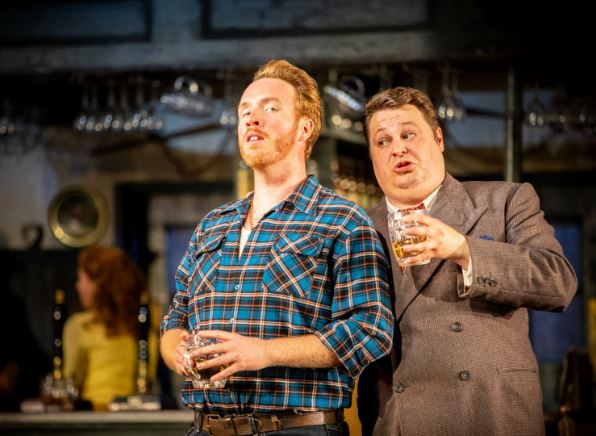
Jeník is an outsider, having returned to the village since being ousted as a child by a jealous stepmother. Oliver Johnston has the characterisation to a tee, a man who is used to having to look over his shoulder. He is very much in love with Mařenka and she with him. His lyric tenor has a gentle romanticism in that opening duet; but it has strong assertiveness in his Až uzříš (When you see …) aria, directed at Kecal, the mayoral marriage fixer, after Jeník has pulled a flanker and outwitted him. Kecal believes he has bought off Jeník to prevent him marrying Mařenka, but Jeník is to have his cake and eat it. Johnston has the cunning nature of his character completely nailed.

David Ireland excels as the garrulous Kecal, the corrupt local politician cum marriage broker, whom he plays as an over confident wide-boy, swaggering and wheeler-dealing. Ireland’s splendid bass-baritone has that faux-gravitas of the part and is vocally gymnastic to make the most of Kecal’s quick-fire patter songs. Kecal establishes his motives in the opening of the Act Two pub scene, when the villagers are singing their drinking song, To pivečko (Here’s to beer). Life not worth it without it, they sing, Jeník comes in and adds “without love”, but Kecal’s contribution is “without money”, and he shuffles around photos of his client girls as if they were playing cards. Jeník has told everyone that “Life’s not worth living without love”, so they are aghast when he ostensibly accepts £300 not to wed Mařenka … conditionally.
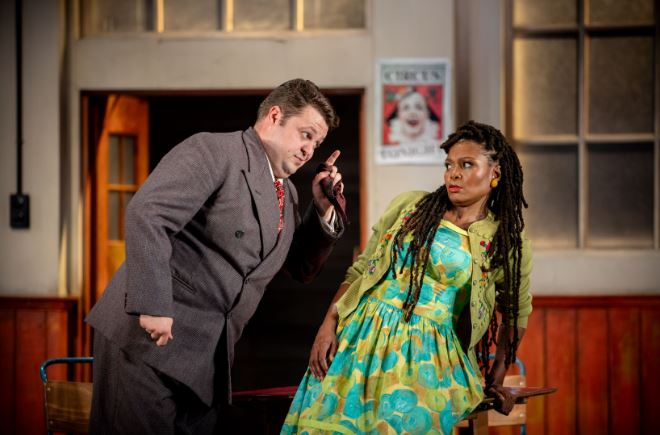
When another outsider, Vašek Mícha enters the pub nobody knows him and they all give him a wide berth on account of his timidity and his marked stammer. He is the would-be groom of the arranged marriage to Mařenka. The excellent tenor John Findon seems to have cornered the market in put-open younger brothers, having made a remarkable Mime in English National Opera’s The Rhinegold earlier this year. The ungainly and unworldly Vašek is a figure of fun, largely because of his stammering, a concept that could be challenging in the climate of today, but Findon plays him with poignant sympathy, and the humour is compassionate. His opening words are Má ma-ma Matička po-po povídala (My my-my mother t-t-told me), for he has been over cossetted by his mother, Háta, robustly played by mezzo-soprano Louise Winter. Vašek is not ready for marriage, or much else, but deep down longs for a wife. When Mařenka comes along, she guesses immediately who he is. In disguise as the local gossip she portrays her alter ego Mařenka as an unfaithful, unkind, and unattractive harridan. Taken in, Vašek looks elsewhere, at first to his new acquaintance …
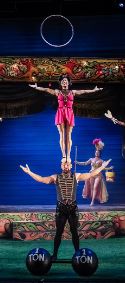
Then the circus comes to town. Act Three opens with even more vigour and plenty of razzmatazz. Garsington’s circus has acrobats, contortionists, jugglers, strongmen, tumblers and trapeze artists. The whole village comes along, enthralled. The circus artists give a thrilling and spectacular performance, including an aerial ballet on a high trapeze by their circus captain, Jennifer Robinson. Another performer, however, catches the eye of Vašek. She is a star attraction, the Spanish dancer Esmeralda, charmingly played by soprano Isabelle Peters (recently seen in ENO’s The Yeomen of the Guard). The circus troupe are marshalled by the Ringmaster, a larger than life Jeffrey Lloyd-Roberts, whose commanding tenor brings both humour and energy, as he did as Monsieur Triquet in last year’s Eugene Onegin at West Green.
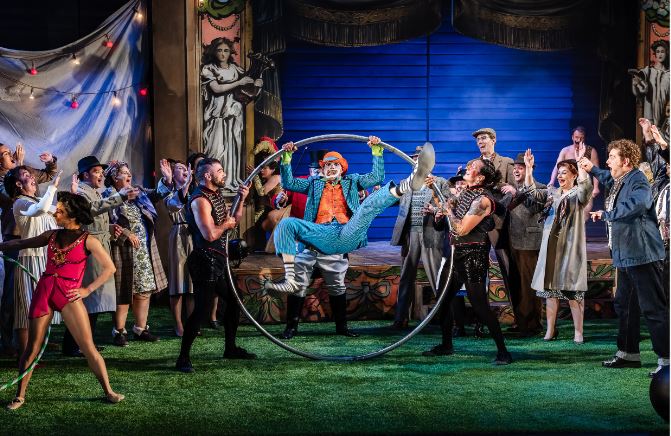
Pandemonium; the bear has escaped! … well the circus performer who plays the bear, now in a state of inebriation. Exit circus act, pursued by drunken bear … right across the auditorium in front of the orchestra pit! Cajoled and coerced by the Ringmaster and by Esmeralda, who surely has a soft spot for him, Vašek is persuaded to join the circus as the last minute stand-in for the bear. When Vašek’s new-found vocation is discovered, it is both his making and his downfall. For now is the opportunity to foreground the two sets of parents.
Mařenka’s father Krušina has been doubtful about the hard-sell of Kercal right from the beginning, and one feels he has been very reluctant to go along with a deal that gets him off of a painful financial hook. Clearly Kercal’s backhanders aren’t coming his way. Experienced baritone William Dazeley lets us see how guilty Krušina feels, in role similar to that he played in Glyndebourne’s classy production of Cendrillon. Marenka’s mother Ludmila is clearly suspicious of the whole thing, as Yvonne Howard in the role makes quite clear.
However, when Vašek bounds out of the circus stage in the bear costume, even his own parents are convinced that he is not yet ready for marriage. Another well-known G&S expert, bass-baritone John Savournin brings great presence to the part of Tobiás Mícha, who resigns himself to his son’s situation … to that of both his sons in fact. The hitherto hapless Vašek has now found freedom, with the circus, and … possibly with Esmeralda.
There is a huge musical drive in The Bartered Bride. The familiarity of conductor Jac van Steen with the opera is obvious in the stylistic veracity, the detail and the sheer energy with which he imbues the bright and responsive Philharmonia Orchestra. The break-neck overture is often played as a stand-alone concert piece, and that alone is exhausting. This production uses the overture with élan to establish the chorus on stage acting out the myriad narratives of the villagers, which forms its rich backdrop. Under van Steen’s baton the orchestra becomes a seamless whole with the action and the chorus. Solo instruments are given freedom, but every player is enjoying the moment.
All over-brims with verve, vim and vigour from that vivacissimo overture right through to the final celebratory finale, when all works out well and shows that “true love will always prevail”.
As Mařenka finally leaps into Jeník’s arms, her earring flies out, a serendipitous symbol of the sheer joyousness of Garsington’s outstanding production of The Bartered Bride.
Mark Aspen, July 2023
Photography by Julian Guidera and Alice Pennefather

 Mark Aspen
Trackbacks & Pingbacks