
A Doll’s House
Teetering On the Edge
A Doll’s House
by Henrik Ibsen
The Teddington Theatre Club at the Coward Studio, Hampton Hill until 8th July
Review by Brent Muirhouse
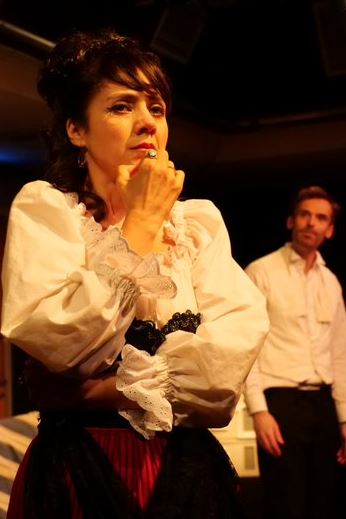
As I returned to Hampton Hill Theatre for Teddington Theatre Club’s production of A Doll’s House, I was caught in a state of conundrum. Having truly enjoyed a reimagined version of the play set in during the British rule of India at The Questors merely months before, I wondered if returning to the original, unspecific Scandinavian setting for Ibsen’s piece would prove less vibrant. Before this reviewer’s state of conundrum could stay long enough to even contemplate being trademarked, the energy bursting from the stage in the first few moments – as Nora (Amanda Adams) returns home from a shopping trip to her enthusiastically patronising husband Torvald Helmer (Paul Downey) – put this emotive thought back somewhere in the amygdala and switched focus to the boards being trodden for an immersive two-hour drama.

Staying true to a classic interpretation of A Doll’s House, though perhaps with a few modern takes on the delivery to enhance the play’s humour, the audience is transported to late 19th century Scandinavia. Patriarchal tradition and societal conformity begins to crack as an at-times-ebullient and at-times-downbeat Nora begins to question how things are and begins to dream of different personal desires. Nora herself embodies the delicate balance between the expectations of those around her and of herself, and whilst the role is played with energy, it shows moments of suffocation. These permeate the narrative as full stops to sentences, which the audience couldn’t help to mull over, and indeed mull over further in terms of their relevance to societal roles today, some 150 years or so later.
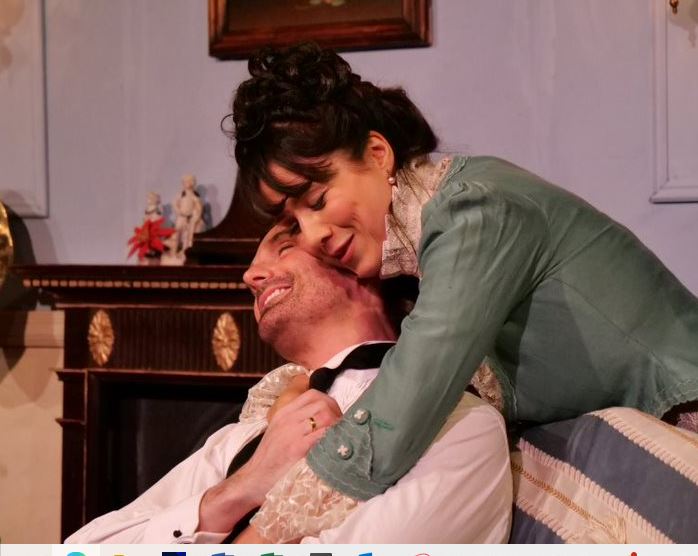
We’re told in the programme notes that the play premiered in Copenhagen in 1879, the same year as Edison claimed the invention of the light bulb, and the ensemble cast both provide the filament to support the moments where the stage is lit up. Whilst Nora and Torvald excel in their performances, Nora being almost on stage for the whole two hours without a dip in energy, and Torvald’s performance delivered with an incredibly well-balanced delivery of false praise and a sense of sweetened disrespect, credit must also go to the rest of the cast for their part in convincingly portraying Ibsen’s work. Owen Huxford as Krogstad, a staid, disgruntled bank clerk in Torvald’s department, is almost chilling in his aptly cold manner, and Madeleine Gordon as Mrs. Linde, Nora’s returning friend, ably provides a voice of reason. Additionally, Dominic Lloyd’s turn as Dr. Rank doesn’t waste what are often the best comedic lines in the play, as he finds deadpan humour sitting in the doctor’s bleak and negative words. In sum, the cast embrace Ibsen’s brushstrokes in order to paint a clear picture of a society clinging to tradition, while the embers of each character’s individuality flicker beneath the surface, fuelled by Nora’s driven persona.

As the plot unfolds, and becomes more complex, it is satisfying that the set and the staging of the play remain in a simple state: the living room of Torvald and Nora’s home, open to welcome the audience in. In the corner is the eponymous doll’s house, lit up in the darkness between changes in acts (providing a focus for the otherwise seemingly lengthy switchover between Act I and II), which is always present yet not directly mentioned in the dialogue. That said, Amanda Adams’ performance as Nora ultimately encapsulates this metaphor, her individuality battling the expectations of the men in her life like the fragility of a porcelain doll teetering on the edge.

All-in-all, this visit to A Doll’s House was worthy of its theatrical heritage, with confident performances allowing Ibsen’s core messaging to be visualised in a way still meaningful in assessing the dichotomy of self-identity and societal expectations in the present day, despite its 1870s Nordic setting. Indeed, director Douglas Schatz’s notes reference the playwright’s quote that society in his day was “an exclusively male society, with laws made by men” and that it would be hard to argue much has changed for women like Nora today. This truth being reinforced by the production’s stormy conclusion aptly occupied my mind as I walked out into the streetlights of suburbia, into the pouring English summer rain; nothing ever changes.
Brent Muirhouse, July 2023
Photography by Kim Harding


 Mark Aspen
Trackbacks & Pingbacks