
Robinson Crusoé
Bonkers-Lite
Robinson Crusoé – in Concert
by Jacques Offenbach, libretto by Eugène Cormon and Hector Crémieux
West Green House Opera, at the Theatre on the Lake, Hartley Wintney, 28th July
Review by Mark Aspen

The none-to serious operetta, Robinson Crusoé, which was contentiously billed as an opéra comique when it was first performed as a pre-Christmas offering in Paris in 1867, is huge fun, in spite of (or perhaps because of) its putting its finger on a number of human weaknesses. If you like panto, you’ll like this. If you like Gilbert and Sullivan, you’ll love this. If you like wonderful symphonic music, you’ll adore this.
Glen Hurstfield, West Green House Opera’s Chairman, in his welcoming remarks from the stage, points out, a little too apologetically, that the evening’s one night stand is a concert performance, although he hints at some add-ons. He goes on to describe it as “quite bonkers”.
It doesn’t really quite fit either of these descriptions. In the event, it turns out to evolve from the black-tie concert event, then bit-by-bit into a costumed semi-staged performance. By the interval, it has acquired a set and we have almost the full works. Equally, it starts with establishing its setting and developing its characters, moves to become a lyrical love-story and on to being a gung-ho adventure, perhaps edging towards bonkers-lite. Everything happens at a joyful canter, whatever the outrageous goings-on, all enacted gorgeously tongue-in-cheek.
The plot bears little resemblance to the adventure story that was the school-boy staple, owning more to a pantomime take on Daniel Defoe’s much-loved tale. One has a picture of a bemused Offenbach watching a British panto, having crossed the Channel with a copy of Defoe in hand.
We start with a back-story. In the dining room of Sir William and Lady Crusoe’s Bristol mansion there is some frustration about the persistent unpunctuality of their son Robinson, as the maid Suzanne and the Crusoes’ niece Edwige, to whom Robinson becomes engaged, help Lady Deborah prepare afternoon tea. Sir William makes his point by loudly reading from Luke’s Gospel, the parable of the prodigal son.
Canadian bass Trevor Eliot Bowes makes an imposing Sir William Crusoe, lending a lyrical and rich singing voice to the biblical reading. His choice of scripture proves to be quite prophetic, for Robinson is planning to withdraw from the family. However, it is not to indulge any dissolute craving, but honourably to assuage his incipient wanderlust.
The carefree Robinson is first seen approaching across the lovely arched bridge to West Green’s “floating” stage. Already he sing that “distant shores are calling”, where (to a resonant woodwind accompaniment) he is “seeking to know, to find my soul”.
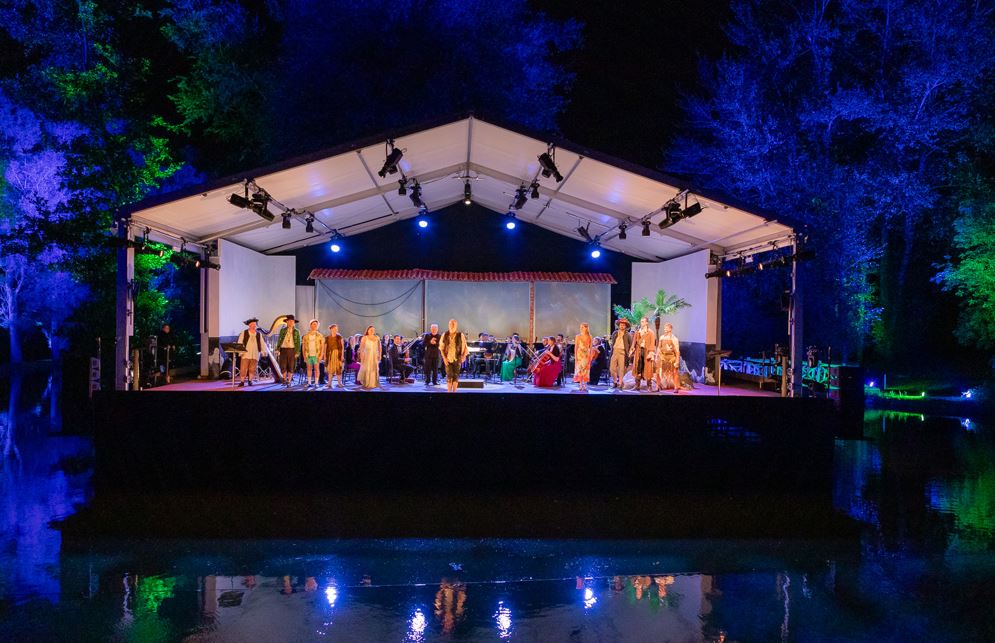
Robinson Crusoe is played magnificently by Robert Murray, who less than a month previously was to seen in another eponymous role in Mitridate, re di Ponto, an entirely different character. Murray’s controlled and characterful tenor creates an engaging picture of the eager headstrong Robinson, who seems to have had quite an involvement downstairs. Suzanne the maid describes him as “a naughty man”, but nevertheless his manservant Toby, who is engaged to Suzanne, says he is “a charming boy”. Toby, though, has been plotting, in cahoots with his master, for Robinson’s absconding. However, when push comes to shove and Robinson tells him that he has a “splendid vessel” awaiting at the port ready to sail, Toby gets cold feet. However, the resultant discussions with the two servants is overheard and the plot is in danger of being discovered.
The family has decided that the afternoon tea could be taken as a picnic. There is rather an obsession in this opera with food, which later takes quite an exotic turn. Meanwhile though, all the various emotions build in a tumultuous sextet, one of many, many thrilling moments in a musical feast.
The music in Robinson Crusoé is a triumph, amongst Offenbach’s very best. Right from the intricately intertwined melodies of the overture, thorough affecting romantic episodes, and the wonderfully diverse pulsating musical comedy pieces, it enthrals, entertains and excites. The extended thirty-eight piece Orpheus Sinfonia, under the scintillating baton of David Parry, brings out the sheer vivaciousness of the score.
Toby has blown the gaff and the pace slows to the phrase “all our trust is turned to dust” as Edwige and Robinson are left alone. Edwige has a beautiful aria, “if this is love, then I love”, accompanied by soaring strings and a contrasting bassoon, which underline the coloratura soprano of Lucy Hall in the role. Her Edwige has a sincerity and earnestness and this aria is deeply touching.
Edwige and Robinson’s ensuing impassioned conversation offers some of the best music in this music-rich opera. He argues that “I’ll explode if I stay”. She admits that he has read her secret thoughts about her love for him, but he says that when he returns enriched, culturally and financially, then “We shall have a life of joy”. Siren voices offstage lure Robinson with promises of “jewels and gold”, but Edwige offers a greater gift of undying love.
Joanna Harries brings her nicely rounded mezzo-soprano to the matter-of-fact matriarch Lady Deborah Crusoe. Eventually Lady Crusoe and Sir William come round to accepting, very reluctantly, their son’s decision and we hear them offstage singing a prayer for his protection.
Toby has been given leave of absence from the voyage, pleading, with Suzanne’s baking, everything from seasickness to aged parents. So Robinson Crusoe sets off alone.
Thereafter, in subsequent acts, the mood swings and the opera changes gear into rollicking adventure mode. The orchestra tells us in a bold entr’acte what has befallen Robinson Crusoe: the drum-roll storm, the wind and waves on the strings, and then the weather abating in a calming cello passage. After his ship was scuttled by pirates, Robinson is stranded on a tropical island, perhaps somewhere in the Lesser Antilles, in the ocean off of the Orinoco delta.

For designer Charlina Lucas’s island, less is more. Rocks with a pair of palm trees; flotsam from the ship, tea-chests and barrels; and worryingly the skulls of a man and a horse, tell it all. Robinson lies asleep on a sack. For here on, Sarah Bath has plenty of opportunities to have fun with her lighting design, whilst Gary Dixon fills in the few sound effects that haven’t been picked up by Offenbach in his score.
The theatrical concept of suspension of disbelief must now go into turbocharge, as a host of serendipitous contingences race the plot along. Six-years have passed and Edwige has commissioned a ship to go and search for Robinson with the help of Suzanne and Toby.
Some of the ship’s crew has mutinied, as it happens, and, in all of the Atlantic Ocean, just off of Robinson’s island. The mutineers have imprisoned the loyal crew on the ship while they search for buried treasure, and they are handing over their passengers to the island’s indigenous tribe. Edwige has become separated from the other two.
Now we have a plot that WS Gilbert would be proud of, while the score would make Arthur Sullivan envious. The opera is sung in English, in a very loose translation of Crémieux and Cormon’s libretto. This was done by conductor David Parry, who has not lost one jot of the humour or the romanticism of the original, nor as you might expect of its rhythm.
While Suzanne and Toby are being harassed by the natives, they realise that one of their number is not from the tribe. He is in an old Bristol neighbour of theirs, Jim Cocks, chef by trade.
It seems that the indigenous tribespeople are cannibals! Jim Cocks however, is cunning and has avoided being eaten by convincing the chief that he could be their chef and create even more delicious dishes from their victims. If you can’t beat ‘em … eat ‘em! Offenbach obviously thought that French cuisine could be infinitely adaptable. Cocks casually informs them, quite by-the-bye, that one of them is to be the plat de jour.
Ruairi Bowen plays Jim Cocks with undisguised glee. Bowen is what Offenbach would call a ténor Trial, which is a tenor who can manipulate the head voice to create character, here comic. Bowen is priceless in this role, savouring the enormity of the patter songs describing the recipes, while he skips around in relish.
Following on the heels of Sweeny Todd, Robinson Crusoé shows that cannibalism seems to be a theme in this year’s West Green season!!
Suzanne and Toby may have been dying for some dinner, but not quite in this sense. Amor Vincit Omnia, as Virgil didn’t quite say, and now here is a situation to test that maxim: does love conquer all? Suzanne and Toby would gladly each die for the other … but it would be unfair to put the unbearable grief on a loved one. So each volunteers to live, in order to heroically bear the heavy burden of grief.
Stephanie Hershaw plays the feisty Suzanne with vivacity, her spirited soprano elevating the role. Anglo-Irish tenor Joseph Doody as the general factotum Toby, having to duck and dive the awkward situations in which he is put, gives a hearty vigour to the part.
Meanwhile, in another part of the island, Robinson has woken. He is full of remorse, recalling the “shadows of the past” with its “joys shunned”. He is fully aware of the cannibals, having rescued a young teenage boy, Friday from them. They stay clear, being afraid of his firearms, as is Friday. Robinson and Friday have formed a bond and have a mutually supportive relationship, although Friday defers to Robinson as his saviour. They have agreed to share everything. Robinson has been dreaming of Edwige and shares his experience of Edwige’s love with Friday. Another beautiful aria compares her to the birds, the flowers and the stars, and explains the wonder of love. This fires up the teenage testosterone of Friday, who wants to experience these things himself.
Edwige has been spared being a raw ingredient of the cooking pot, because the cannibals believe her to be a goddess. She has however been drugged and is to be sacrificed to the fire to regain union with Saranha, their god. It is Friday her rescues her, for when he sees Edwige he falls instantly in love with her. Plucking up his courage, he fires Robinson’s pistol; and rescues her, together with Suzanne, Toby and Jim Cocks. In her hazy state, Edwige imagines her love … and during her romantic aria a breeze ruffles the water of the West Green lake.
Friday is torn between being full of pity and being totally smitten. For the others it is an excuse for a waltz.
The busy-ness of the scenes on the Orinoco island is provided by a quartet who form a chorus in which the fresh tenors Graham Neil, Hugo Brady and Thomas Fesmer support the weightier voice of Eliot Bowes. And busy they are, with plenty of quick changes, as variously cannibals, loyal sailors and mutineers; adding to the humour of the piece.
Friday has brought Edwige back to the safety of Robinson’s camp, where he has laid her down to sleep, himself sleeping with her in a blissful purity of the discovery of being in love.

A horn makes a triumphant start to the new day of the final act, and the violins introduce a nocturne sung by Friday, “From Him comes the beauty sublime”, as he discovers, in his wide-eyed innocent naivety, the ecstasy of romantic love.
In the breeches role of Friday, mezzo-soprano Martha Jones comes near to stealing the show. The glowing purity of her voice enhances a beautifully acted part, as she portrays the simple boyish candour of the artless Friday. It is a picture of discovery, but of the innocence of the pubescent Friday. He is rather like a Cherubino, but without the guile and without the lust.
The ecstatic reunion of Edwige and Robinson after six years presents even more musical opportunism, but there is a dilemma on the personal front. Friday take Robinson to his word about sharing everything, innocently believing this would extend to the love of Edwige.
The French have a word for it (or a phrase), one might say, but here there is the awkward business of disentangling Friday’s expectations. “You say love means different things”, says the bemused Friday, smarting that promises have been broken. It takes the intervention of all the Bristolian sophisticates to explain “How love is done”.
But now the gung-ho stuff: how to deal with the triple problem of the angry hungry cannibals; of the drunken treasure-seeking mutineers, and of the ship, their means of escape, being hove-to with its loyal crew incarcerated below decks. The last is bravely solved by Friday who swims to the ship to release the crew. The second problem by Robinson, in a crafty subterfuge, who appears to the mutineers as a half-crazed castaway who is sated with the plethora of precious metal on the other side of the island. And the cannibals? Well there are the mutineers, fine flesh, who are left kicking their heels, literally, as they lay prone in the sand while the sound drums gets closer. It’s all a rip-roaring finale to the frolics of this fun-filled piece.
Director, Thomas Guthrie, has taken a concert piece and elevated it to a cannibal’s feast of music, romance, comedy, adventure, all with a spice of bonkers-ness.
And a message? Yes. Robinson Crusoé is a piece about faith; belief that all will be well. It is about the strength of the family, an unfashionable notion nowadays, for the prodigal son returns, chastened and better. Moreover Edwige is able to give her greater gift of undying love. So then, of course, love conquers all. Or does it … ask Suzanne and Toby!
Mark Aspen, July 2023
Photography by Paul Reading

 Mark Aspen
Since West Green House called my faithful translation “excellent”, I don’t know David Parry decided to do a free translation as we have had to endure Don White’s free version for decades. Mine is published by Bote and Bock/ Boosey and Hawkes. It deserves proper productions & is the fruit of many years’ hard slog.