
Le Roi de Lahore
Paradise Found
Le Roi de Lahore
by Jules Massenet, libretto by Louis Gallet
Dorset Opera at the Coade Theatre, Bryanston, Blandford Forum until 29th July
Review by Claire Alexander

Dorset Opera was one of the first of the many summer opera festivals that have sprung up around the gardens of the UK in the last twenty years or so. In fact Dorset Opera, the prophetic brainchild of the late Patrick Shelley, then Director of Music at Sherborne School, will celebrate its 50th birthday next year and I am pleased to say it is in robust health.
Dorset Opera’s festival has come a long way since the first production of The Bartered Bride in 1974. Not to undermine its quickly successful early beginnings – it has always had top class productions. In 2005 it moved from the historic surroundings of Sherborne School to the expansive grounds of Bryanston School near Blandford Forum in Dorset where there is greater capacity (including great picnic space) to cater for the loyal and highly knowledgeable local audience, and many from London and beyond.

The festival now produces two operas annually over a week in July. But it still retains at its heart its early ambition of providing opportunity to younger singers, often music students, to take part in the chorus of top class opera; and many of those who first encountered opera in Dorset have been inspired and gone on to make highly successful careers in the arts and as singers. Indeed this year’s director of Le Roi de Lahore, Ella Marchment, is exactly such an example – once a pupil of Bryanston School, who is now building an exciting and impressive career as an opera director.
Dorset Opera also has a proud tradition of revivals or producing British or World Stage premieres having successfully launched no less than seven over its 49 years; as well as almost all of the well-known crowd pleasers. One often wonders why operas are rarely staged, suspecting there may be fundamental flaws. I couldn’t find one in Le Roi de Lahore except possibly its sheer epic scale transporting us from Indra’s temple in Pakistan to the Elysium fields of paradise. From the bold opening chords of the overture, searingly played by the Dorset Opera Orchestra, one was transfixed by the music of Jules Massenet. In fact the overture itself would play well as a stand-alone piece.

The plot is typically operatic – one woman, an avowed ‘priestess’ (Sita), and two men wishing to claim her for themselves – the proud King Alim of the title, and villain Cyndia, who not only has his greedy eyes on Sita but also the crown. In the ensuing tale of deceit and dishonesty (of which none of the three main protagonists are entirely blameless) the King is killed by Cyndia and ends up in paradise, before being released back as a poor man and to his earthly true love, forever linked in life and death – predictably enough the latter comes tragically almost immediately after the lovers have been reunited!

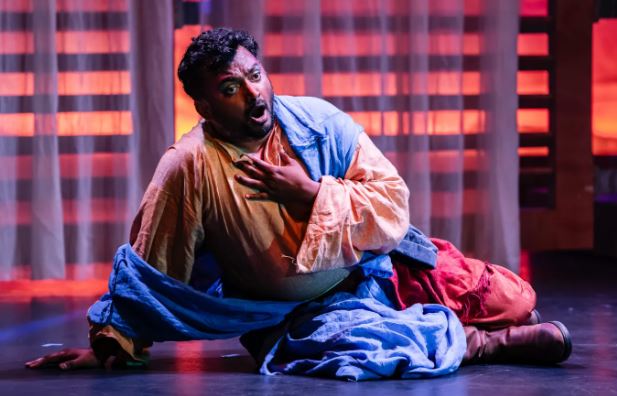
From the outset the stage is filled with the vibrant Asian colours and the ornate majestic costumes of the fables of the time (what a task for Stewart Charlesworth and his team), set against a simple but versatile series of slatted doors that also give us a sense of cool, while opening out onto the steamy plains of central Asia. (I also loved the painting of paradise, reminiscent of the renaissance of Titian or Caravaggio). Thomas Bagley, as Timour, the High Priest of Indra, is impressive as a living statue in the first two acts; and Julian Close as Indra comes into his own in Act Three with his memorably sung aria as he condemns the King to his fate. The singing from the three protagonists Amar Muchhala as King Alim, Michael Anthony Magee as Scindia, and Seljan Nasibli as Sita, is impeccable and all make the most of the emotional depths of Massenet’s splendid music.
But Dorset Opera really is able to return to its roots in this opera which offers a full and wide ranging chorus for all voices. As soldiers, villagers, priestesses and ‘souls in paradise’ this chorus offers us committed and fearless singing. I particularly enjoyed Act Three with the ‘souls in paradise’; and the evening hymn, (reminiscent of Mascagni’s Easter Hymn) which returns a little like a refrain at various points throughout.
All of this comes together in Ella Marchment’s brave production. The opera is epic in style and Marchment absolutely goes with this giving us bold characterisation reminiscent of Aladdin or Flash Gordon. And this was no more evident than in the original mix of camp and evil in Michael Anthony Magee’s delightful performance of Cyndia.

Perhaps the score of Le Roi de Lahore does not quite have the maturity and subtlety of his later works, but you can hear in this early Massenet score his searing emotions in personal moments, contrasted with the narrative comments of the crowd. I would like to have had a little more stillness and reflectivity occasionally and indeed let the sweeping music do the talking. I was really struck by the clarity and passion of Dorset Opera’s orchestra, intelligently led by Jeremy Carnall.
But this is a truly epic opera stunningly brought to life by Dorset Opera. It deserves further airing.
I do not know what Dorset Opera Festival is planning for its well-deserved Golden Anniversary next year but it will be well worth a trip out of the city to the quiet Dorset countryside, where you will find a gem that led the way for all the current country park opera festivals.
Claire Alexander, July 2023
Photography by Julian Guidera

 Mark Aspen
Trackbacks & Pingbacks