
Cavalleria Rusticana and Pagliacci
Emotions on a Knife Edge
Cavalleria Rusticana
by Pietro Mascagni, libretto by Giovanni Targioni-Tozzetti and Guido Menasci
Pagliacci
by Ruggero Leoncavallo
West Green House Opera, at the Theatre on the Lake, Hartley Wintney, until 30th July
Review by Mark Aspen

It may be forty degrees and upwards in Sicily and only fifteen in damp Hampshire, but the West Green House Opera brings all the heat and passion of a Sicilian summer to its enchanting opera gardens with the inseparable Italian operatic pair, affectionately known as Cav and Pag.
Cavalleria Rusticana and Pagliacci are opera’s torrid twins, or rather cousins, having different composers, but both from the same pedigree, the verismo school of late nineteenth century Italian literature and opera.
The realismimplied in the term verismo refers to opera that is not about the wealthy, the nobility, royalty or divinity; but about everyday people. One hesitates to say “ordinary, as the subjects of these operas are just as extraordinary as their higher-class counterparts.
Although it is Giacomo Puccini whose name is associated most readily with the style, it is Pietro Mascagni’s Cavalleria Rusticana that is credited as the first verismo opera. In fact Mascagni and Puccini studied together in Milan at the Conservatorio. They shared the same digs with two other improverished students, and were undoubtedly the real-life inspiration for the friends in Puccini’s La Bohème. There was also clearly opportunity for mutual musical inspiration.
The cynic might say that Cavalleria Rusticana and Pagliacci have an enduring popularity because they have the age-old selling points of sex and violence, but that considerably belittles the wealth of overwhelmingly beautiful music that each has. Also the real point is missed, that the protagonists are relatable people, which relatable feelings. Feelings of course are heighted in opera, but there is surely a “there but for the grace of God, go I” aspect.
The plot is in essence the same for both operas. A husband, and one who is inclined to violence, is cuckolded. He finds out, and ends up killing the lover(s). That’s it; no subplots: simple. … … Except, it is not that simple, for the characters are complex three-dimensional human beings and one can find sympathy with each of them.
West Green, in its double bill, has taken the similarity of the two plots a step further and used the figure of the commedia dell’arte Taddeo character from the prologue of Pagliacci to open the double programme as a mute weeping clown. It hints at the idea that art follows life … and vice versa. It is a nice symbolic image, but caused some confusion to those who know the operas. Was the order of their presentation not as billed? This hanging question drew concentration from the overture, which is a pity as, although not as well-known as the intermezzo, it introduces the sheer richness of Mascagni’s music.
The overture gives opportunity for the performers to sketch the outline of the backstory. The young Turiddu has been conscripted into the army, during the war. In his prolonged absence, his fiancée Lola has become a wartime bride, and has married Alfio, a comparatively better-off haulier, as Turiddu discovers on his return. On the rebound, he has seduced Santuzza, a vulnerable young woman. Lola, simmering with jealousy over Santuzza, tit-for-tat begins an adulterous affair with Turiddu. In the close-knit community of a Sicilian village, here is a pressure-cooker without a safety-valve. Its dangerous simmering is palpable. And the action hasn’t even yet started.
West Green’s gorgeous Theatre on the Lake becomes the same fishing village for the two operas, set by the Mediterranean in Scilly in 1946. Designer Bridget Kimak has created a simple set, a veranda with a roof of pantiles, which forms a screen across the stage, behind which the orchestra can just be made out. A plain trucked platform sits on the stage. However, its simplicity is deceptive. It at first seems a little pedestrian, but it holds some later surprises.
Turiddu is first seen on the bridge onto the island where the stage hovers above the water. He sings of Lola, praising her pale beauty in O Lola c’hai di latti la cammisa. The aria is a siciliano, in a lilting minor key that underlines the pastoral atmosphere. It forms a good introduction to the vital voice of Siberian tenor Alexey Dolgov, who gets many opportunities to express his conflicting passions. His lusting for Santuzza, which develops into a genuine affection and concern, his eventual remorse at using her ably, and his unabated desire for Lola are all conveyed with conviction.
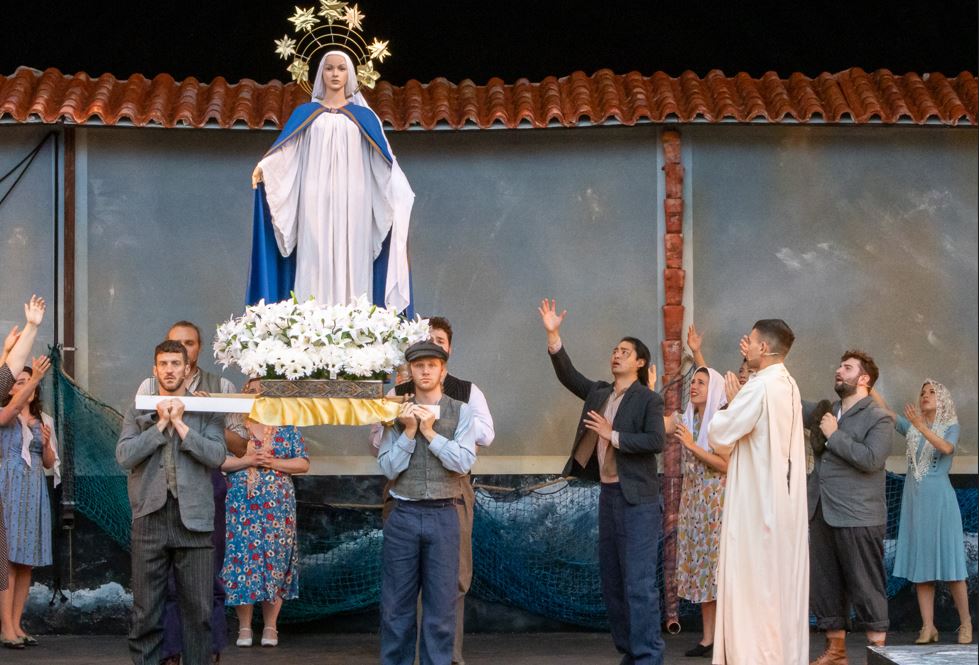
The chorus are an ubiquitous presence in Cavalleria Rusticana, for it is they who are the rustic society against which the action has its cultural and societal repercussions. And Mascagni gives them generous opportunities. They are initially heard offstage, where they are conducted by WGHO’s Artistic Director Kirsty Hopkins. They melt onto the stage as the dawn of Easter Sunday breaks, painting a pastoral background in Gli aranci olezzano , their singing of the oranges fragrance on the spring air. At the sound of a bell, their song becomes a hymn as the villagers Easter devotions start.
John Ramster, in directing both operas, has an enviable knack for creating atmospheres and a sense of tension, of things unsaid. Here, the priest, ushering some of his flock into the church, seems anxious; maybe he has learnt too much in the confessional. It’s a nice detail.
And Santuzza’s hands pass absently across her belly. She is distraught when she first enters and begins a terse conversation with a prickly Mamma Lucia, the mother of Turiddu, and owner of the village’s trattoria. Santuzza is about to her something, when …
Alfo’s entrance is startling. He strides in purposefully cracking a huge bullwhip. He clearly likes his work and sings of il cavallo scalpita, i sonagli squillano, the horses champing at the bit and the harnesses jangling. He comes across as an obvious bully. It is an impressive entrance; the mood certainly changes. Maybe the character is overstated, but George von Bergen is magnificent in the role, a great stage presence adding to his imposing baritone, powerful yet velvety.

However, the mood snaps back as the church service begins, and the chorus comes into its own with Cavalleria Rusticana’s second best-known piece, the Easter Hymn, sung with genuine fervour … il Signor non è morto.
However, West Green excels with a coup de théâtre. The pascal statue of the Virgin Mary is brought in by an oarsman rowing across the lake! The trucked staging becomes a jetty and the effigy is borne up on a litter on the shoulders of the villagers. It is quite a wow moment.
It is Santuzza who has the most of the operatic passion-filled moments, for she, poor girl, have much to be passionate about. Although the libretto is never explicit, it is clear that she is carrying Turiddu’s baby. Her initial encounter with Lucia is truncated by a metaphoric shin-kicking moment as Lucia is about to reveal Turiddu’s whereabouts the previous evening to Alfo, during his absence. When the villagers are in church, the three ensuing scenes are Santuzza pouring out her heart to Lucia, to Turiddu and to Alfo in turn and in different ways.
These displays of passion are demanding for a performer, but Samantha Crawford tackles them all with bravura, her fine soprano is luminous, lyrical and lustrous, but she can certainly ride all of those wringing emotions demanded of the role of Santuzza. She tells the defensive Lucia why she hushed her. It pours out: the anguish “But he loved me!”, the green-eyed spite “she stole him”, and her shame “disgraced … damned … destitute”. Lucia can only reply “Lord have mercy”.

Then meeting with Turiddu, and pleading with him, Santuzza’s torment is ratchetted up by the brazen, and scarlet clad, Lola passing on her way to church. “I beg you in tears” but in words they flow in torrents. Crawford shows the depth this enormous emotion, without swamping it with over-expression.
Of course, then when Alfo comes along, she blows the whole story to him. “Turridu has stolen my honour”. It is a powerful duet as Santuzza adds e vostra moglie, lui rapiva a me!, “and your wife has stolen him from me”. From Alfo, we hear loud and clear, the well-used operatic word, “vendetta”.
With all the dramatic springs fully wound, Mascagni steps back with an intermezzo. This of course is THE Intermezzo, possibly more famous than the opera itself, and perhaps with some justification, as it is a musical masterpiece. I recall once seeing an octogenarian conductor at his swansong performance (it may have been Georges Prêtre at the Chorégies d’Orange) profusely weeping with tears running down his face as his own music overwhelmed him. Our conductor John Andrews equally pulls out all the emotional stops with the WGHO Orchestra, for we know what is about to happen dramatically. The music soars, sweeps, swoops, and a light breeze ruffles the waters of the lake.
The story returns with the chorus in a Verdi-esque brindisi, singing that sparkling wine “like a lover’s smile, brings happiness”. When Alfo reuses Turiddu’s drinks-all-round, it is an ironic punctuation, as ominous music from trumpet and cello foretells the outcome.
The score gives less opportunities to the other two female protagonists than to Santuzza, but both Lola and Mamma Lucia pack hearty dramatic punch, and there are star quality castings in these roles.
Angharad Lyddon adds an audacious air of triumph as Lola, the scarlet woman, figuratively dressed as such in a sensual red dress. (There is similarity with her Princess Irene in Handel’s Tamerlano.) Nevertheless, there is a subtlety in her portrait, for under the smirk of the cat with two lots of cream, there is a sense of loss. Has she swapped love for security? Lyddon’s mezzo-soprano is honey rich and seen in arias such as Lola’s stornello, Fior di giaggiolo, flower of the iris, with its tantalising ambiguity.
Distinguished mezzo-soprano Sarah Pring excels in the role of Mamma Lucia. Lucia is a bedrock character in the village, representing the continuity of the community. But it is she who is impotent to alter the dreadful inevitability of the plot. It is a similar matriarchal role to that of Larina in Eugene Onegin, her last appearance at West Green. Lucia is a part that requires skill and Pring delivers it. Even in her singing voice one can hear those catches of surprise, fear or dread. The final scene when Santuzza rushes into Lucia’s arms with a cry of Oh! madre mia! is almost unbearably moving.
The early success of Cavalleria Rusticana is said to have given Ruggero Leoncavallo the impetus to write Pagliacci and it is now rare for them to be performed separately.
We are in the same fishing village in Sicily later that year and a travelling theatre has arrived. It is a Commedia dell’arte show run by Canio, an overbearing boss, who will truck no nonsense.

The two operas may basically tell the same story but Leoncavallo gives the raw emotional blast of Cavalleria Rusticana a more subtle psychological wrapping in Pagliacci and, by mounting it as a play within a play, adds a philosophical juxtaposition of stylised art and verismo reality. Commedia dell’arte may now be an obsolescent art form, but it is art stylised and the characters who play the actors in the play within take on Commedia dell’arte personae, as life and art become entwined.
Usually, one of the characters Tonio, addresses the audience in his costume as the commedia dell’arte character Taddeo. This production however, mirrors the opening of Cavalleria Rusticana, with the converse. The announcement is by Grant Doyle, not in costume, who plays Tonio. It is a neat consistency. He points out that the performers have the same emotions as other people, with the same emotions. What we about to see are real people, just like you. This is the crux of the drama.

Tonio, malformed in body, is full of resentment. He is also manipulative and full of spite; and he pulls many of the strings in the action. His telling tales propels the plot towards its tragic end. Australian-born baritone Grant Doyle skilfully changes the timbre of his singing voice from reedy to more abrasive, as his character moves from wheedling to threatening. He puts across well that here is a nasty piece of work … except that Leoncavallo allows a little room for empathy even with Tonio.
The opening parenthesis immediately follows an overture on a par with Mascagni’s, or indeed any other verismo composer. It has a reflective flow, but a concealed edge that immediately draws the listener into the story. It has a playful opening at which all the instruments seem to get a turn, but the contrasting layers of darkness and lyricism come in.
John Andrews takes the WGHO Orchestra, and us, on a narrative that foreshadows the action of the opera.
Twilight envelopes the gardens, the overture plays and the orchestra is lit from behind the gauze screen across the stage. Then the musicians gradually appear as a phantasmal phalanx. Again Kimak’s design and Sarah Bath’s lighting creates another delightful surprise.
Nedda who, in the play within, plays Columbine, the make-believe lover of Harlequin, who is played by another member of the troupe, Beppe. However, she is in reality having an affair with a young villager, Silvio, a real-life lover. Jenny Stafford, as Nedda, makes the most of the gorgeous vocal opportunities that the role affords. Her lyrical soprano voice has all the expression that we heard as Tanya in Eugene Onegin at West Green, but with a mellow reflective feel. Her aria as Nedda contemplates with envy the freedom of the birds, disfidano le nubi e il sol cocente, defying the clouds or the scorching sun, is as soaring and glorious as avian flight. Serendipitously, at our performance, a goose took to the wing from the waters of the lake right on the line about birds, “gypsies of the sky” … “launching on their flight like arrows”, or was it another wow moment stage-manged by WGHO?
A rising talent, Thomas Chenhall takes the role of Silvio, Nedda’s secret lover, his velvet baritone portraying the earnest passion of a young man smitten with desire. He has a series of ardent duets with Nedda, pleading her to run away with him. “Is your great love a whim?” he asks, “you have bewitched me only to leave”. She however succumbs and they plan to leave. They have a duet tutto scordiam, “let’s forget everything”, and the music underlines their words with a brooding cello solo (Miriam Lowbury).
However, Tonio has overheard them and the fate of both of them is sealed. When Canio comes roaring in, violently demanding of Nedda her lover’s name, it is Beppe who intervenes to restrain him. Again the music underlines the action, emphasising Beppe’s agitation.

Beppe is the character with the most perception of what is happening … and he doesn’t like it. Tonio has already tried to force his amorous intentions on Nedda and Beppe is aware that Tonio is seething with jealously after being squarely repulsed by her. Tenor Lawrence Thackeray portrays all the tension, apprehension and frustration of a man who is forced to duck and weave to keep the lid on the dangerous emotions emerging, whilst keeping the show on the road.
The role of Canio is momentous. (It was a defining role for Enrico Caruso). Trinidadian tenor Ronald Samm has an assured stage presence and is utter impressive as Canio. It is a part that requires some power, and my, Samm really delivers. The well-known aria Vesti la giubba, when the distraught Canio is alone in his dressing room and he tells himself he must “put on the costume”, go on stage, perform in pain, and laugh, is richly delivered in all its heartbreaking pathos.
Pagliacci also has an intense intermezzo. It musically reflects on the foregoing action, but has a sense of foreboding and tension. Meanwhile loose-limbed dancers bring on the chairs for villagers to see the play within the play.
As art and reality converge, the commedia dell’arte performance closely resembles the lives of its performers. When Nedda says the Columbine’s words per sempre io sarò tua, “I’ll always be yours”, Canio cracks as he recognises them as her own, said to another man. He attempts to resume the plot of the play, but goes off script. Pagliaccio non son! presents another powerful aria for Samm, “I am not Pagliaccio!” Ramster’s direction ramps up the intensity of this climactic scene, as the villages cry that that the play they are watching is so real, and the orchestra pushes the tension further. (The cello features again, this time pizzicato.) The violent end, with its double fatal stabbings, is truly horrific.
Tonio makes the celebrated final announcement, La commedia è finita! But who is it really who says “the comedy is finished” ? Is it Taddeo, the character that Tonio plays; or is it Doyle, who plays Tonio in the opera; … … or is it us the audience? This is the question that Pagliacci poses.
West Green House Opera’s Cav and Pag is a masterly melding of two searingly passionate operas on the destructive nature of jealousy, adultery and treachery. Now Hartley Wintney is aflame with the torridity of Sicily.
Mark Aspen, July 2023
Photography by John Paul Reading


 Mark Aspen
Trackbacks & Pingbacks